
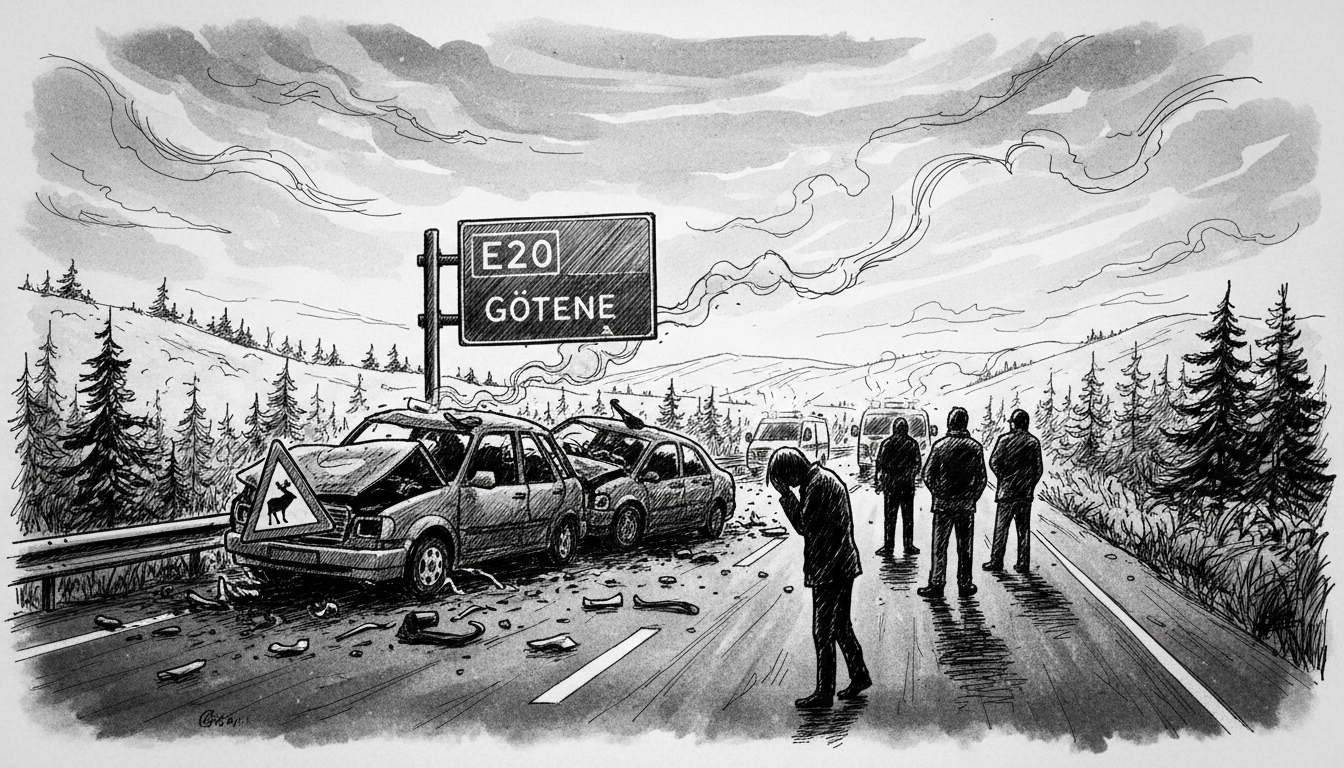
Sweden's E20 highway was the scene of a fatal head-on collision Monday afternoon, claiming the life of a man in his 20s. Emergency services raced to Brännebrona north of Götene after the crash between a truck and a car. The victim was trapped in the smaller vehicle, according to police. Traffic ground to a total stop on this crucial artery, with closures expected to last all Tuesday. For locals and travelers alike, the incident casts a somber shadow over a route many depend on daily.
A Tragic Afternoon on E20
At 2:52 PM on Monday, police, ambulance, and fire rescue units were dispatched to the E20 near Götene in Västsverige. What they found was a severe head-on collision. A man, reported to be in his mid-20s, was pronounced dead at the scene. He had been driving the car involved in the crash with a heavy goods vehicle. Police spokesperson Johan Håkansson confirmed the fatality and described a major rescue operation. The force of the impact left the car severely damaged, requiring extensive efforts to extricate the victim. The stretch of highway between Holmestad and Myggeberg was immediately shut down in both directions. This closure disrupted freight and passenger travel across a key region.
The Ripple Effect of a Road Closure
The total stoppage on the E20 created immediate logistical headaches. Traffic was diverted onto smaller local roads, causing congestion and delays throughout Monday afternoon and into the evening. By Tuesday morning, the Swedish Transport Administration (Trafikverket) announced the road would remain closed the entire day for investigation and cleanup. For commuters and truck drivers, this meant recalculating routes through the Swedish countryside. The E20 is not just any road; it's a primary corridor connecting Malmö in the south to Stockholm and beyond. Its closure echoes through the supply chain and daily routines. In communities like Götene, such events are stark reminders of how fragile our interconnected mobility can be.
Sweden's Transport Lifeline Under Scrutiny
The E20 highway functions as a backbone for Swedish commerce and travel. Running across the country, it supports everything from family road trips to international freight. Accidents on this scale spotlight the inherent risks of high-speed travel. Sweden generally boasts a strong road safety record, but this tragedy asks difficult questions. In 2022, there were 334 fatal road accidents in Sweden, resulting in 340 deaths, according to the Swedish Transport Agency. Heavy goods vehicles are involved in a significant proportion of serious accidents. The sheer mass difference in a collision between a truck and a car often leads to grave outcomes, as seen here. Road safety experts consistently stress fundamentals: adhering to speed limits, maintaining safe distances, and combating driver fatigue. An investigation into this crash will likely examine all these factors.
Cultural Reflections on Risk and Safety
As a society, Swedes place a high value on safety and systematic prevention. The vision zero policy, aiming for no road fatalities, is a national point of pride. Yet, accidents like this one near Götene pierce that confidence. They force a collective pause. In Swedish culture, there's a deep respect for the dangers of the long, dark winters and high-speed roads. Local communities often come together in the wake of such losses, with quiet support for affected families. While we wait for official investigation results, there's an unspoken understanding on Swedish roads: every journey carries weight. The conversation inevitably turns to how to make these essential routes safer for everyone, from young drivers to experienced truckers.
Analyzing the Path to Prevention
What leads to a head-on collision on a major highway like the E20? Expert context points to several common factors. Driver fatigue, especially on long, monotonous stretches, is a perennial concern. Road conditions, including weather or visibility issues, can play a role. Vehicle maintenance, particularly for heavy trucks, is critical. Sweden has invested in safer road designs, including median barriers on many highways, but not all sections are equally protected. This accident occurred on a part of the E20 that may lack such infrastructure. Comparing Sweden to its Nordic neighbors, the country has made strides, but each death is a call to re-examine measures. Are speed limits appropriate? Is rest stop frequency sufficient? These are the practical, human-centric questions that arise from tragedy.
A Community and a Nation Mourn
The death of a young man resonates far beyond the crash site. In Götene and surrounding towns, the news spread quickly on Monday. Such events touch the fabric of Swedish society, where personal safety is often taken for granted. There's a cultural tendency toward reflection and improvement after a loss. Memorials might appear near the site, a quiet testament to a life cut short. For the family and friends of the victim, the support networks—both formal and informal—will mobilize. Sweden's relatively tight-knit communities often respond with practical help and emotional solidarity. This incident is a raw reminder that behind every statistic is a personal story, a future unrealized.
Looking Ahead with Sober Resolve
The E20 will reopen, and traffic will flow again. But the questions linger. How can Sweden further reduce road fatalities? The investigation into this crash will provide specific answers, but the broader mission continues. It involves continuous education, infrastructure investment, and cultural attitudes toward driving. As Swedes, we trust our systems to protect us, but we also bear individual responsibility. This tragic collision on a sunny Monday afternoon near Götene is a heartbreaking footnote in Sweden's ongoing story with road safety. It challenges us to not just move on, but to move forward with greater care and commitment for every life on the road.