
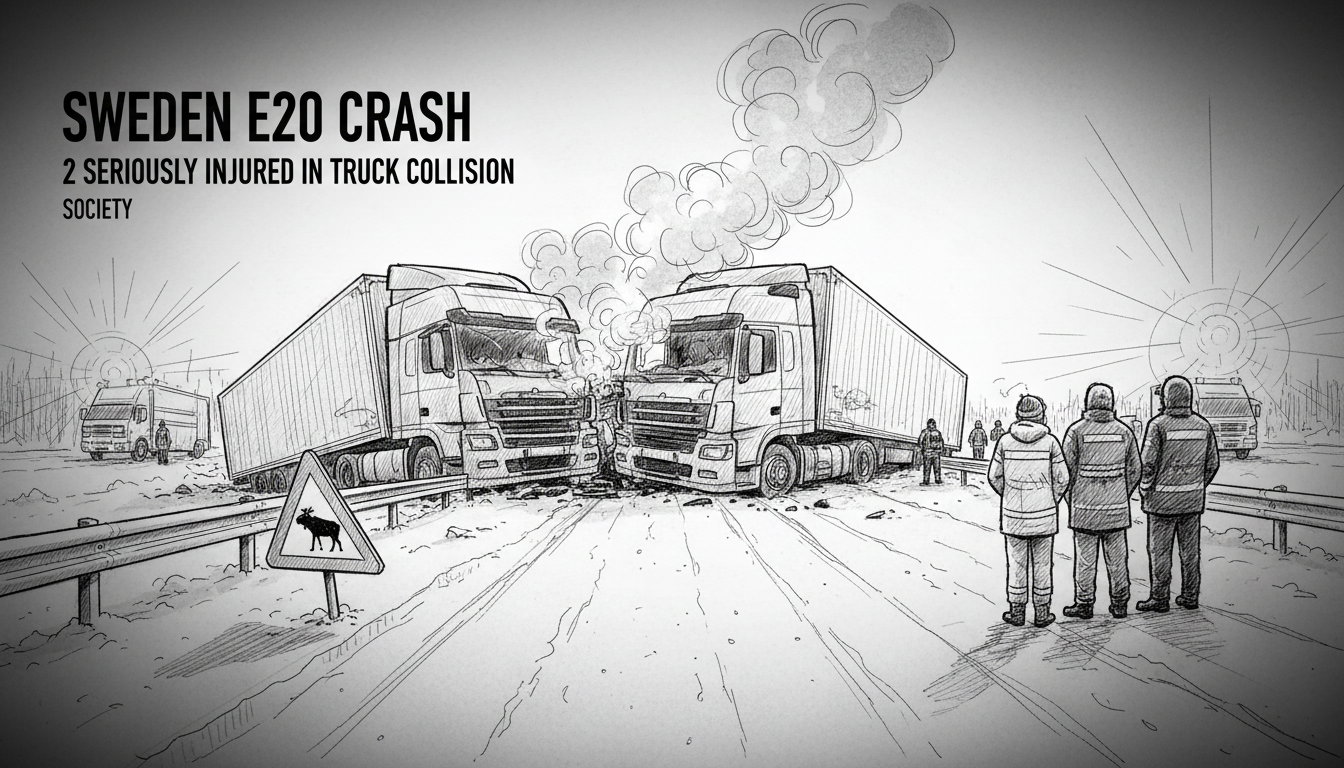
Sweden's E20 highway was the scene of a serious crash north of Götene on Tuesday, leaving two people with life-threatening injuries. A van and a truck collided head-on near Brännebrona, forcing a major road closure and creating long traffic delays across the region.
Emergency services received the alarm just after midday. Police, firefighters, and multiple ambulance crews rushed to the scene. Initial reports indicated two people were trapped in the smaller vehicle, requiring extensive rescue efforts.
“The call came in as a head-on collision. Two people were initially trapped in the smaller vehicle. Police, rescue services, and ambulance are on site and working,” said Johan Håkansson, the police press spokesperson for the West region.
The driver of the truck was reported to be conscious and able to speak with responders at the scene. The condition of the van's occupants remains serious. The Swedish Transport Administration, Trafikverket, immediately closed the road, warning of a "very large impact" on traffic with long queues forming.
A Vital Artery Severed
The E20 is not just any road. It is one of Sweden's most critical transport corridors, part of the European route E20 that stretches from Ireland to Russia. In southern Sweden, it functions as a main east-west artery for both passenger and freight traffic. A closure here sends shockwaves through the regional transport network.
Detours were quickly established, but they funnel heavy traffic onto smaller local roads not designed for such volume. For the municipality of Götene in Västra Götaland County, a quiet Tuesday was suddenly disrupted by diverted trucks and confused drivers. The economic ripple effect of such an incident is immediate, delaying goods and commuters alike.
“Accidents on this scale on the E20 have consequences far beyond the crash site,” says traffic analyst Erik Lundström, who has studied highway safety for over a decade. “It halts commerce, strains local infrastructure not built for detours, and occupies emergency resources for hours. Every minute of closure costs the economy.”
The Grim Reality of Frontal Impacts
While details of this specific crash are under investigation, traffic safety experts point to the inherent danger of head-on collisions, especially when involving vehicles of vastly different sizes and weights.
“A frontal collision at highway speeds is one of the most violent events on the road,” explains Dr. Lena Forsberg, a trauma surgeon who has consulted on road safety. “The forces involved are tremendous. Even with modern safety features like airbags and crumple zones, the difference in mass between a passenger van and a fully loaded truck creates a severe imbalance. The occupants of the smaller vehicle are at extreme risk.”
Statistics from the Swedish Transport Administration paint a clear picture. In 2022, 273 fatal road accidents in Sweden resulted in 285 deaths. While heavy goods vehicles are involved in about 15% of all injury accidents, their involvement often leads to more severe outcomes for other road users.
The Long Road to the Scene
For first responders, a call to a crash like this initiates a well-rehearsed but grim protocol. The priority is always life-saving: extricating the trapped, stabilizing the injured, and securing the scene. The process is methodical, often painstakingly slow from the perspective of backed-up traffic, but every second is focused on preventing further harm.
“Our teams train constantly for these scenarios,” says Mia Karlsson, a veteran firefighter and rescue team leader in the region. “The goal is to get people out safely and to the hospital as fast as possible. But it’s delicate work. You’re dealing with twisted metal, potential fuel leaks, and critically injured people. You cannot rush.”
Once the injured are transported to hospital—likely to the larger hospital in nearby Skövde or further to Sahlgrenska in Gothenburg for specialized trauma care—the investigative phase begins. Police will work to reconstruct the event, examining skid marks, vehicle positions, and gathering witness statements.
Beyond the Crash Barriers: A National Conversation
Every serious accident on a major route like the E20 reignites a perennial debate in Sweden about road safety. Sweden has long championed its 'Vision Zero' policy, aiming to eliminate road deaths and serious injuries. While the country has one of the world's lowest traffic fatality rates per capita, incidents like this underscore the work that remains.
Analysts point to several factors that are routinely examined after such crashes: driver fatigue, especially among professional drivers; speed compliance; road design, including median barriers; and vehicle safety standards. The stretch of the E20 where this crash occurred will now be scrutinized.
“Vision Zero means looking at the entire system—the driver, the vehicle, and the road,” says analyst Erik Lundström. “Could a better median barrier have prevented this head-on collision? Were there any contributing environmental factors like sun glare or ice? These are the questions investigators and planners will ask. The goal is not just to understand what happened, but to make sure it doesn’t happen again in the same way.”
For now, the community waits. The injured fight for their recovery in hospital. Their families begin a difficult journey. The clean-up crews work to clear the wreckage. And slowly, as the police investigation concludes and the report is filed, traffic on the E20 will return to its normal flow.
But the memory of the crash near Brännebrona will linger. It serves as a stark, sudden reminder of the fragility of life on the road, even on a familiar highway on an ordinary day. It asks every driver who passes the spot in the future to pause, just for a moment, and consider the weight of the wheel in their hands.