
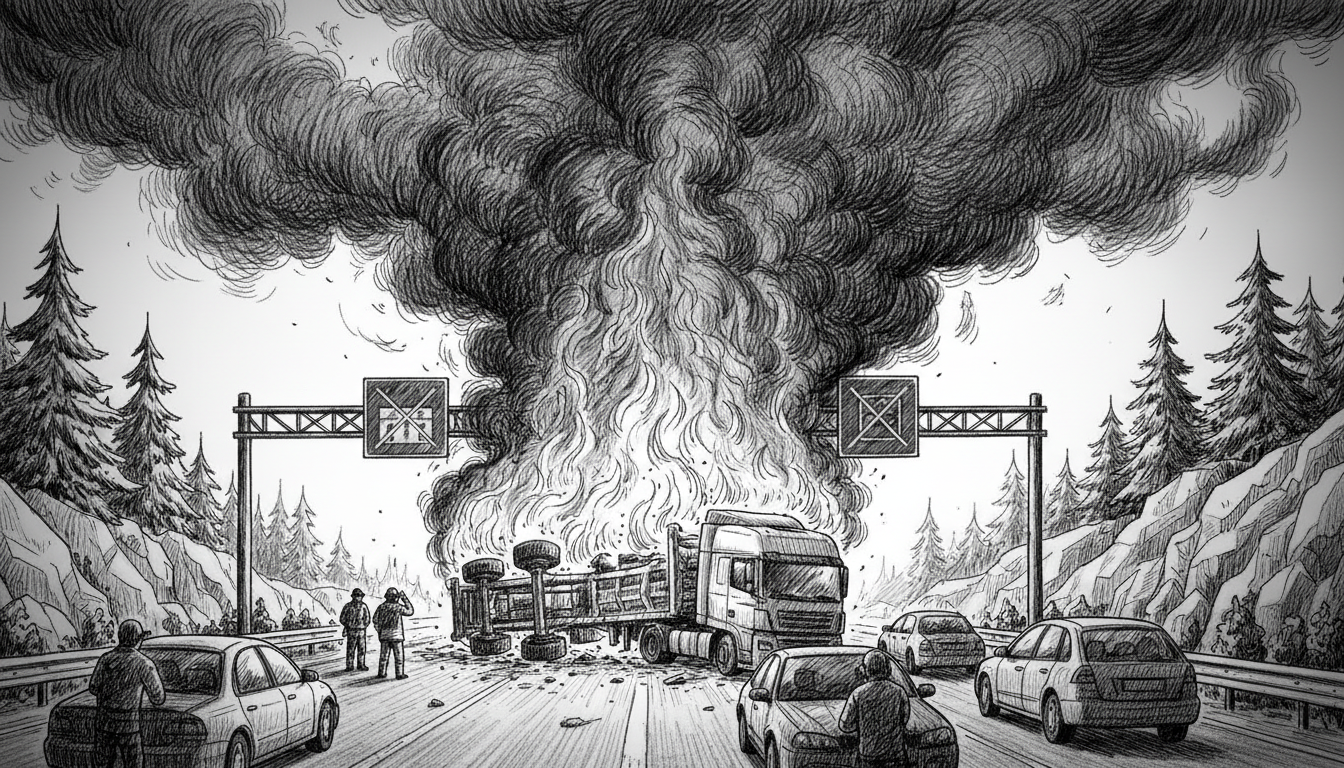
Sweden's E20 highway was closed in both directions after a truck carrying 18 pallets of alcohol caught fire between Arboga and Kungsör. Dramatic witness accounts described large flames and heavy smoke, creating a major disruption on one of the country's most critical transport arteries. The incident, which occurred just before 6 PM, is expected to cause traffic problems until at least 7 PM, with light vehicles being rerouted via roads 250, 577, and 572, and heavy vehicles via road 250 and the E18.
A Dramatic Scene on a Key Corridor
A witness at the scene described a standstill. "You just stand here and the queue keeps growing," they said. "There are large flames and a lot of smoke development. It looks very dramatic." The E20 is not just any road. It is the vital east-west link connecting Sweden's two largest cities, Gothenburg and Stockholm. This stretch through Västmanland County is a crucial segment for freight, with road transport accounting for about 40% of Sweden's total goods movement. A closure here sends immediate shockwaves through logistics networks. For hours, this key national vein was blocked, forcing a complex rerouting operation for everything from commuter cars to heavy goods vehicles destined for central Sweden.
The Unusual Cargo: Alcohol and Logistics
The truck's cargo—18 pallets of alcohol—adds a specific layer of context to the incident. In Sweden, the retail sale of alcohol is controlled by the state monopoly Systembolaget. All alcohol sold in Systembolaget's stores is transported by approved carriers under strict regulations. While the origin and destination of this specific shipment are unknown, its presence on the E20 highlights the constant flow of goods that sustain both commerce and Swedish cultural life. A disruption like this can have a knock-on effect, potentially delaying deliveries to state-run stores, though Systembolaget's robust logistics are designed to handle such contingencies. The flammable nature of the cargo also presented unique challenges for the responding rescue services, likely requiring specific firefighting tactics to manage the blaze safely.
Expert Perspective on Supply Chain Vulnerability
Logistics analysts point to this incident as a stark example of the fragility of modern supply chains. "The E20 is a backbone for Swedish industry," explains a freight transport analyst based in Stockholm. "An unplanned closure, even for a few hours, forces a complete recalculation of routes and schedules. For time-sensitive goods, especially, this creates immediate cost increases and delays. The rerouting of heavy vehicles onto smaller roads like the 250 also puts strain on infrastructure not designed for that volume or weight of traffic." This fire is a localized event, but in a country where road freight is so dominant, its impact radiates outward. It underscores how dependent daily economic life is on the smooth operation of a few critical highways.
The Ripple Effects Beyond the Smoke
While the flames are extinguished and the highway eventually reopens, the effects of such an incident linger. Local businesses in Arboga and Kungsör that rely on passing traffic see an immediate drop. Commuters face long, frustrating detours through the Västmanland countryside, disrupting family dinners and evening plans. For the truck driver and the transport company, it represents a significant financial loss and operational headache. There's also an environmental consideration; run-off from firefighting foam and potential contamination from the burnt cargo require assessment. The incident serves as a real-time stress test for the coordination between the Swedish Transport Administration (Trafikverket), rescue services, and police—a coordination that, by all accounts, functioned as intended with clear diversion plans implemented swiftly.
A Moment of Swedish Stoicism on the Road
Scenes like this often bring out a particular form of Swedish resilience. The witness account, noting how people "just stand here," captures a common national response to crisis: a calm, if frustrated, acceptance. There's no honking, no outbursts. Instead, drivers likely turned off their engines, checked traffic apps like Trafikverket's, and settled in to wait. They might have called home, explained they'd be late for middag (dinner), and listened to the radio. This collective patience is a small but integral part of handling public disruptions. It's a societal agreement to not make a bad situation worse, a trait often observed from the orderly queues at a Systembolaget to the calm demeanor during traffic standstills.
Looking Ahead: Resilience and Reflection
As cleanup crews work to clear the E20 and investigators look into the cause of the fire, the event prompts reflection on infrastructure resilience. Sweden's highways are generally well-maintained, but a single accident can paralyze a key route. This raises ongoing discussions about alternative transport routes and the balance between road and rail freight. For the average Swede, tonight's news is a story of a dramatic fire and a long detour. For planners and businesses, it's a case study in vulnerability. The highway will reopen, traffic will resume its flow, and the pallets of alcohol will be replaced. But for those caught in the queue, watching the dramatic plumes of smoke darken the Västmanland sky, it was a stark reminder of how quickly normalcy can be interrupted, and how a single truck on a key stretch of asphalt can impact the rhythm of an entire region.