
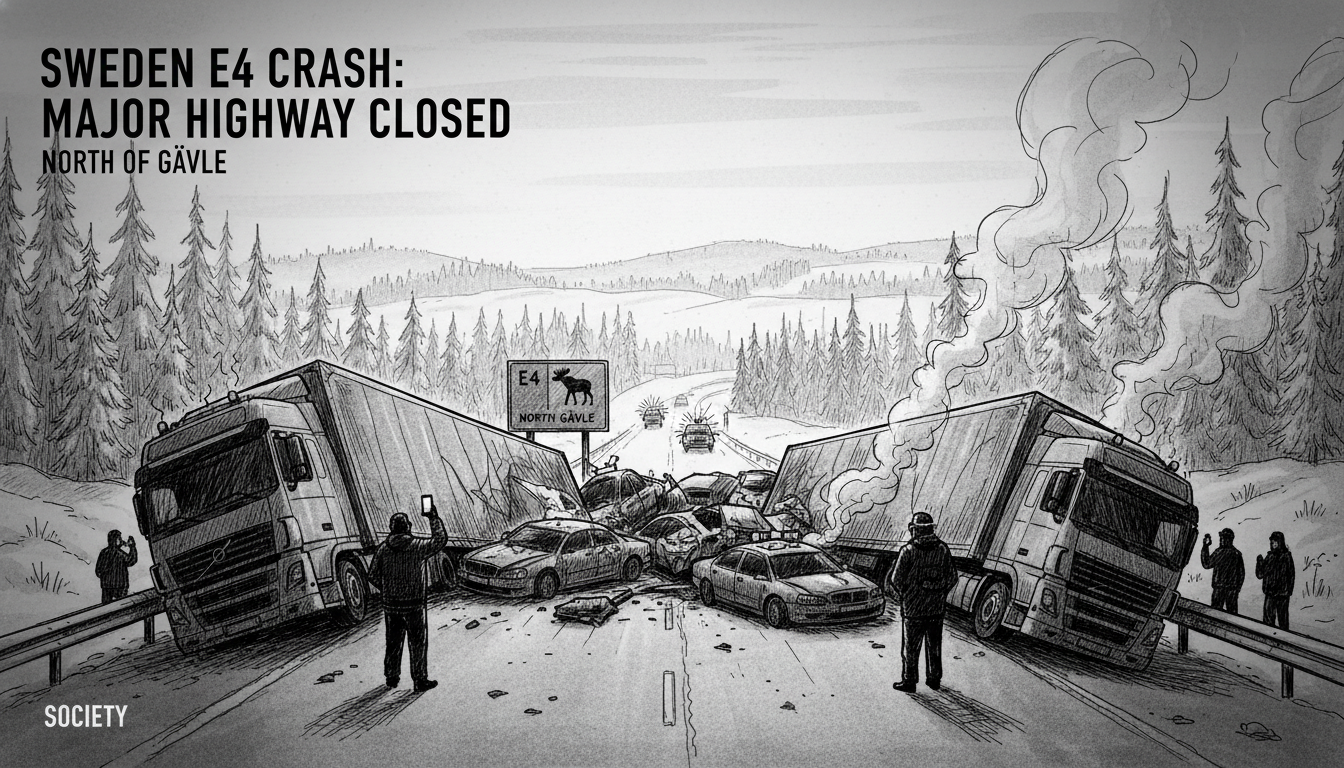
Sweden's crucial E4 highway faces major disruptions after a three-car collision north of Gävle. The accident occurred on Monday near Tönnebro, involving around ten people. Police report no serious injuries, but the crash has caused a complete stoppage of southbound traffic. Northbound lanes are also affected. The Swedish Transport Administration estimates traffic won't flow normally until 5:30 PM.
For a Monday afternoon, the scene was one of controlled chaos. Flashing blue lights from multiple emergency vehicles lit up the overcast sky. Tow trucks waited as officers directed the few drivers already on the road to turn back. This stretch of the E4, a vital artery, fell silent. The usual hum of commerce and travel was replaced by the static of police radios. The human cost, thankfully, appears minimal. But the logistical and economic ripple effects of closing Sweden's main highway are just beginning.
A Nation's Main Artery Blocked
The E4 is not just any road. It is the longest highway in Sweden, stretching approximately 1,630 kilometers from Helsingborg in the south to Haparanda on the Finnish border. It connects major cities like Stockholm, Uppsala, Gävle, Sundsvall, and Umeå. Near Gävle, it carries a significant portion of the nation's north-south freight and passenger traffic. A closure here creates a bottleneck felt across the country. "When the E4 stops, a large part of Sweden's transport system stutters," says traffic analyst Erik Lundström. "It's the backbone. Delays here mean delayed goods in warehouses hundreds of kilometers away, and people missing appointments, flights, and ferry connections."
The timing, on a Monday, is particularly disruptive for commercial transport. Lars Bergman, a long-haul driver stranded in the backup, shared his frustration. "I have a delivery of fresh produce to a supermarket in Stockholm tonight. This delay means it won't get there in time. It's a chain reaction—one accident affects so many people you never see." The Swedish Transport Administration's estimate of a 5:30 PM reopening is considered optimistic by some stranded motorists, who have begun sharing alternative route suggestions via social media. These detours, however, flood smaller regional roads not designed for heavy traffic.
The Safety Record of a Busy Highway
While this accident had a fortunate outcome regarding injuries, it highlights the constant pressure on Sweden's main roads. In 2022, there were approximately 35,000 reported road accidents across the country. The E4, due to its high traffic volume, is a focal point for safety initiatives. "We have a vision zero philosophy, but high-volume highways present unique challenges," explains Anna Kjellberg, a road safety researcher. "Driver fatigue, sudden weather changes, and the monotony of long-distance travel can all be factors. The priority after any collision is swift clearance to prevent dangerous secondary accidents, which are a major risk in congestion situations."
The area near Tönnebro, north of Gävle, is characterized by a mix of forest and coastal landscapes. The road is generally straight in this section, which can sometimes lead to reduced driver attention. Authorities have not yet released details on the cause of the three-car collision. Standard procedure involves a technical investigation of the vehicles and witness interviews. For now, the focus remains on clearing the wreckage and restoring traffic flow as safely and quickly as possible.
A Cultural Reliance on the Open Road
This disruption touches a core aspect of Swedish lifestyle: mobility and access to nature. The E4 is the gateway to the Norrland coast, leading families to summer cottages and tourists to destinations like the High Coast. A closure disrupts more than commerce; it interrupts a way of life. In Gävle, a city famous for its giant straw Christmas goat, residents are accustomed to being a hub, not a halt. Local cafes near alternative routes may see an unexpected influx of stranded travelers, a small silver lining for businesses.
Swedes have a pragmatic relationship with their long, dark winters and cherish efficient summer travel. An event like this tests the famous Swedish preparedness, beredskap. It also showcases community response. "You see it every time," says Sofia Andersson, reporting from Stockholm. "People offering water to stranded drivers, sharing real-time info in local Facebook groups. There's a collective deep breath, a resignation, and then a practical focus on solving the problem together."
The highway will reopen. The cars will be towed to a garage in Gävle. The investigation will conclude. But for a few hours on a Monday, the relentless flow of modern life on the E4 was paused. It serves as a reminder of our shared vulnerability on the road and the intricate network we all depend on. It also underscores a quiet truth about Swedish society: that between the vast forests and long distances, connectivity is both a necessity and a constant, careful effort. How does a nation built on mobility cope when its main road suddenly stops? With patience, practical solutions, and an unspoken agreement to look out for each other until the traffic starts moving again.