
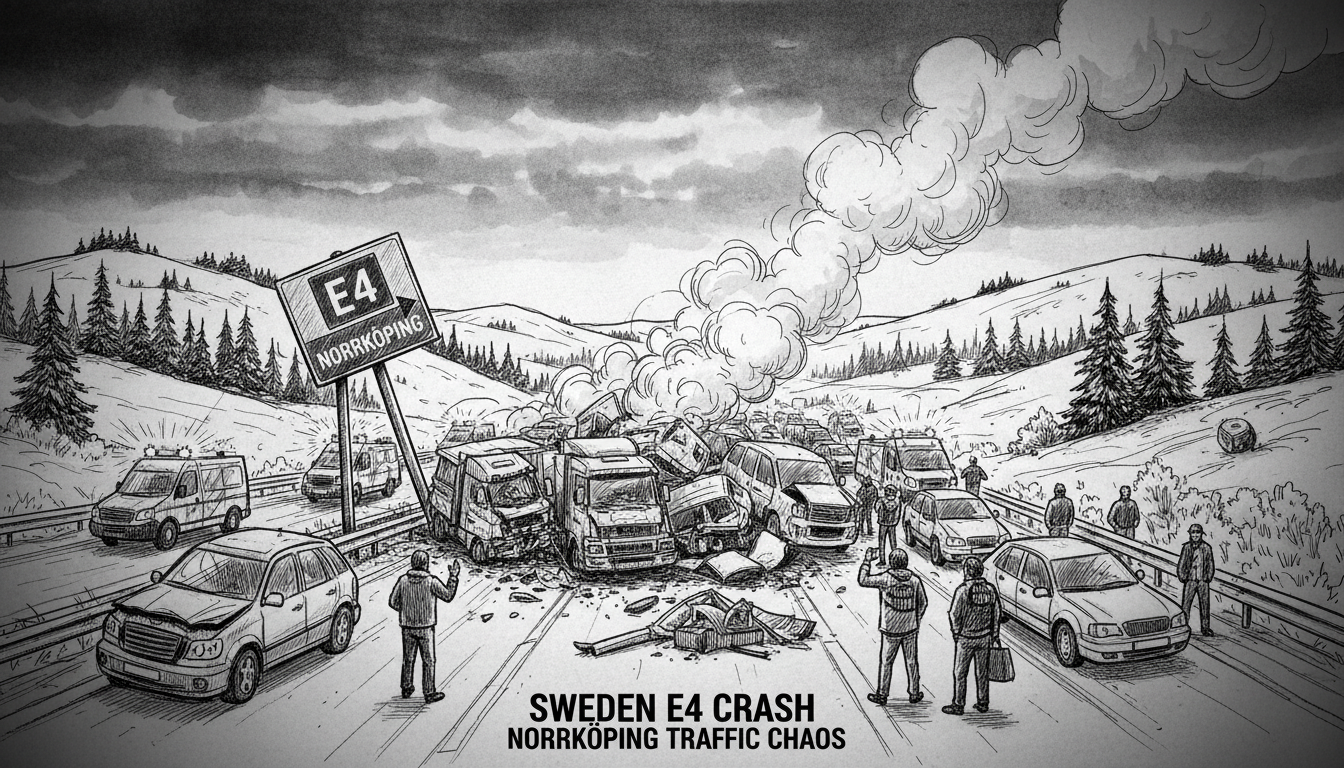
Sweden's E4 highway faced major disruption today after a serious collision between two passenger cars. The accident occurred at the Mejlby interchange near Kimstad, just south of the industrial city of Norrköping. Police confirmed at least one lane was closed, creating significant traffic delays during the morning commute. No immediate reports of injuries were available, leaving many drivers and families waiting anxiously for updates.
For anyone who has driven Sweden's main arterial road, the news triggers a familiar sense of dread. The E4 is the country's backbone, a 1,590-kilometer lifeline connecting cities from Helsingborg in the south to Haparanda in the north. A closure near Norrköping—a key logistics and industrial hub 160 km southwest of Stockholm—doesn't just slow traffic. It ripples through the entire regional economy, delaying freight, complicating work commutes, and testing the patience of thousands.
The Morning Commute Grinds to a Halt
Early reports from the scene described a collision involving two personal vehicles. The specific cause remains under investigation by local police. The immediate effect was concrete and chaotic. Authorities moved quickly to close at least one lane at Trafikplats Mejlby, a crucial junction where local and highway traffic merges. This standard safety procedure, while necessary, guarantees congestion.
"When one lane closes on the E4, especially near a city like Norrköping, the domino effect is almost instantaneous," explains Lars Bengtsson, a retired traffic planner I spoke with. "You have commuters heading into the city's industries, long-haul trucks serving the port, and families on the school run. All that volume gets funneled into a smaller space. Stress levels rise, and the risk of secondary incidents increases." This bottleneck impacts not just the E4 itself but the surrounding network of regional roads, as drivers seek alternative routes through communities like Kimstad.
The Human Cost Beyond the Congestion
While the physical damage is to vehicles and asphalt, the real impact is measured in missed moments and mounting frustration. Imagine the delivery driver for a Norrköping manufacturing firm, watching the clock tick on a just-in-time shipment. Picture the parent, stuck in a line of red brake lights, knowing they will be late to pick up their child from daycare. Consider the emergency responders, navigating the same clogged roads to reach the scene. Each accident writes a story of personal and economic disruption.
Sweden prides itself on road safety, with its Vision Zero policy aiming to eliminate fatalities and serious injuries. The statistics show progress is being made. In 2022, Sweden recorded 322 fatal accidents resulting in 340 deaths. The national target, set by the Swedish Transport Administration (Trafikverket), is to push that number below 200 per year. Yet every accident, especially on a flagship route like the E4, serves as a stark reminder of the work left to do. It underscores the constant balance between efficient mobility and absolute safety.
Why the E4 is Sweden's Indispensable Artery
To understand the scale of today's disruption, you must understand the road's role. The E4 is more than just a highway; it's a central plank in the nation's infrastructure. It connects Sweden's three largest metropolitan areas: Stockholm, Gothenburg (via connecting routes), and Malmö. For Norrköping, a city built on textile and paper mills with a modern focus on tech and logistics, the E4 is its direct link to the national and European market. Goods flow north to the capital and south to the continent.
This isn't just about geography. It's about cultural rhythm. The E4 is the route for summer exoduses to northern cottages, for student moves to university cities, and for festival-goers heading to events like Stockholm's Culture Festival or Norrköping's own celebrations. A major closure disrupts these rhythms, the planned and cherished parts of Swedish life. The social contract of free movement is temporarily suspended.
The Ripple Effects Through Business and Daily Life
The economic toll of a major highway closure is difficult to calculate in real-time but is undoubtedly significant. Logistics companies face penalty clauses for late deliveries. Employees lose productive work hours sitting in traffic. Local businesses near the accident site may see a sudden drop in customers who cannot reach them. For a region like Östergötland, which competes for investment and talent, reliable infrastructure is a key selling point. Incidents like today's chip away at that reputation, however temporarily.
From a societal perspective, these events also test public trust in the system. Drivers rely on accurate, timely information from police and transport authorities. They depend on efficient tow truck and cleanup operations. The speed of the response and the clarity of communication can turn a frustrating incident into a manageable one, or alternatively, amplify public anger. The digital age means traffic apps and social media light up with warnings and complaints, creating a parallel stream of crowd-sourced—and not always accurate—information.
Looking Ahead: Safety on Sweden's Roads
As the cleanup on the E4 proceeds and traffic slowly returns to normal, the questions linger. What caused this collision? Was it driver error, a vehicle malfunction, or road conditions? The investigation will seek answers, not just for accountability, but for prevention. Traffic safety experts consistently highlight that post-accident response is only one part of the equation. The larger goal is designing roads, vehicles, and systems that prevent accidents from happening in the first place.
This involves continuous investment. It means maintaining road surfaces, ensuring clear signage, and considering smart traffic management systems that can dynamically adjust speed limits or lane usage based on volume and weather. It also requires a cultural commitment from every driver to respect speed limits, avoid distractions, and share the road responsibly. The Swedish model combines engineering, enforcement, and education. Each serious accident is a painful audit of how well that model is functioning.
For now, the people of Norrköping and the countless travelers on the E4 will hope for a swift resolution and, most importantly, news that no one was seriously hurt. The highway will reopen, the traffic reports will move on to the next issue, and the rhythm of life will resume. But in homes and offices across the region, today's disruption serves as a reminder of our shared vulnerability on the road. It highlights how deeply our modern lives are intertwined with the thin grey lines on a map, and how quickly a single moment can bring everything to a standstill. How much are we willing to invest, and change, to make these disruptive moments a rare exception rather than a regular headline?