
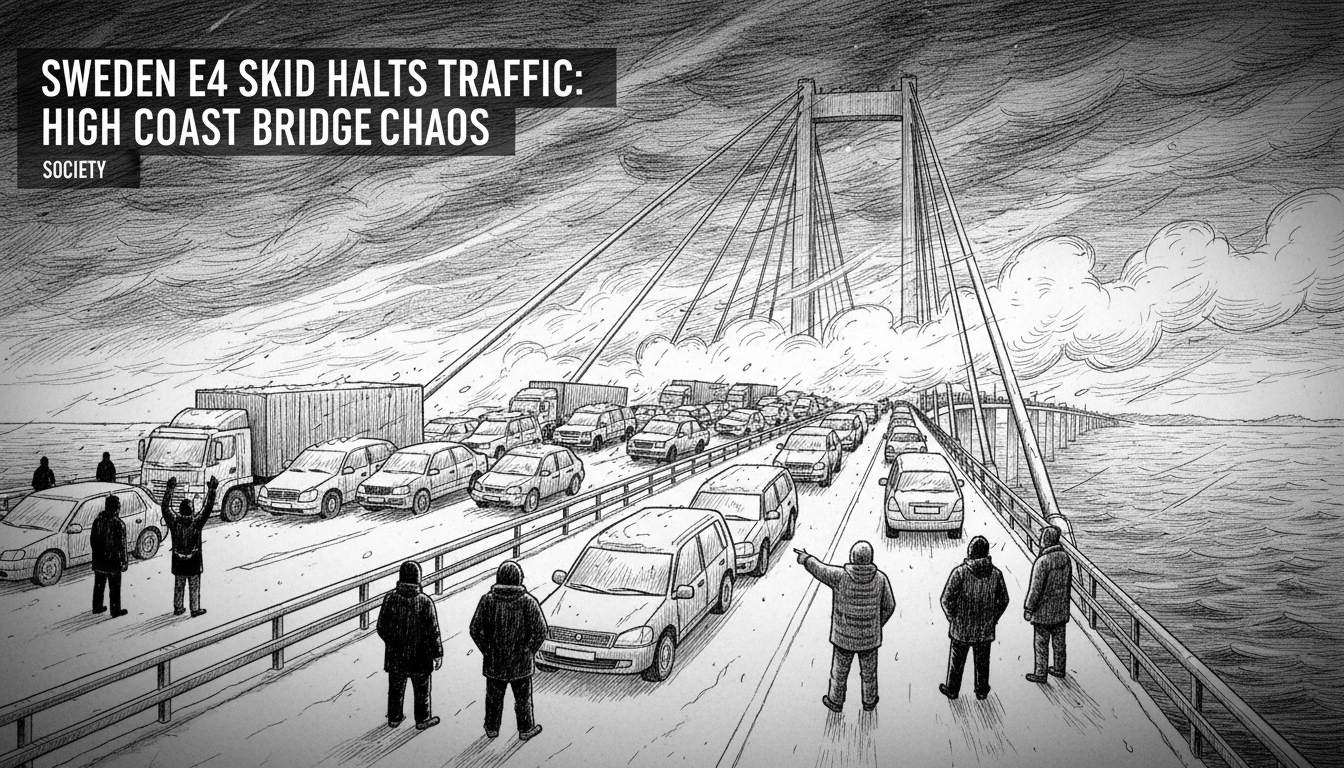
Sweden's E4 highway faced major disruption Sunday evening after a car skidded into a guardrail near the iconic High Coast Bridge. The incident, described by police as a minor skid with no injuries, still caused significant traffic jams in both directions on this vital north-south artery.
For drivers heading home or towards Stockholm on a damp autumn Sunday, the journey turned into a long, frustrating wait. The södergående (southbound) lanes were completely closed, while one northbound lane was also blocked as emergency services worked to clear the scene. The police regional command center confirmed the situation was under control but messy. "It's a car that skidded a bit and ended up in an awkward position, hence the queues," a police commander said. "There are no personal injuries."
A Sunday Snarl on a National Artery
The E4 is more than just a road; it's the spine of eastern Sweden. It connects major cities like Helsingborg, Stockholm, and Luleå, facilitating everything from daily commutes to the transport of essential goods. A closure here, even for a short time, sends ripples across the region. The location of this incident amplified its impact. Occurring near the Höga Kusten-bron, a landmark cable-stayed bridge, it blocked a critical chokepoint where traffic has few alternative routes.
"Any incident on a major bridge like this creates an outsized problem," explains Lars Mikkelsen, a traffic analyst based in Stockholm. "You can't just divert traffic onto the next exit. The geography of the High Coast, with its steep terrain and water, means the E4 and this bridge are the only efficient paths for long-distance travel. A minor skid becomes a major delay for hundreds of vehicles."
The bridge itself is an engineering marvel and a symbol of the region. With a main span of 1,210 meters and soaring 180 meters above the Ångerman River, it dominates the landscape of the High Coast, a UNESCO World Heritage Site celebrated for its dramatic geology. On Sunday, however, drivers were less focused on the view and more on their unmoving dashboards.
The Human Cost of Traffic Standstills
While no one was physically hurt in the skid, the incident highlights the broader human and economic cost of such disruptions. Imagine the families returning from a weekend at a stuga (summer cottage) in the north, now delayed for hours with restless children. Picture the truck driver carrying fresh produce from Norrland to Stockholm's markets, watching his schedule unravel. These are the unseen consequences of a single vehicle losing traction.
"It's the domino effect," says Mikkelsen. "One car stops, and within minutes, kilometers of congestion build up. It affects business deliveries, family time, and overall regional mobility. In Sweden, where long distances are common, reliable road networks are not a luxury but a necessity for daily life."
This event was part of a busy Sunday for emergency services in northern Sweden. Police reported multiple minor traffic accidents and wildlife collisions across the region, though thankfully none resulted in serious injuries. The autumn season, with its shifting weather, fading light, and increased animal movement, often sees a rise in such incidents.
Navigating Sweden's Seasonal Driving Hazards
The cause—a simple "sladd," or skid—is a familiar hazard for Swedish drivers, especially during seasonal transitions. Early autumn brings rain, fallen leaves creating slippery conditions, and the first frosts at night. Roads that were dry in the afternoon can become slick by evening. This requires a shift in driving mentality, from the relaxed pace of summer to the more vigilant, prepared approach needed for colder months.
Swedish driving culture emphasizes preparedness. The concept of "vinterdäck" (winter tires) is legally mandated from December 1st to March 31st, but many, especially in the north, switch earlier. This incident near the High Coast, while not necessarily ice-related, serves as an autumn reminder. It underscores the importance of adjusting speed, increasing following distance, and ensuring your vehicle is ready for less predictable conditions.
For visitors and new residents, understanding these seasonal rhythms is key to Swedish society. Life here adapts to the climate. The same landscapes that offer breathtaking hiking in the summer and northern lights in the winter also present practical challenges like slippery roads. Adapting to this is part of integrating into Swedish lifestyle and society trends.
When Infrastructure Meets Geography
The response to the incident followed a well-rehearsed Swedish protocol. SOS Alarm coordinated the initial response, the rescue service secured the scene, and Trafikverket, the Swedish Transport Administration, provided updates on clearance times. By 6:15 PM, the scene was cleared. The efficiency of the response likely prevented even longer delays.
However, the event sparks a conversation about resilience. With climate change potentially leading to more volatile weather, are critical infrastructure points like the High Coast Bridge prepared for increased disruption? Experts suggest that while physical infrastructure is robust, the focus is increasingly on digital tools—better real-time traffic information through apps, dynamic message signs, and coordinated logistics to manage delays.
"The goal is not just to clear the accident, but to manage the information flow," Mikkelsen notes. "Informing drivers early allows them to make choices, perhaps take a break in Härnösand or Kramfors, rather than sitting in a stationary queue. It reduces frustration and secondary risks."
Beyond the Traffic Report
As the taillights finally began to move on the E4 Sunday night, life returned to its normal flow. But this minor skid leaves us with broader questions. It's a story about our dependence on seamless connectivity and how fragile it can be. It connects to Swedish culture's relationship with nature—both its awe-inspiring beauty and its practical demands. The High Coast is a place of recreation and natural wonder, but also a corridor that must function in rain, snow, and shine.
For those caught in the delay, it was an annoying end to the weekend. For analysts, it's a data point in traffic management. For everyone, it's a reminder to pack a little extra patience, check the weather forecast, and ensure the car is ready for the season ahead. Because in Sweden, the journey—especially along the majestic, sometimes challenging, east coast—is as significant as the destination. Will our infrastructure and habits keep pace as the environment around these vital roads continues to change?