
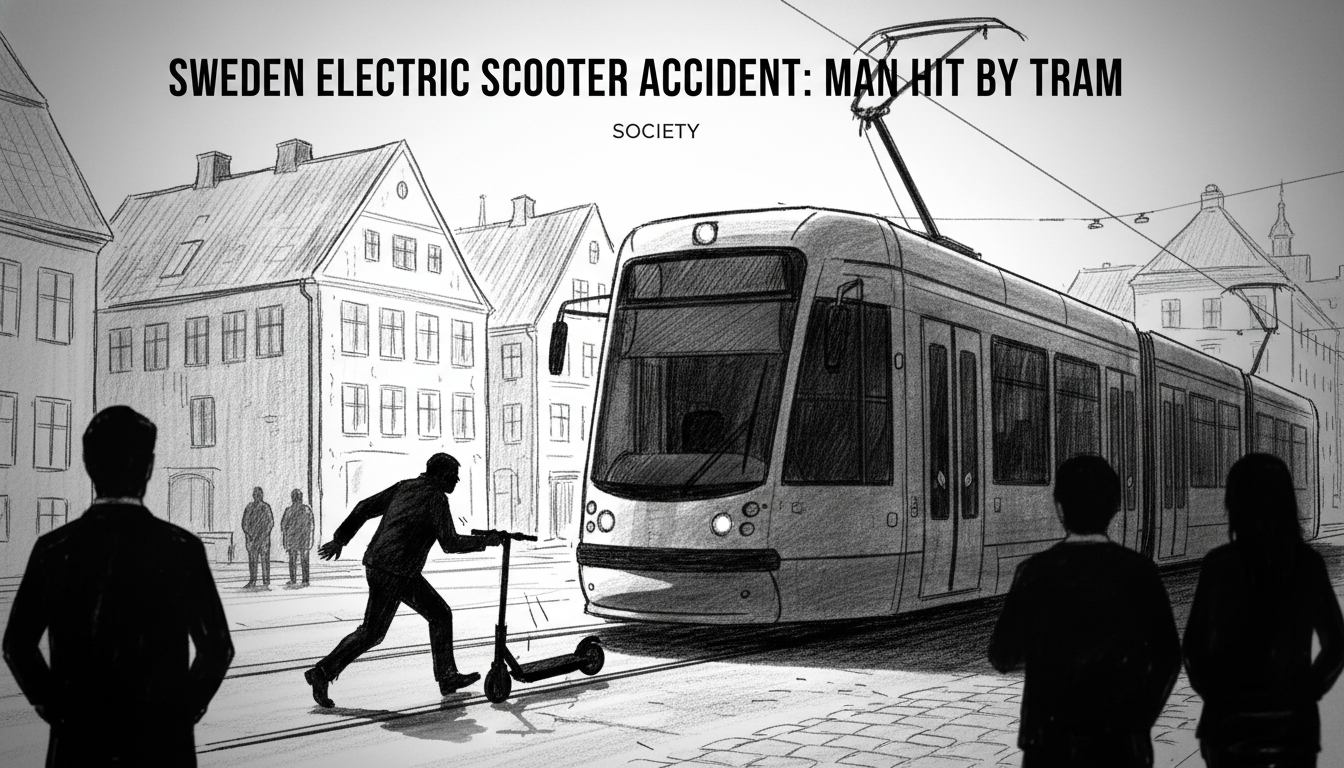
Sweden's latest electric scooter accident has left a man in his 50s seriously injured after a collision with a tram in Gothenburg. The incident, which occurred on a quiet Sunday afternoon, has reignited a fierce national debate about safety, regulation, and the future of our city streets.
Emergency services rushed the man to Sahlgrenska University Hospital. His condition was described as serious but stable. Police confirmed he was conscious after the crash. Officers have opened an investigation into negligent driving in traffic. The electric scooter itself was seized for a technical examination.
"We have initiated a report on careless driving in traffic, and the electric scooter has been seized for a technical investigation," said Jon Franzén, the police officer in charge at the time. The collision disrupted Gothenburg's vital tram network for nearly an hour, a ripple effect felt by hundreds of commuters on a weekend.
A Sunday Afternoon on the Tracks
Gothenburg's trams are the lifeblood of the city. The network spans roughly 160 kilometers of track, weaving through neighborhoods from Majorna to Linnéstaden. They are a symbol of efficient, green Swedish urban planning. But this incident highlights a growing tension on those same rails. The quiet hum of an electric scooter is now a common sound, but its place in the traffic ecosystem remains dangerously unclear.
This was not an isolated event. It is part of a sharp, worrying trend. In 2023, Swedish authorities recorded 7,753 accidents involving personal transporters, a category dominated by electric scooters. That number marks a 22% increase from the year before. Each statistic represents a life altered, an emergency call made, a family receiving bad news.
The Regulatory Grey Zone
The fundamental problem is one of definition and infrastructure. Where does an electric scooter belong? Is it a vehicle for the cycle path, a pedestrian on the sidewalk, or something entirely new? Swedish traffic law has struggled to keep pace. National regulations set a general speed limit of 20 km/h for electric scooters, but enforcement is patchy. Local councils, like Gothenburg's, can create their own rules for public spaces, leading to a confusing patchwork.
"We are seeing the consequences of introducing a new type of vehicle into complex urban environments without fully adapting the rules or the physical space," says traffic safety analyst, Erik Lundström. "Trams have fixed paths. They cannot swerve. The responsibility for avoiding collision falls almost entirely on other road users, who may not fully understand the risks."
Lundström points to the need for clearer segregation. "Should there be designated, painted lanes for scooters? Should they be banned entirely from certain tram-adjacent zones? These are difficult but necessary conversations for cities to have."
The Human Cost of Convenience
Behind the statistics and policy debates are real people. The man injured on Sunday is someone's partner, perhaps a father, a friend, a colleague. His life is now on a different trajectory because of a split-second incident. This human cost is what fuels the growing public concern.
I spoke with residents in the city's Vasastan district, not far from where many such rentals are parked. "They're everywhere, and people ride them so fast, often without helmets," said Anna, a local shopkeeper. "It's only a matter of time before something terrible happens. We see near-misses every day."
Another resident, Markus, offered a different perspective. "I use them to get to work. They're affordable and fast. The problem isn't the scooters; it's the few people who ride them recklessly. We need education, not just more bans."
This divide is typical. The convenience is undeniable, offering a last-mile solution that complements public transport. But the perceived lack of accountability—anonymous rental apps, no license requirements, easy abandonment—creates a sense of lawlessness.
A Search for Solutions
What happens next? The police investigation will determine if specific traffic laws were broken. But the larger societal investigation is already underway. Possible solutions are being tested in cities across the Nordics.
Some advocate for geofencing technology to automatically reduce scooter speeds in high-risk areas like tram lines and crowded squares. Others call for mandatory helmet use, a rule that exists in some Danish municipalities. There is also a push for clearer, universal signage and street markings to define where scooters can and cannot go.
"The goal cannot be to eliminate a popular form of transport," Lundström argues. "The goal must be to integrate it safely. That requires investment in infrastructure, consistent national guidelines, and a public awareness campaign about the unique dangers around trams."
The Road Ahead for Swedish Cities
This accident in Gothenburg is a stark reminder that urban evolution has growing pains. Swedish cities pride themselves on sustainability and innovation. The electric scooter fits neatly into that narrative. Yet, this vision clashes with the equally strong Swedish value of 'trygghet'—a sense of security and safety in public spaces.
The disruption lasted less than an hour, but the questions raised will linger far longer. Can Swedish cities design streets that safely accommodate century-old trams and brand-new micro-mobility? Or will the pursuit of green convenience continue to leave a trail of human casualties?
The answer will determine not just the future of electric scooters, but the character of our urban life. As the man in the hospital recovers, planners, politicians, and citizens are left to navigate a track that still feels dangerously uncertain.