
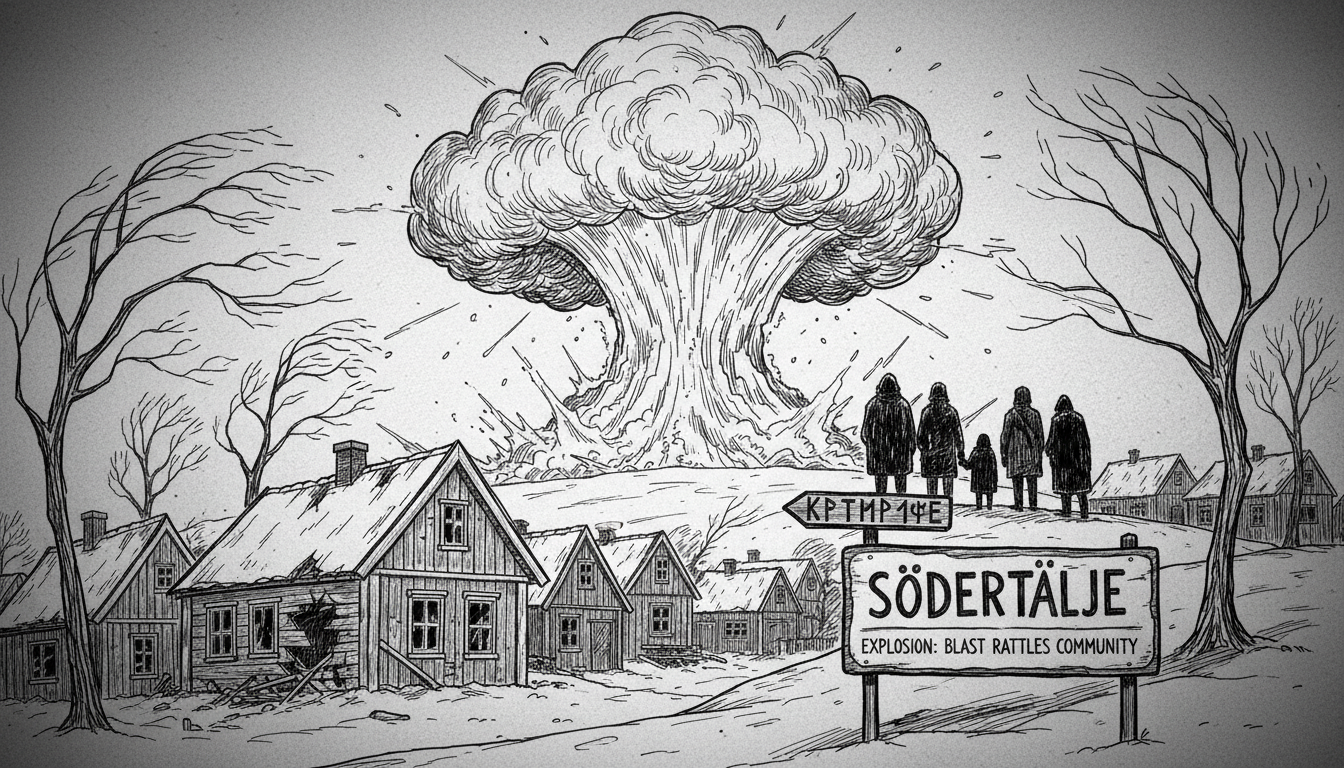
Sweden police are investigating an explosion at a residential building in Södertälje. The blast occurred in the Rosenlund area just before 7 PM, shattering a window and sending shockwaves through the neighborhood. Authorities report no injuries so far.
“Something exploded and a window pane broke,” said Mats Eriksson, press spokesperson for Stockholm Police. Officers and emergency services rushed to the scene with multiple units. They are working to establish a clear picture of what happened.
Daniel Kassidis, the duty officer at Södertörns Fire and Rescue Service, provided initial details. “There has been a bang from some form of pyrotechnic in the stairwell. It could be a banger or something similar,” he said. The use of such pyrotechnics without a permit is illegal in Sweden.
For residents of the quiet Rosenlund neighborhood, the sudden noise was terrifying. “It sounded like a bomb,” said one local who wished to remain anonymous. “My whole apartment shook. You don’t expect this here.” The incident has left a community on edge, questioning the safety of their own homes.
A Pattern of Violence in Södertälje
This explosion did not happen in a vacuum. Södertälje, a city located about 30 kilometers southwest of Stockholm, has grappled with gang-related violence for years. The municipality is a diverse hub, home to large Assyrian/Syriac and Iraqi communities. It has also faced significant challenges with social integration and criminal networks.
Local authorities have launched numerous initiatives to combat crime. These include increased police patrols, youth outreach programs, and community cooperation projects. Despite these efforts, incidents involving explosions and shootings periodically shatter the calm. Each event deepens concerns among residents about persistent underground conflicts.
“When you hear an explosion in a residential area, the first thought is gang intimidation or a message being sent,” said a Swedish criminologist familiar with the region. “These acts are rarely random. They are designed to create fear, to mark territory, or to retaliate.” The expert, who spoke on background, stressed that while the Rosenlund blast appears minor, it fits a troubling national pattern.
The Human Cost of Fear
Beyond the broken glass, the real damage is to the sense of security. Families in Rosenlund are now looking over their shoulders. Parents worry about letting children play outside. The mundane act of walking through a stairwell becomes fraught with anxiety.
“This is where we live, where we sleep,” said Maria, a long-time resident of the affected building. “We should feel safe. Now we are just waiting for the police to tell us what happened, and if it will happen again.” Her story reflects a common sentiment in areas touched by such violence. The trauma lingers long after the debris is cleared.
Swedish society takes explosions in residential areas extremely seriously. They trigger large-scale police investigations, often involving national units. The priority is always to determine if there is an ongoing threat to the public. Investigators will meticulously examine the stairwell for forensic evidence. They will also canvass the neighborhood for witnesses and review any available security camera footage.
The use of a “banger” – a powerful firework – suggests a potentially accessible weapon. However, authorities are cautious. They have not ruled out other explosives or motives. The investigation will seek to answer critical questions. Was this a targeted act against a specific resident? Was it a reckless prank that escalated? Or was it a deliberate show of force by a criminal group?
Community Response and Resilience
In the face of such incidents, the strength of the local community is tested. Södertälje has a history of grassroots organizations working to steer young people away from crime. Community leaders often act as vital bridges between residents and the authorities.
“The solution cannot come from the police alone,” said a local youth worker in Södertälje. “We need to be in the stairwells, in the schools, and in the homes. We need to offer alternatives before a young person ever picks up a firework with the intent to harm.” This perspective highlights the dual approach needed: immediate law enforcement and long-term social investment.
For many Swedes following the news, the Södertälje explosion is another data point in an ongoing national debate about crime and integration. It fuels discussions about resource allocation for police, the effectiveness of sentencing, and the roots of gang recruitment. These conversations are complex and often politically charged.
Yet, for the people of Rosenlund, the issue is not abstract. It is the smell of smoke in their hallway. It is the crunch of glass underfoot. It is the sleepless night wondering if a loud noise outside is just a car backfiring or something far worse.
Looking Ahead: Safety and Uncertainty
As the police investigation continues, life in Rosenlund attempts to return to normal. The broken window will be replaced. The official report will eventually be filed. But the memory of the blast will not fade quickly.
The incident serves as a stark reminder of the challenges facing many Swedish suburbs. These are places of vibrant multicultural life, but also places where socio-economic gaps and criminal elements can create a volatile mix. Success stories of integration and business prosperity exist alongside headlines of violence.
What happens next in Södertälje depends on the findings of the police. It also depends on the community’s ability to come together. Will this event galvanize more residents to cooperate with crime prevention programs? Or will it deepen a sense of isolation and fear?
The ultimate goal for any society is to ensure that a person’s home is a sanctuary. The explosion in Rosenlund violated that basic principle. Restoring it requires more than just investigative work. It requires a sustained commitment to safety, opportunity, and trust from every level of Swedish society. The people of Södertälje, like people everywhere, deserve nothing less.