
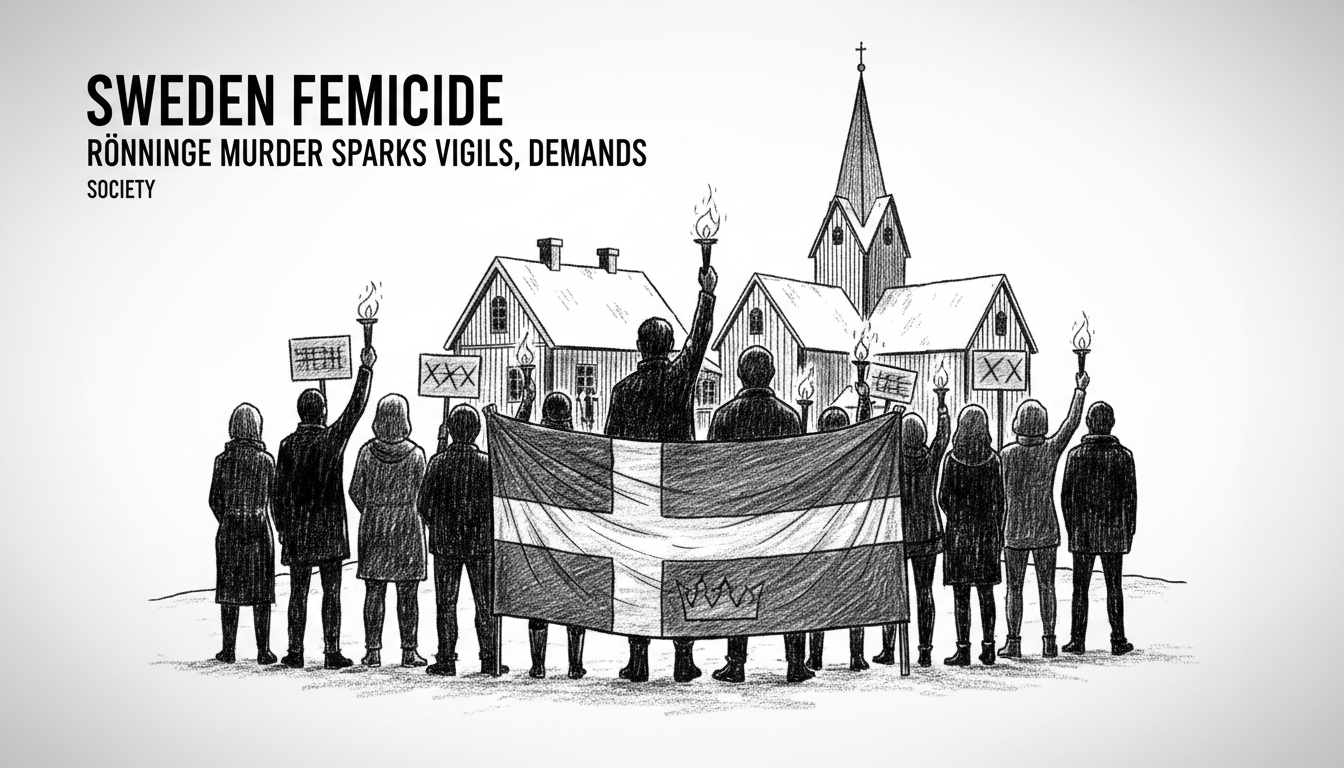
Sweden femicide has returned to the national spotlight after the murder of a 25-year-old woman in Rönninge. A 26-year-old man is now in custody, suspected of the killing and aggravated violation of the peace of the dead. The case has ignited grief, anger, and renewed calls for action to protect women from domestic violence in Sweden.
On a cold square in Rönninge, a commuter town southwest of Stockholm, a memorial grows. Flowers cover the ground. Candles flicker in the winter dark. People stop, light a new flame, and stand in silent reflection. This quiet gathering is the community's first response to a brutal loss. The woman, reported missing since Boxing Day, was found dead here. Her death has shattered the local sense of safety.
“We are sad and angry – something must change,” said a local woman organizing one of the planned vigils. Her words capture a national mood of frustration. This is not an isolated tragedy. It is part of a pattern that challenges Sweden's self-image as a world leader in gender equality.
From Grief to Grassroots Action
In response, grassroots action is forming. Engaged women in the Rönninge area have applied for a permit to hold a candlelight manifestation on January 3rd. It will honor the 25-year-old victim and demand a safer society. Another vigil is planned at Medborgarplatsen in central Stockholm on January 2nd. These gatherings are more than memorials. They are public statements of mourning and protest.
“The planning happens quickly, through social media and word of mouth,” the organizer explained. “There is a powerful need to come together, to show we care, and to show we demand better.” This impulse to turn personal sorrow into collective action is a defining feature of Sweden's contemporary response to violence against women.
The Persistent Shadow of Partner Violence
The statistics provide a grim backdrop to the emotional outcry. According to the Swedish National Council for Crime Prevention (Brå), women are far more likely than men to be killed by a current or former partner. In 2022, 14 women in Sweden were murdered by a partner or ex-partner. Each number represents a life like the one lost in Rönninge.
“We have a paradox,” says Dr. Lena Karlsson, a sociologist specializing in gender-based violence. “Sweden scores high on global gender equality indexes, yet intimate partner violence and femicide remain serious problems. The legal framework is strong, but implementation and prevention often fall short.” She points to societal attitudes, gaps in the justice system, and insufficient resources for victim support as key issues.
Domestic violence in Sweden often follows a familiar, tragic script. Warning signs may be reported but not adequately acted upon. Protection orders can be difficult to obtain and enforce. Women's shelters, while existing, frequently operate at full capacity. “The system is strained,” Karlsson notes. “And when it fails, the consequences are fatal.”
A Community Reckoning in Rönninge
Back in Rönninge, the sense of a tight-knit community shaken to its core is palpable. The town, part of Salem municipality, is typical of Stockholm's suburbs—a mix of residential areas, small businesses, and green spaces. Crime here is often measured in bicycle thefts or vandalism, not murder.
“You don't expect this here,” says Mikael, a longtime resident who came to lay flowers. “It makes you look at your neighborhood differently. It makes every woman you know think twice.” This erosion of perceived safety is a secondary trauma that spreads through a community after such a crime.
The suspect, a 26-year-old man, was arrested on Tuesday. The specific charge of “grovt gravfridsbrott” – aggravated violation of the peace of the dead – suggests a particularly disturbing aspect to the crime, adding to the community's horror. Police have released few details, focusing their public statements on the ongoing investigation and the arrest.
Beyond Thoughts and Prayers: Demanding Concrete Change
The planned vigils in Rönninge and Stockholm are part of a larger movement that has grown over the past decade. Swedish women are increasingly vocal in demanding that “enough is enough.” They are moving beyond moments of silence to calls for concrete policy shifts.
Activists list several key demands. These include stricter enforcement of restraining orders, increased and guaranteed funding for women's shelters (kvinnojourer), and mandatory risk assessments in all reported cases of domestic violence. There is also a push for educational programs in schools that tackle harmful gender norms from an early age.
“We hear ‘thoughts and prayers’ after every tragedy,” says activist Sofia Mahmoud. “But thoughts don't save lives. We need more police resources dedicated to protecting women. We need judges who understand the dynamics of coercive control. We need a society that believes women when they first cry for help.”
The Long Road Ahead for Swedish Society
The murder in Rönninge is a stark reminder that geographic location or national reputation offer no immunity. Gender-based violence cuts across postal codes and income brackets. For Sweden, confronting this reality means looking inward at the gap between progressive ideals and lived experience.
Experts argue that prevention is as crucial as prosecution. “We must address the root causes,” Dr. Karlsson emphasizes. “This means challenging the normalization of male violence, teaching young people about healthy relationships, and creating economic independence for women so leaving a dangerous partner is a real option.”
As the candles are lit on Medborgarplatsen and in Rönninge square this week, they will symbolize both remembrance and resolve. The light honors a young woman whose future was stolen. It also illuminates the path forward—a path demanding vigilance, resources, and an unwavering commitment to making Sweden safer for all women.
The question now is whether this latest tragedy will be a turning point or just another headline. For the women organizing, for the families grieving, and for a society grappling with its contradictions, the demand is clear: the time for empty words is over. Action must follow the anger.