
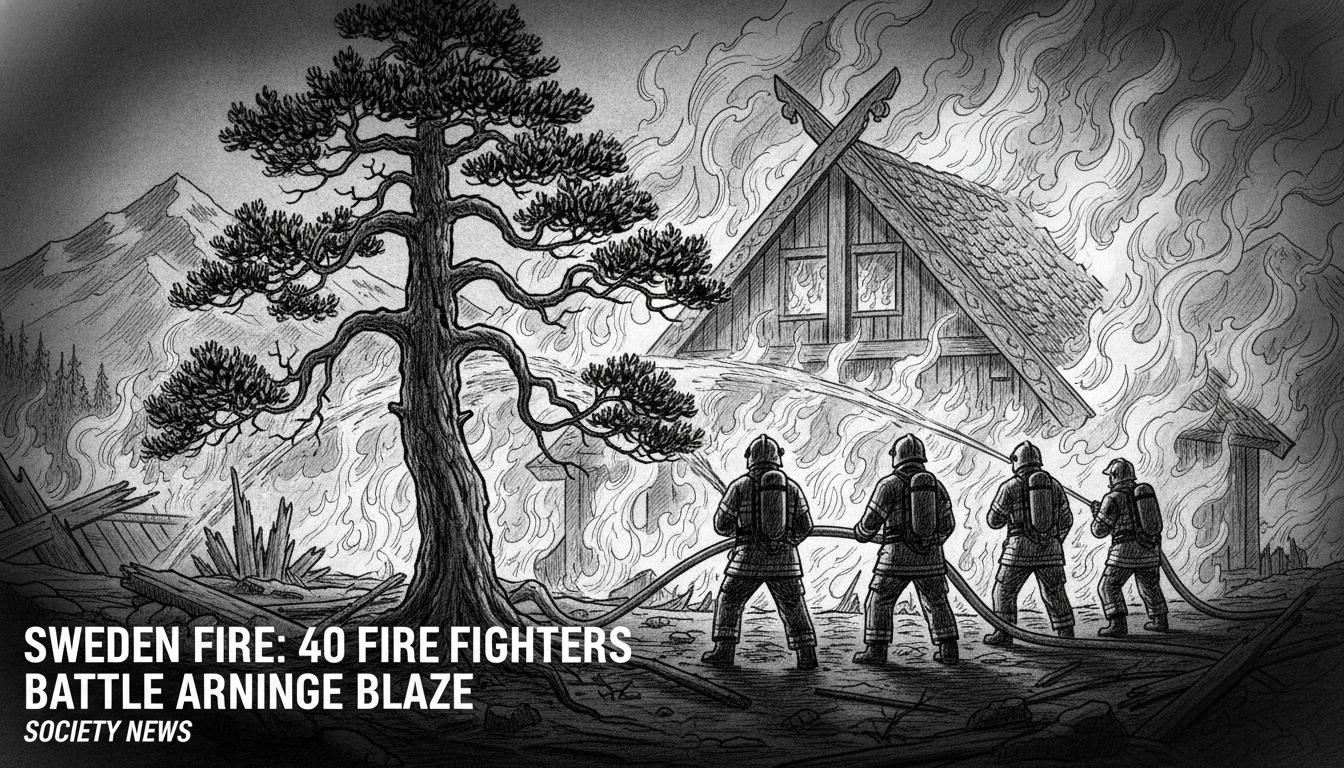
Sweden's rescue services mobilized 40 firefighters to combat a fully developed fire in an Arninge industrial building Monday morning. The blaze erupted in a ventilation room just after 8 a.m., sending flames racing across the roof of the two-story structure. Göran Norman, a command operator with the regional rescue center, confirmed the intensity. 'We're working with 40 people on site,' Norman said. 'It's burning at full pace on the roof, and this is a fairly large operation.' All occupants evacuated safely, with no injuries reported—a relief in this bustling commercial zone north of Stockholm.
Flames Engulf Arninge Industrial Zone
The fire transformed Arninge's typically orderly industrial landscape into a scene of chaos. Thick smoke billowed above the rooftops, visible from nearby residential areas in Täby Municipality. Firefighters faced a stubborn blaze fueled by building materials and ventilation systems. Industrial fires like this pose unique challenges, as ventilation rooms can accelerate spread and complicate containment. 'Several different businesses operate in the building,' Norman noted, hinting at the potential economic ripple effects. For locals, the incident disrupted the quiet Monday morning, a stark contrast to Arninge's usual rhythm of delivery trucks and commerce.
The Response: Swedish Efficiency in Crisis
Sweden's emergency response showcased its characteristic coordination. Within minutes of the alarm, crews from multiple stations converged on the scene. The 40 firefighters deployed represent a significant force, reflecting the perceived risk. Industrial zones in Sweden adhere to strict safety codes, but old buildings can harbor hidden dangers. I spoke with Lars Bengtsson, a retired fire safety inspector now consulting in Stockholm. 'Ventilation systems are common ignition points,' he explained. 'They can act like chimneys, spreading fire rapidly. In areas like Arninge, where growth has been fast, regular updates to safety protocols are crucial.' His insight underscores a tension between development and safety in Sweden's expanding suburbs.
Arninge's Evolution: From Fields to Commercial Hub
To understand this fire's context, look at Arninge's transformation. Once a rural patch north of Stockholm, it's now a mixed-use area with retail outlets, logistics centers, and offices. Täby Municipality has championed this growth, leveraging proximity to Stockholm and good transport links. But rapid development brings risks. 'You see these older industrial buildings alongside new constructions,' said Anna Forsberg, a local business owner who runs a design studio nearby. 'We've had minor incidents before, but nothing this dramatic. It makes you think about safety when everyone's rushing to expand.' Her concern echoes broader Swedish society trends, where balancing progress with tradition is a constant dialogue.
Industrial Fires: A National Perspective
Sweden averages around 500 industrial fires annually, according to national statistics. Most are minor, but a handful, like today's, require major interventions. The Swedish Civil Contingencies Agency (MSB) emphasizes prevention through regular inspections. However, in areas like Arninge, where space is at a premium, buildings may be repurposed without full safety reviews. This fire started in a fläktrum—a ventilation room—a detail that highlights maintenance gaps. 'These systems need cleaning and checks,' Bengtsson added. 'In busy industrial parks, that can fall by the wayside.' For Swedes, known for their meticulous safety culture, such oversights are unsettling.
Cultural Reflections: Community in Crisis
Swedish culture often emphasizes collective responsibility, and today's response illustrated that. Neighboring businesses offered water and support to firefighters, a small gesture rooted in the concept of 'duktighet'—competence with humility. No injuries were reported, a testament to effective evacuation plans. Yet, incidents like this ripple through community events. Arninge hosts summer markets and cultural festivals, which may now face scrutiny over safety permits. As a society & culture reporter, I see how crises test Sweden's famed 'lagom'—balance. Here, the balance between industrial growth and resident safety feels precarious.
The Human Impact: Stories from the Ground
Beyond the flames, personal stories emerge. Erik Lundström, a warehouse manager in a nearby building, watched the fire from his office. 'We heard the sirens and saw smoke. Our team evacuated immediately—it's drilled into us,' he said. His business, which imports Swedish lifestyle products, faces delays due to road closures. For immigrants working in Arninge's diverse workforce, the fire sparked anxieties. 'I came here for stability,' said Maria Gonzalez, a cleaner from Spain. 'Seeing this makes you wonder about risks.' Her voice adds a layer to Sweden immigration news, where integration often hinges on workplace safety.
Looking Ahead: Investigations and Prevention
The fire will trigger a thorough investigation by Swedish authorities. Causes could range from electrical faults to human error, with results likely in coming weeks. For Arninge, this may prompt a review of building codes in Täby Municipality. Stockholm events today often focus on sustainability, but safety must be part of the conversation. 'We'll learn from this,' said a local council member I reached by phone. 'Our priority is ensuring businesses can operate safely.' As the smoke clears, the community faces a choice: maintain the status quo or advocate for stricter controls. In a nation proud of its innovation, prevention is the next frontier.
Final Thoughts: A Wake-Up Call for Growing Sweden
This Arninge fire serves as a wake-up call. Sweden's industrial areas are economic engines, but they must not become risk zones. The successful response today shows system strengths, yet vulnerabilities remain. As Stockholm's suburbs expand, balancing development with safety will define Swedish society trends. For now, residents and workers in Arninge are grateful for no injuries, but questions linger. How can Sweden protect its commercial heartlands without stifling growth? The answer may lie in blending traditional caution with modern technology—a challenge as complex as fighting any blaze.