
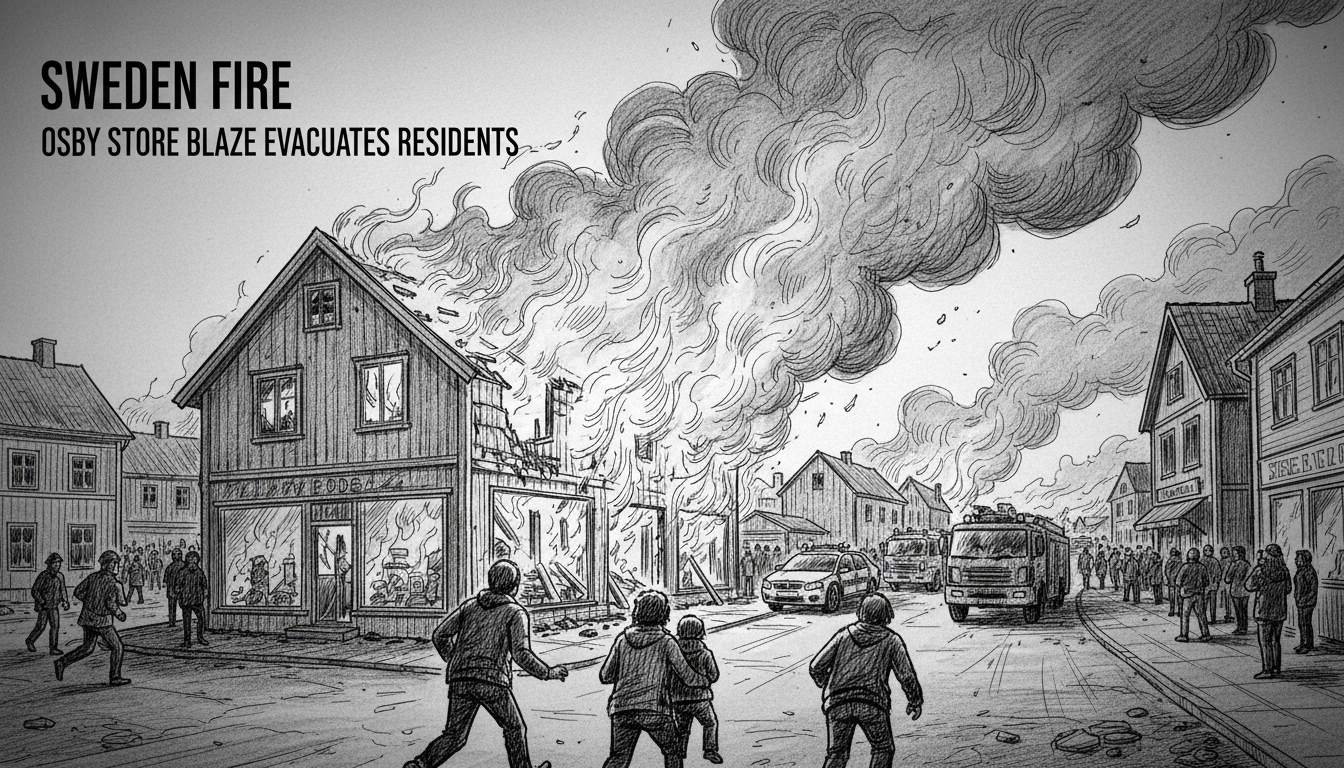
Sweden's emergency services battled a major store fire in Osby overnight, evacuating residents from apartments above the burning shop. 'We received calls about open flames in the store and we had crews from four stations on site,' said Tony Johansson, the duty officer for the Northeast Rescue Service. The incident highlights the ever-present fire risks in mixed-use buildings across Swedish towns.
Flames lit up the night sky in central Osby, a quiet municipality in Skåne County. The fire broke out in a ground-floor store located in a multi-story residential building. For the residents living above, a normal night turned into one of fear and disruption. Emergency services moved quickly to get everyone out safely. 'It was a few people who had to be checked by ambulance, but no one needed to be taken to hospital,' Johansson confirmed. The relief in his statement is palpable—a potential tragedy was avoided.
Police cordoned off the area as firefighters, including smoke divers, entered the building. By 3 AM, the blaze was fully extinguished. The cause remains unknown, leaving a charred storefront and a community with questions. This fire in Osby is not an isolated event. It serves as a stark reminder of the vulnerabilities in our built environment, where a commercial fire can instantly threaten dozens of homes.
A Night of Disruption in a Quiet Town
Osby, with a population of around 7,000, is the kind of place where news travels fast. A fire of this scale is a major event. The sight of crews from four different fire stations—a significant response for a locality of this size—would have been alarming. For the evacuated families, the night was spent in uncertainty, waiting for the all-clear, worrying about their homes and possessions. While physically unharmed, the psychological impact of being forced from your home by flames below is significant. It disrupts the fundamental sense of security a home should provide.
Local journalist Erik Månsson, who covers community events in Skåne, notes the ripple effect. 'In a town like Osby, a central store isn't just a business; it's a meeting point, part of the daily rhythm,' he says. 'A fire like this affects everyone. People worry about the business owners, their neighbors who were evacuated, and what it means for the town center.' The economic damage to the business owner is immediate and severe. For the residents, it's about more than property; it's about community cohesion being tested by a sudden crisis.
The Persistent Challenge of Mixed-Use Building Fires
This incident underscores a recurring safety challenge across Sweden and the Nordics: fire safety in mixed-use buildings. Combining commercial spaces with residential apartments is common, especially in town centers. It promotes vibrant, living communities. But it also creates complex risk scenarios. A fire that starts in a restaurant kitchen, a retail storeroom, or a workshop can rapidly threaten escape routes for those living above. Modern building codes are strict, but older buildings, which form the character of many Swedish towns, may not have the same level of compartmentalization or alarm systems.
Fire safety expert Lena Karlsson, a former fire prevention officer with the Swedish Civil Contingencies Agency (MSB), explains the priorities. 'In these situations, the first goal is always life safety—evacuation. The second is containing the fire to its unit of origin. The fact that this was brought under control without serious injury suggests the firewalls and structural protections worked as intended to slow the spread,' she says. However, she emphasizes that prevention is key. 'Regular, unannounced inspections of commercial premises are crucial. So are clear evacuation plans that everyone in the building understands, not just the residents.'
Karlsson points to common risks in retail settings. 'Faulty electrical installations, storage of flammable materials near heat sources, or neglected maintenance of ventilation systems can all be culprits. Until the Osby investigation is complete, we won't know, but these are typical focal points.'
Community Response and the Road to Recovery
The response in Osby reflects Sweden's decentralized but well-coordinated emergency system. The ability to deploy crews from multiple stations quickly is a testament to regional preparedness. For the evacuated residents, the immediate crisis has passed, but the aftermath begins. They now face the process of returning, assessing any smoke or water damage to their apartments, and dealing with insurance claims. The business owner must confront the total loss of their livelihood. The road to rebuilding a shop, both physically and commercially, is long and difficult.
Local authorities will now work with the property owner and the rescue service to investigate the cause. This is standard procedure. The findings can inform future fire prevention efforts not just in Osby, but in similar municipalities throughout Skåne and beyond. There is also a community healing aspect. In tight-knit Nordic towns, such events often lead to an outpouring of local support—fundraisers for the affected business, offers of help for displaced neighbors. This social resilience is a key part of recovery.
A Broader Look at Fire Safety in Swedish Society
While Sweden has an excellent fire safety record overall, incidents like the Osby fire prompt necessary reflection. They occur against a backdrop of ongoing national discussions about resource allocation for rescue services, especially in rural areas, and the constant need to update safety regulations for older building stock. Every fire is a live test of the system. This one, thankfully, appears to have been a test passed in terms of human safety.
For the international reader, understanding the Swedish context is important. The Swedish model relies heavily on prevention, public education, and robust building codes. The MSB runs constant awareness campaigns about smoke detectors and escape planning. The fact that the Osby evacuation proceeded without major injury suggests a level of public awareness and a effective operational response. However, no system is perfect. The unknown cause of the fire is a reminder that risk can never be fully eliminated.
As dawn broke over Osby, residents returned to their homes, greeted by the smell of smoke and the sight of fire-hose water on the streets. The store stands damaged, a blackened gap in the row of shops. The investigation will piece together the 'how.' For the community, the question now is 'what next?' How quickly can normalcy return? And what lessons can be learned to make this tight-knit town, and others like it, even safer? The open flames are out, but the work to understand and prevent the next fire is just beginning.