
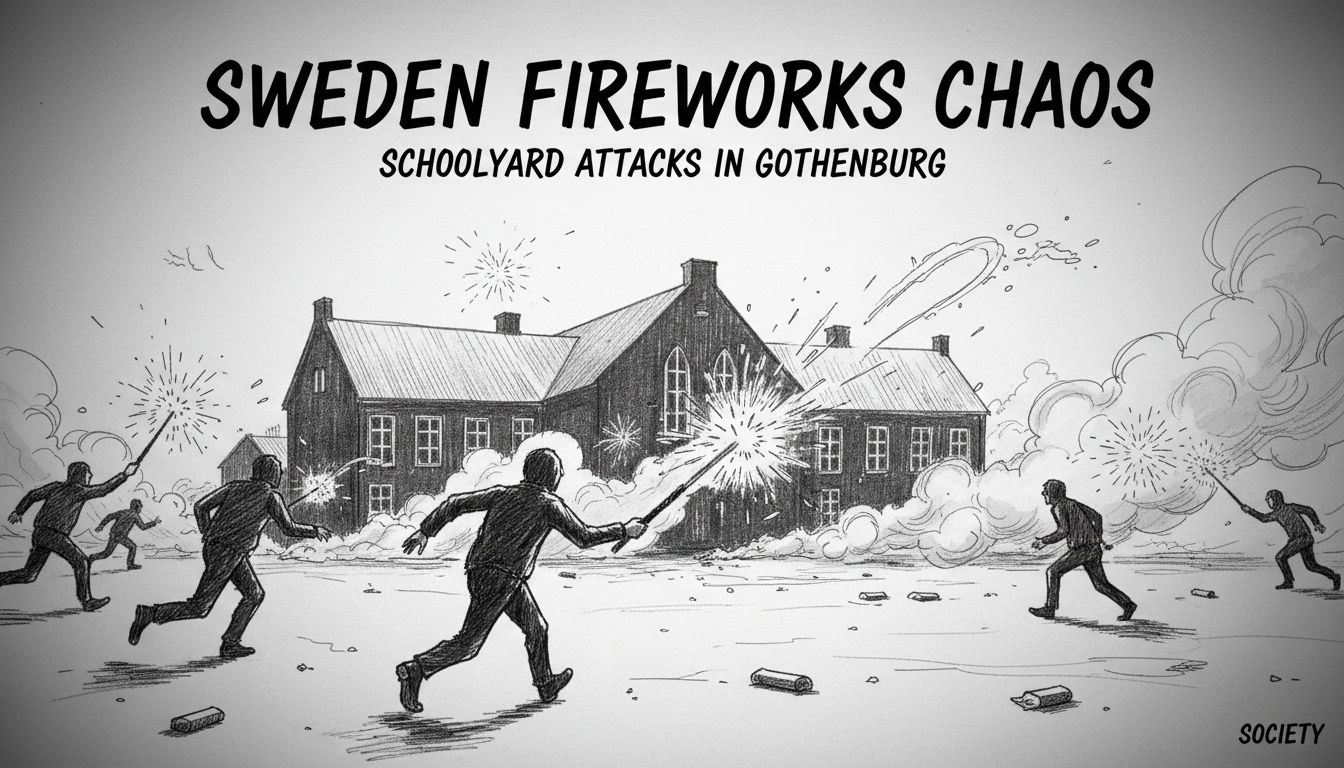
Sweden fireworks laws are being tested as the New Year approaches. In Gothenburg's Västra Frölunda district, the sound of explosions isn't just celebration. It's a nightly barrage that has turned a schoolyard into a battleground. Residents report people shooting fireworks at each other and at buildings on the grounds of Flatåsskolan. The situation has left families terrified and reignited a fierce national debate about safety, regulation, and community.
"My two-year-old and dog are scared to death every single evening," said one local resident, describing the constant fear. The police have received multiple alarms in recent weeks about individuals firing pyrotechnics at both people and property. This isn't isolated revelry. It's a dangerous escalation that transforms a place of learning into a zone of conflict.
A Disturbing Trend in Urban Sweden
The incident at Flatåsskolan is not an anomaly. Gothenburg, Sweden's second city, has grappled with illegal and dangerous firework use for years, particularly in its suburbs. Reports to police typically surge in the weeks before December 31st. But what was once seen as noisy, youthful mischief is increasingly viewed as a serious public safety issue. The act of aiming fireworks at another person moves the behavior from disturbance to potential assault.
A 2022 report by the Swedish National Council for Crime Prevention (Brå) provided crucial context. It found that public disturbances involving fireworks are more common in socioeconomically disadvantaged areas. This statistic is often at the heart of the complex discussion. Is it simply a law enforcement problem, or a symptom of deeper social challenges? For the parent trying to calm a frightened toddler, the distinction matters less than the immediate need for safety and quiet.
The Tightrope of Swedish Pyrotechnic Policy
Swedish law walks a careful line with fireworks. Private use is heavily restricted for most of the year, permitted mainly during the official New Year period, usually from December 31st to January 1st. Individuals generally need a permit outside this window. This system aims to balance a cherished cultural tradition—the luminous, noisy welcoming of the new year—with public order and safety.
Yet, as the Flatåsskolan case shows, regulations are only as strong as their enforcement. "The rules are clear, but the resources to police every schoolyard and housing estate are finite," notes a public safety analyst familiar with Gothenburg. The available fireworks are also increasingly powerful, sometimes entering the country illegally, making the traditional consumer rockets seem tame by comparison. This creates a perfect storm: easily available explosives, a permissive cultural moment, and urban spaces where oversight is limited.
Community Fear and the Call for Change
The human impact is profound and personal. Imagine living near that school. The early winter darkness in Sweden is deep and long. The sudden, violent bang of a firework is not a celebration but a shockwave of fear. It shatters the peace, wakes sleeping children, and terrifies pets. For residents, it represents a loss of control over their immediate environment, a fundamental breach of the sense of security that is a cornerstone of Swedish society.
This fear is fueling a political and municipal push for stricter measures. Several Swedish towns and cities have debated outright bans on private fireworks, advocating for organized public displays instead. Proponents argue this would improve safety, reduce garbage, and lessen the distress for veterans, pet owners, and wildlife. Opponents see it as an overreach, a removal of personal freedom and a fun family tradition. The debate often splits along urban-rural lines, with cities bearing the brunt of the misuse.
Beyond Policing: Seeking Root Causes
Experts urge looking beyond simple enforcement. Sociologists point to the need for community engagement, especially with young people. "When you feel disconnected from a place, you have less respect for it," one researcher explained. "A schoolyard is a symbol of the community. Attacking it, even with something seen as a toy, is a powerful act of alienation." Initiatives that provide alternative activities and foster a sense of ownership in neighborhoods are cited as crucial long-term strategies.
Police strategy often involves targeted presence in known hotspot areas during the pre-New Year period. But it's a reactive game of cat and mouse. The challenge, as seen in Västra Frölunda, is that the problem is diffuse and opportunistic. It doesn't stay in one designated "problem" area; it erupts in spaces that should be safe, like a school after hours.
The Stockholm Perspective and National Ripples
While this incident is centered in Gothenburg, the issue resonates across Sweden. In Stockholm, discussions about fireworks are equally heated. The noise pollution in dense city neighborhoods is intense. Every year, emergency services deal with preventable injuries. The sight of teenagers setting off rockets in Stureplan or a square in Södermalm is common, but the mood is shifting from annoyance to genuine concern for safety.
Swedish lifestyle has long accommodated the New Year's bang. But the cultural tolerance is wearing thin. The conversation is evolving from "how do we manage this tradition?" to "is this tradition still worth the cost?" The image of fireworks being used as weapons in a schoolyard accelerates that shift dramatically. It strips away any romantic notion of celebration and reveals a tool for intimidation and chaos.
What Happens Next for Flatåsskolan?
The immediate need is for peace around Flatåsskolan. This will likely fall to local police to increase patrols and respond swiftly to alarms. The school itself may need to review its security after hours. But the long-term solution is less clear-cut. Will Gothenburg follow other municipalities and push for a local ban? Will national laws be tightened, perhaps raising the age limit for purchase or banning the most powerful categories?
For the resident with the terrified two-year-old, change cannot come soon enough. Their story is a microcosm of a national dilemma: how to preserve joy and tradition while protecting the fundamental right to safety and peace. As 2026 draws nearer, the explosions in that dark schoolyard are sounding an alarm far beyond Västra Frölunda. They are a stark reminder that sometimes, the lights in the sky are preceded by fear on the ground. The question for Sweden is whether the familiar New Year's ritual needs a serious rewrite, before someone gets seriously hurt.