
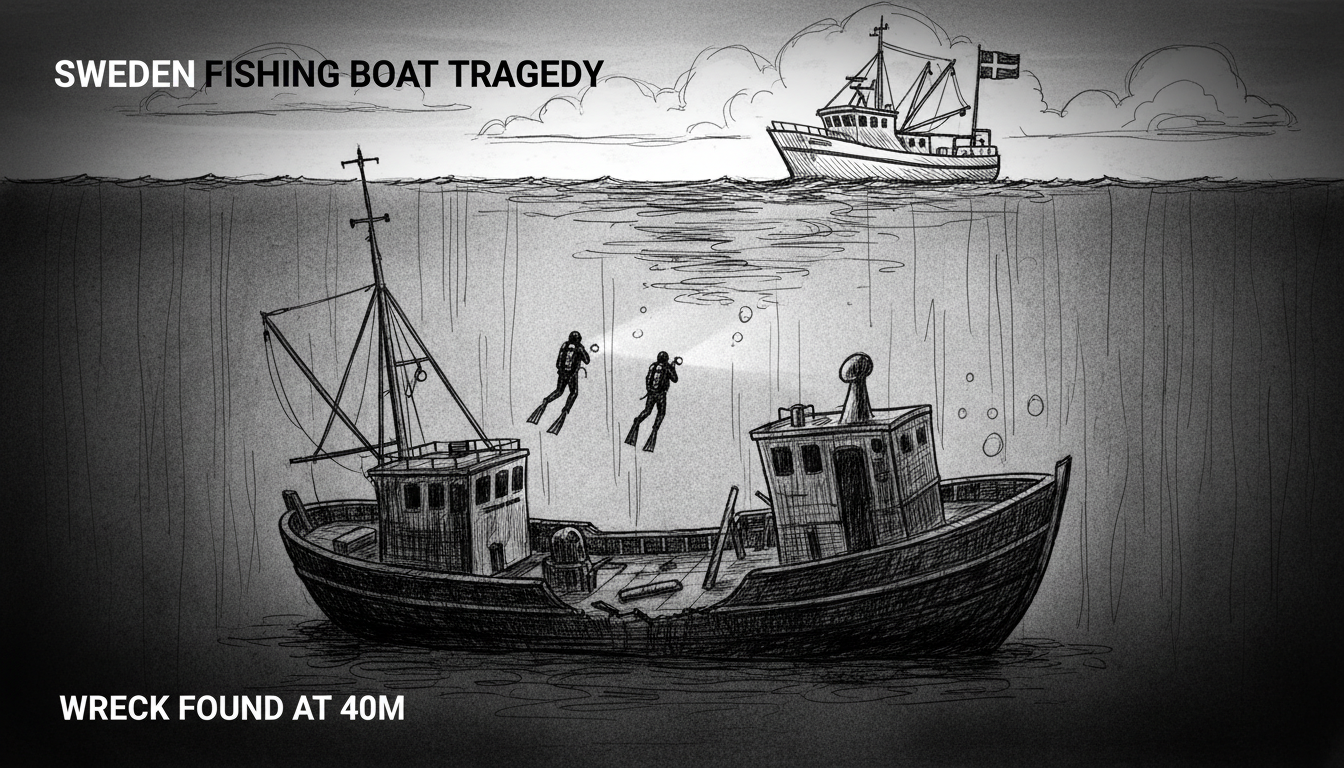
Sweden's coast guard has located a missing fishing boat at a depth of 40 meters, concluding a tragic search for two professional fishermen who vanished on Christmas Day. The vessel was found in the archipelago south of the industrial port town of Oxelösund, a community where maritime life and risk are deeply intertwined. The discovery brings a grim resolution to a holiday search that has gripped the local fishing community and highlighted the enduring dangers of the profession, even in a nation with advanced maritime safety systems.
A Christmas Day Disappearance
The two men, both in their sixties and known as experienced professionals, set out from Oxelösund on December 25th. They never returned. Their disappearance triggered an immediate response from the Swedish Coast Guard, launching a search operation in the challenging winter conditions of the Baltic Sea. The fact that they were seasoned fishermen, not casual boaters, adds a layer of somber complexity to the incident. It suggests that even profound skill and local knowledge can be overcome by the sea's unpredictable power. The community, where many make their living from the water, waited anxiously for news throughout the holiday period.
"We continue the work with cooperating authorities to clarify what happened in connection with the tragic accident," said Hanna Bühler, the officer in charge at the Coast Guard's command center. This formal statement underscores the shift from search and rescue to investigation and recovery. The boat's location, at nearly 40 meters (over 130 feet), presents significant technical hurdles. At that depth, light is scarce, pressure is immense, and any recovery operation becomes a delicate, potentially dangerous undertaking for salvage teams. The vessel's fishing trawl was also found at the same site, a detail that investigators will scrutinize for clues.
The Risks Beneath the Surface
While Sweden has an excellent maritime safety record, this tragedy is a stark reminder that fishing remains one of the world's most hazardous occupations. The waters around Oxelösund, part of Sweden's vast and intricate archipelago, can be deceptively treacherous. Winter brings short days, freezing temperatures, and sudden storms. An equipment failure, a rogue wave, or an entangled net can swiftly escalate into catastrophe. Maritime safety experts point to the 'man overboard' scenario as a critical risk for small crews; if one person falls into frigid water, the other faces an almost impossible rescue task alone, potentially leading to a cascading disaster.
Oxelösund itself is a town built around its deep-water port, a hub for steel and industry where fishing has long been a cultural and economic cornerstone. The local identity is tied to the sea. News of such a loss resonates deeply here, far more than it might in an inland city. It strikes at the heart of a community that understands the sea's dual nature: provider and reaper. There is an unspoken bond among those who work on the water, a collective understanding of the risks accepted every time a boat leaves the harbor. This shared context makes the loss of two of their own a profound collective grief.
The Long Road from Discovery to Answers
With the wreck located, the focus turns to a painful process. Authorities must now determine if and how to recover the boat from its deep resting place. A salvage operation at 40 meters is not a decision taken lightly; it requires specialized equipment, favorable weather windows, and a clear investigative or legal purpose. The Swedish Accident Investigation Board will be deeply involved, analyzing weather data, vessel maintenance records, and communication logs. Their goal is not to assign blame, but to understand the sequence of events to improve future safety for all mariners.
This investigative phase is meticulous and slow. It can take months or even years for a final report to be issued. For the families of the fishermen, this wait for official answers is an additional burden on top of their immediate grief. They are left with the haunting questions of 'how' and 'why' that may never be fully answered. The community, meanwhile, will likely hold a collective memorial. In Swedish coastal towns, it is common to see wreaths laid by the harbor or a moment of silence observed at the local fishermen's association.
A Culture Grappling with Inherent Danger
This incident touches on a central paradox in Swedish society's relationship with nature. Sweden prides itself on a 'folkhemmet' or people's home ideal of safety and security, with robust state systems to protect its citizens. Yet, certain professions, like fishing and forestry, inherently defy this total security. The state can regulate, inspect, and equip, but it cannot tame the sea or the storm. This tragedy shows the limits of control, a humbling reminder in a technologically advanced nation. It sparks conversations in fik (coffee breaks) and community halls about safety gear, emergency beacons, and check-in protocols, debates fueled by loss but aimed at prevention.
Swedish maritime culture is one of respect, not conquest. There’s a saying along the coast: 'Havet ger, och havet tar.' The sea gives, and the sea takes. This fatalistic wisdom doesn't diminish the pain of loss, but it frames it within a centuries-old narrative. The fishermen lost were part of a tradition that sustains Sweden's famous culinary culture—providing the herring, salmon, and shellfish that grace midsummer tables and Christmas feasts. Their work is essential, yet its dangers often remain out of sight for the average Swede enjoying fish from a supermarket.
As the investigation proceeds quietly in the background, life in Oxelösund continues, marked by this loss. The port's cranes will still swing, other boats will still head out at dawn, but with a renewed, heavy awareness. The ultimate legacy of such tragedies often manifests in small, concrete changes: a family insisting on a better life jacket, a boat owner upgrading his radio, a community fundraising for a new safety seminar. The sea will not become safer, but the people who work upon it can be better prepared. For now, a coastal community mourns two of its own, a reminder that even on a silent, snowy Christmas, the Baltic Sea demands the utmost respect.