
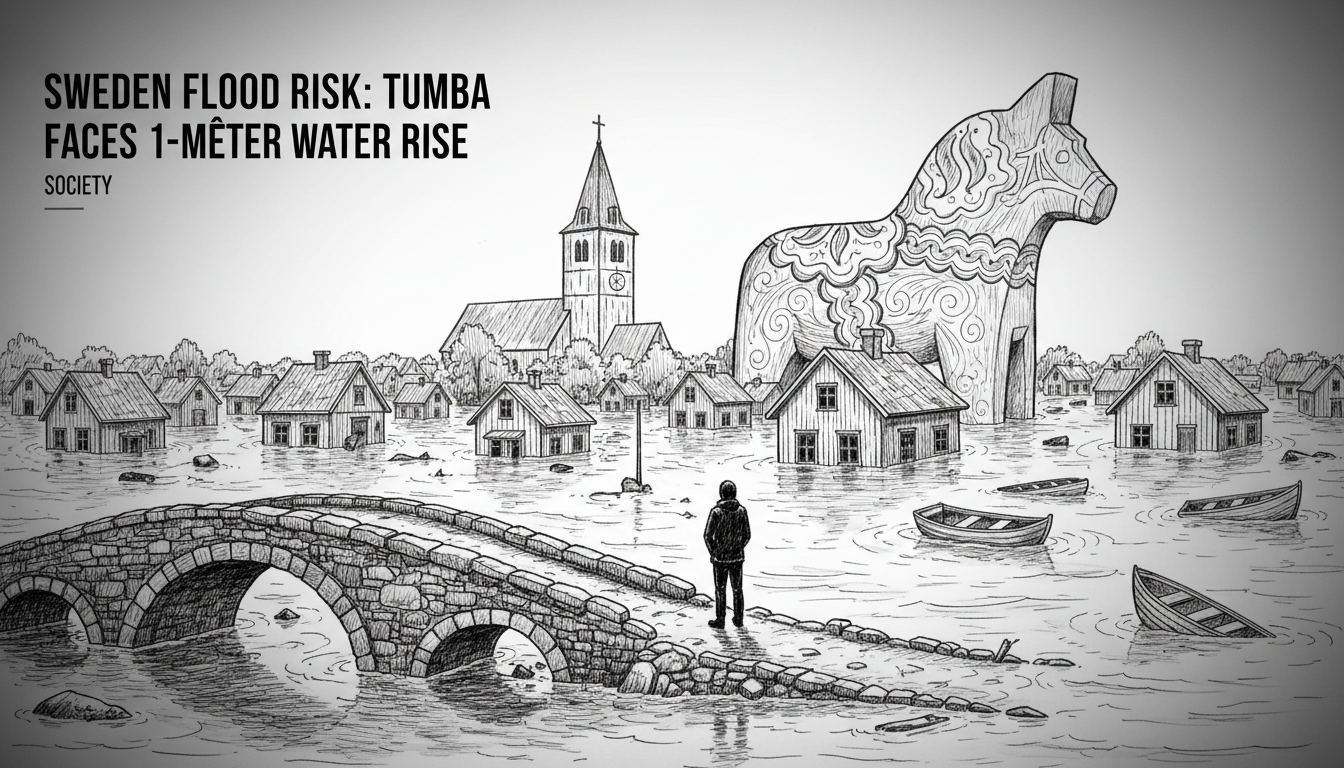
Sweden flooding risks are being recalculated across the Stockholm region. A new climate model suggests parts of Tumba could be submerged under a meter of water. The finding has forced Botkyrka Municipality to reconsider years of planning. It highlights a growing challenge for Swedish towns built on low-lying, water-rich land.
“We realized we might have used an older model,” said municipal planner Fredrik Holmgren. He was discussing a recent project near Tullinge station. “That led us to conclude we need to re-examine the situation in Tumba too.” The older model underestimated potential water flow during extreme rain. The new ‘skyfallsmodell’ from Sweden’s Civil Contingencies Agency (MSB) paints a wetter, more alarming picture.
For longtime residents, the news is unsettling but not entirely surprising. The Tumba valley, lying above Sven Tumbas Park, has long been known as ‘vattensjuk’ – water-sick. The area sits low in the landscape. It has a natural tendency to flood. Now, climate change promises more intense cloudbursts. What was once a manageable nuisance could become a severe threat to homes and infrastructure.
A Community Built on a Stream
Tumba’s relationship with water is fundamental. The Tumbaån stream winds beneath the community, buried in a culvert for decades. This was a common post-war solution. It tidied away natural waterways to make room for expansion. But it also created a vulnerability. During heavy rain, the buried stream can quickly exceed its capacity. Water has nowhere to go but up and out into streets and basements.
“We’ve always known this area is damp,” said Karin Lindström, who has lived in central Tumba for 40 years. “My cellar has gotten wet before. But a meter of water? That’s a different story. That’s cars floating away.” Her concern echoes through the neighborhood cafes and social media groups. The abstract concept of climate change is becoming a tangible, local planning issue.
From Old Models to New Realities
The shift from the old hydrological model to the MSB’s new cloudburst model is significant. It represents Sweden’s accelerating effort to understand a changing climate. The old data might have informed drainage pipes and curb heights. The new data demands a reimagining of the landscape itself. Municipalities across Mälardalen are facing similar recalculations.
“This isn’t just about bigger pipes,” explained environmental scientist Lisa Pettersson, who consults on urban water issues. “The old engineering approach is hitting its limit. The new models show us that extreme events will overwhelm gray infrastructure. We need to work with nature, give water space. That’s the paradigm shift.” For Tumba, this shift means reconsidering a central proposal: unearthing the Tumbaån.
The Stormwater Park Proposal
Back in 2018, a study proposed a radical solution. It suggested creating a stormwater park in Sven Tumbas Park. The core idea was to daylight the Tumbaån. This means bringing the buried stream back to the surface. The park would be designed to temporarily hold and absorb floodwater during heavy rains. It would be a functional green space, a flood defense, and a restored natural habitat.
The 2021 investigation into flood risks was meant to refine this plan. It looked at various measures to protect the northern part of central Tumba. Now, with the new model’s findings, that entire investigation may need a complete overhaul. The baseline risk has changed. The solutions may need to be more extensive and more expensive.
“A stormwater park is a good example of blue-green infrastructure,” Pettersson noted. “It’s not just a hole in the ground. It’s a designed ecosystem that manages water, increases biodiversity, and provides recreation. But its size and capacity depend on the data you feed into the design. If the risk is higher, the park needs to be bigger or work in tandem with other measures.”
The Cost of Climate Readiness
The big question for Botkyrka Municipality is one of resources. Re-doing studies and upgrading plans costs money. Actually building large-scale climate adaptation infrastructure costs much more. This comes at a time when many Swedish municipalities face tight budgets. There is a tension between immediate needs and long-term resilience.
Holmgren, the planner, acknowledges the challenge. “It’s frustrating to think work may need redoing,” he said. “But it’s essential. Building something based on outdated risk is a waste of money. It’s better to pause and get it right.” The municipality must now weigh the updated risks. They must engage with residents about potential solutions and disruptions. A project to daylight a stream and build a park is complex. It involves digging up roads, redirecting utilities, and years of construction.
A Broader Stockholm Story
Tumba’s dilemma is a microcosm of the wider Stockholm region’s struggle. From Hökarängen to Haninge, suburbs built on clay and near water are at risk. The MSB’s updated models are likely to reveal similar vulnerabilities elsewhere. The story moving forward will be about prioritization. Which areas get protected first? Who pays?
For Karin Lindström and her neighbors, the abstract has become concrete. Their quiet suburb is on the front line of Sweden’s climate adaptation. The view from their windows might one day include a renaturalized stream winding through a park designed to flood. It is a vision of a future where water is a visible guest, not a hidden threat.
The path there is filled with technical reports, public consultations, and political decisions. It starts with accepting a hard new number: one meter of potential water. That measurement will now shape everything that comes next for Tumba. It is a number that connects a local neighborhood to global climate patterns. It turns a community’s relationship with its own land into a national case study in survival and adaptation.