
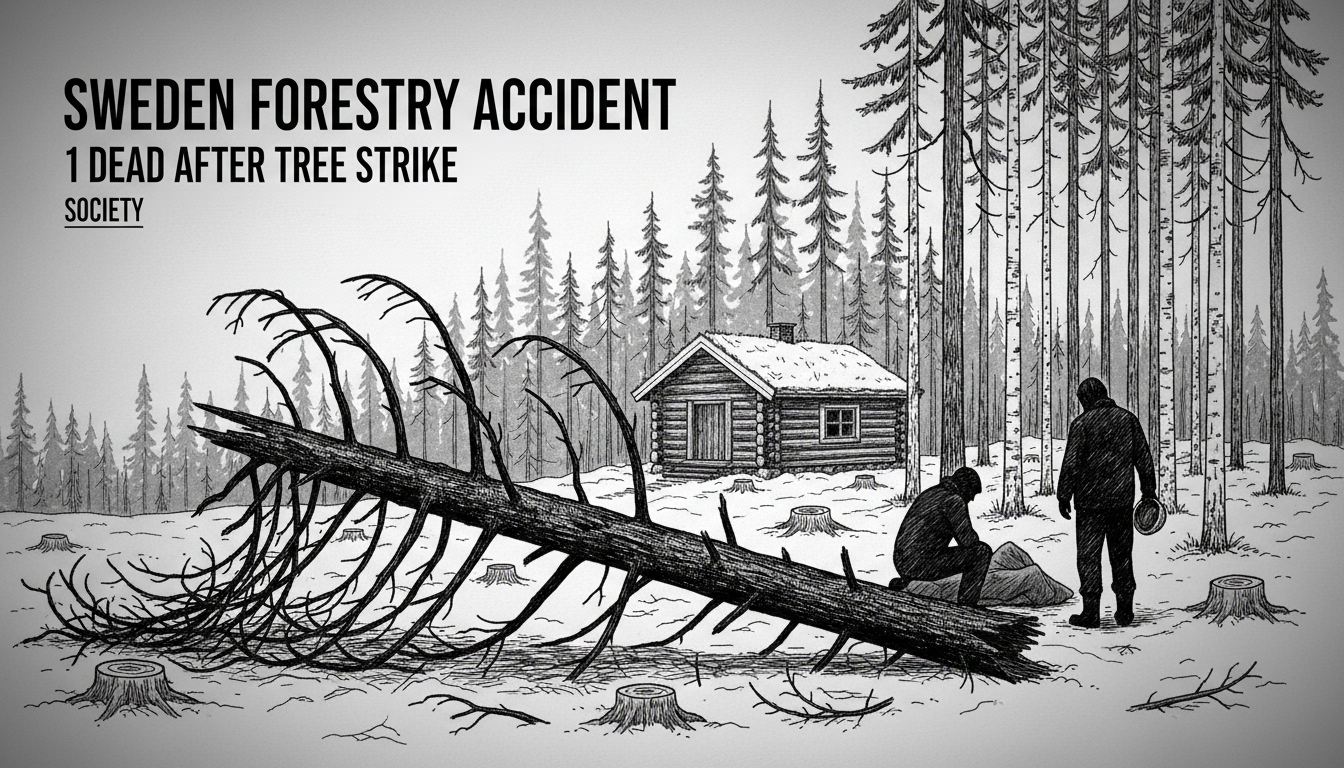
Swedish forestry has one of the world's highest rates of serious workplace accidents despite stringent regulations. A man in his sixties lost his life this week after a tree fell on him while he was working in a forest. The tragic event occurred on Tuesday afternoon. Police were alerted around 5 p.m. after someone found the man’s tractor with its engine still running, a silent witness to the sudden incident. A search operation involving multiple patrols, a dog unit, and a drone was launched. After several hours, the man was located. He was transported to a hospital but could not be saved. No crime is suspected, and his next of kin have been notified. This fatality casts a sobering light on the inherent dangers of an industry foundational to the Swedish economy and identity.
A Silent Forest and a Running Engine
The scene that greeted responders was hauntingly ordinary. A tractor stood alone in a wooded area, its engine a persistent hum against the quiet of the forest. The operator was missing. This detail—the running engine—immediately signaled that something was terribly wrong. It suggests a sudden, unforeseen event that interrupted a routine workday. For the search teams, it painted a picture of an accident that happened in an instant. The use of drones and dogs underscores the challenging, often dense terrain where forestry workers operate. These are not easily accessible places. The successful yet grim conclusion of the search after hours highlights both the efficiency of the response and the severe nature of the incident. The man, whose identity has not been publicly released, was a professional doing his job in an industry that employs tens of thousands across Sweden.
The Inherent Risk Among the Trees
Forestry is a pillar of the Swedish economy, contributing approximately 0.5% to GDP and supporting countless rural communities. Sweden is a global leader in sustainable forest management, with strict laws protecting biodiversity and ensuring regrowth. Yet, the fundamental act of harvesting trees remains perilous. According to the Swedish Work Environment Authority (Arbetsmiljöverket), the forestry and logging sector consistently reports a higher rate of serious accidents compared to the national average across all industries. Workers operate heavy machinery like harvesters and forwarders on uneven ground. They manually assess, cut, and process massive trees, often in isolation. Factors like wind, hidden rot in a tree, slippery terrain, or simple fatigue can turn a calculated action into a fatal mistake. This accident, while under investigation, fits a known pattern of tree-related strikes, one of the industry's most feared hazards.
Safety Culture and the Human Factor
‘We have the rules, the technology, and the training. The challenge is the unpredictable environment and the human factor,’ says Lars Jansson, a retired forestry safety instructor from Värmland. He explains that Swedish forestry safety protocols are exhaustive. They mandate protective gear, safe distances, and detailed risk assessments before any work begins. ‘But a forest is not a factory floor,’ Jansson notes. ‘The tree you are felling can have a hidden crack. The wind can change direction. You can be as skilled as possible, and still face a moment of pure chance.’ This perspective is crucial for understanding such tragedies. They are not necessarily failures of regulation but reminders of nature's volatility. The industry continuously works to improve, incorporating better cabin protection on machines, enhanced communication devices for isolated workers, and more robust training. Yet, the core reality persists: forestry is dangerous work.
A Community Feels the Loss
In small towns and rural villages where forestry is a way of life, an accident like this reverberates deeply. It is not just a statistic for the Work Environment Authority; it is a neighbor, a friend, a member of the local volunteer fire department. ‘Everyone knows someone who works in the forest,’ says Anna-Karin Berg, who runs a café in a forestry-dependent community in Dalarna. ‘When something like this happens, the entire community holds its breath. We know the risks these men and women take to provide for their families and keep our industry running. There’s a profound respect, and now, a shared grief.’ This collective impact is a significant part of the story. The notification of the family is a formal procedure, but the support that will follow—from neighbors, employers, and the union—is part of Sweden's strong social fabric. The victim was likely a member of the Swedish Forest Industries Federation or a local cooperative, structures that provide support beyond the workplace.
The Statistical Reality and the Path Forward
While individual fatal accidents are relatively rare, the statistical trend is clear. The forestry sector's accident rate remains stubbornly high. Each fatality triggers a mandatory investigation by the Work Environment Authority to determine the cause and identify potential preventive measures for the future. These findings often lead to updated guidelines or new safety recommendations. Experts argue for greater investment in automation, like remotely operated machinery, to remove workers from the most dangerous zones. They also emphasize the need for mental health and fatigue management, as long hours in demanding conditions can impair judgment. The conversation in the wake of this accident will inevitably turn to these points. How can one of Sweden’s most iconic and important industries become safer? Is the goal of zero fatalities achievable, or is a certain level of risk an accepted part of the profession? These are difficult questions with no easy answers.
An Unavoidable Dialogue About Risk
This tragedy forces a national dialogue Sweden has had before. It’s a dialogue between economic necessity and human safety, between technological advancement and nature’s unpredictability. The country is justifiably proud of its sustainable forestry model, a key part of its green transition and export economy. Yet, that model is built on the labor of individuals who face genuine physical danger. As the industry promotes its climate-friendly wood products abroad, it must simultaneously look inward at the welfare of its own workforce. The man who died this week was part of this essential chain. His loss is a stark reminder that behind the statistics of GDP and cubic meters of timber, there are human stories. It challenges the industry, regulators, and society to continually ask: Are we doing enough? The search teams have left the forest. The tractor’s engine is silent. But the conversation about how to better protect those who work among Sweden’s millions of trees is one that must continue, with urgency and respect.