
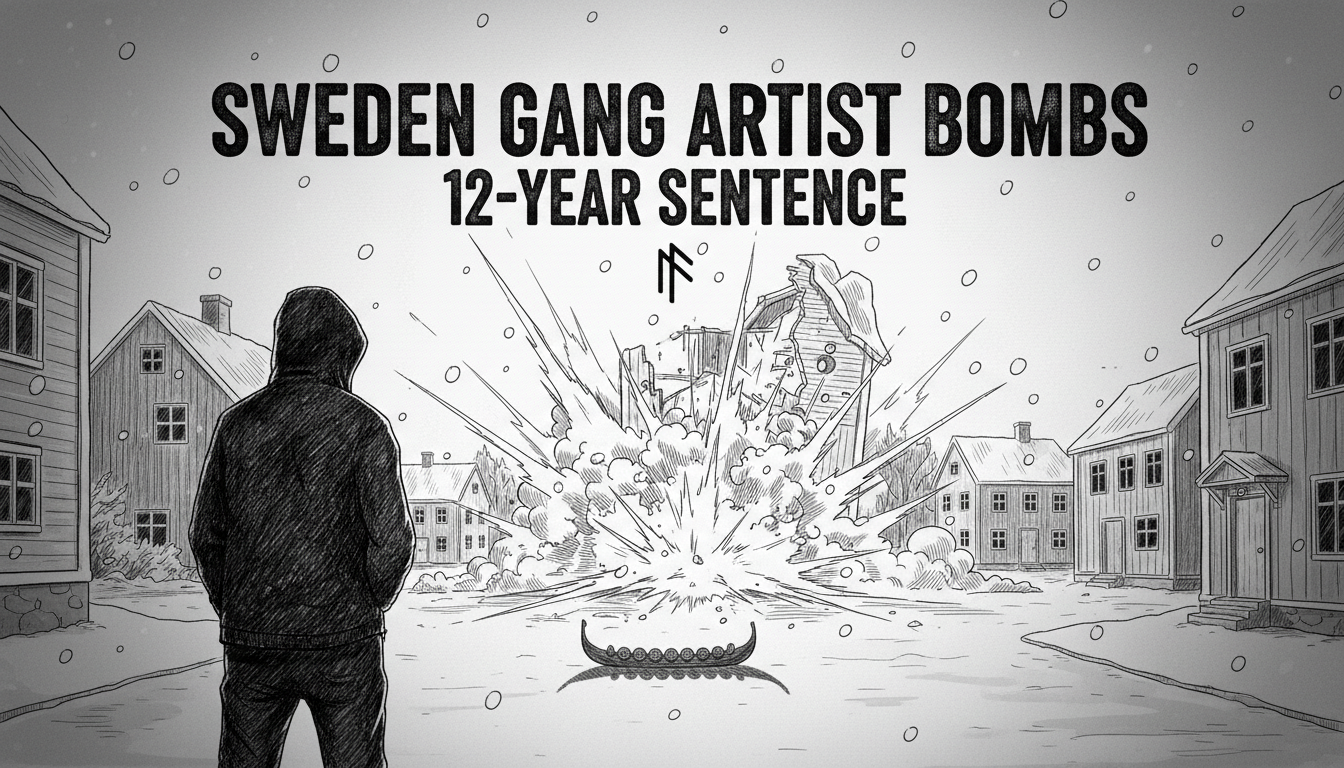
Swedish gang violence has taken a dark turn into the world of aspirational youth culture, as a 21-year-old man was sentenced to 12 years in prison for recruiting a minor to carry out a bombing. The case, centering on a failed rap career and an attack in Gothenburg's Hammarkullen suburb, highlights the disturbing methods used to ensnare young people in Sweden's ongoing conflict between criminal networks.
A Dream Deferred in a Gothenburg Courtroom
The Gothenburg District Court heard a story that has become tragically familiar, yet with a new, cultural twist. A young man, whose ambitions were pinned on a breakthrough as a recording artist, saw his musical dreams evaporate. Instead of crafting lyrics in a studio, he was found guilty of orchestrating a bombing by a child. The explosive device was detonated in Hammarkullen, a suburb north of Gothenburg known for its strong community spirit but also its struggles with socio-economic challenges. "It represents a chilling evolution in recruitment tactics," a local social worker, who asked not to be named due to safety concerns, told me. "They don't just offer money or status anymore. They sell a lifestyle, an identity, wrapped up in music and flashy cars."
From Microphone to Manipulation
Court documents revealed the 21-year-old's parallel pursuits. While working on his music, he was deeply embedded in gang activity. His strategy for advancing within that world involved exploiting someone even younger and more vulnerable. The minor he recruited was tasked with executing the bomb attack. In a separate but related incident, the older man was also convicted for possessing a firearm found hidden in bushes in Slottsskogen, Gothenburg's vast central park. This juxtaposition—between the creative pursuit of rap and the brutal reality of weapon caches in a family-friendly park—struck many as a stark symbol of the conflict within Swedish society. The sentence, 12 years, reflects Sweden's stringent laws against using minors in crime, but community leaders ask if prison alone solves the attraction of the gang lifestyle.
The Echo in Hammarkullen's Streets
Walking through Hammarkullen today, the scars are not always visible. Children play in the squares, and the iconic concrete housing from the Million Programme era bustles with life. But residents speak of an underlying tension. "We heard the blast. Everyone did," said Farid, a long-time shopkeeper in the area. "It’s not the first time and, sadly, I fear it won’t be the last. These boys are our boys. They go to our schools. Their families are our neighbors. When they are pulled into this, it breaks the whole community." The 2021 report from the Swedish National Council for Crime Prevention (Brå) supports this localized view, finding gang-related crime is increasingly concentrated in specific geographic areas and involves younger individuals. For 2023, national police statistics recorded 391 shootings, with 41 people killed, numbers that feed a pervasive sense of insecurity.
The Cultural Allure of the Gangster Persona
Experts point to a dangerous synergy between digital youth culture and criminal recruitment. The archetype of the successful gangster-rapper, flaunting wealth and power, is a potent global export. In Swedish suburbs, where feelings of exclusion can run high, that image can be dangerously seductive. "It's about belonging, respect, and a quick path to what society tells them is success," explains Dr. Lena Korsell, a researcher specializing in organized crime. "When legitimate roads feel blocked—by discrimination, by lack of opportunity—the illegitimate road, packaged as cultural rebellion, can seem attractive. Addressing this requires more than police. It requires schools, social services, and the music industry itself to provide alternative narratives and real economic pathways." This case is a extreme example: the suspect wasn't just influenced by the image; he tried to become it, funding his climb through violence.
A Society at a Crossroads
The response in Sweden has been a mix of hardened legal measures and urgent social debates. The government has tightened laws and given police greater powers. Yet, there is growing acknowledgment that a purely punitive approach is insufficient. Community initiatives in places like Hammarkullen focus on early intervention, mentorship, and creating safe spaces for youth. The challenge is immense, requiring a sustained commitment to integration, housing policy, and job creation in vulnerable areas. As one youth outreach worker in Angered, the district containing Hammarkullen, put it: "We are fighting for the very soul of our young people. The gangs offer a twisted family. We must offer a real one, with real hope."
Can the Rhythm Change?
The 21-year-old’s 12-year sentence closes a legal chapter. But the broader story continues to unfold in Sweden's suburbs. His case forces uncomfortable questions about how Sweden nurtures its diverse youth and counters the narratives that lead them astray. As the Swedish summer light lingers over Slottsskogen, where a gun was once hidden, and over Hammarkullen, where a bomb once shook the community, the work of mending the social fabric continues. The dream of a music career used as a lure for violence stands as a cautionary tale. The hope now is that other young talents find their stage without ever stepping into a courtroom."