
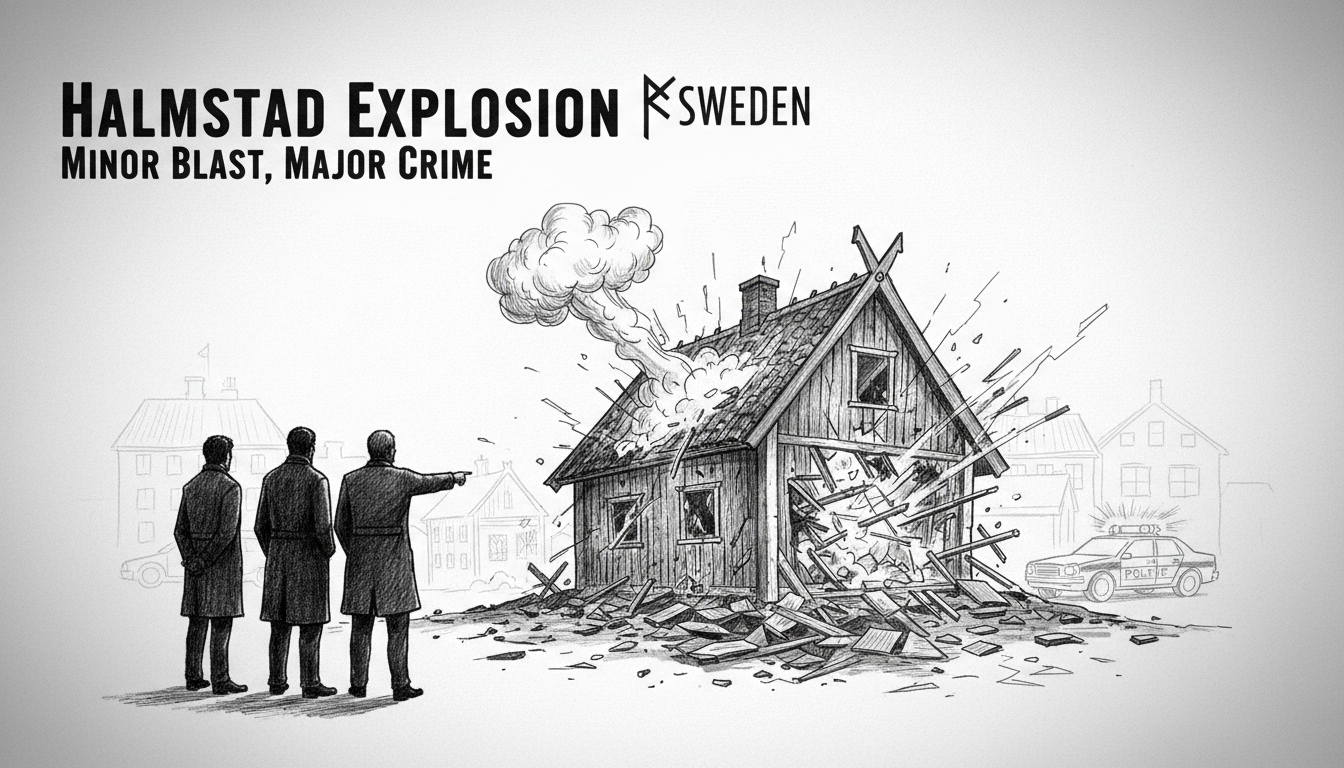
Sweden police are investigating a minor explosion in Halmstad as a serious case of public endangerment. The incident occurred at a residential doorway on Tuesday night, caused by an ignited plastic bottle filled with gasoline. No one was injured and the small fire was quickly put out with snow, but authorities have filed a report for allmänfarlig ödeläggelse, a crime with potentially severe penalties.
"It resulted in a small puff of smoke and a minor fire that could be extinguished with snow," said duty officer Göran Carlbom in a statement. The event, reported to emergency services at 22:30, caused no physical damage to people or the property. Yet the intent behind the act transforms it from a harmless prank into a significant criminal investigation. This quiet Tuesday night in a coastal city now highlights the fine line between a disruptive act and one that threatens public safety.
A Coastal City's Unusual Disturbance
Halmstad, a city of about 70,000 on Sweden's scenic west coast, is better known for its long beaches, golf courses, and the Nissan river than for explosions. The summer tourist hub was deep in a typical winter quiet when the blast occurred. Incidents like this are rare here, which makes the police response notably swift and serious. The choice of location—a residential doorway—immediately raises questions about motive. Was it targeted, random, or an attempted act of intimidation? Police have not released details about potential suspects or a specific motive, focusing first on securing the scene and documenting the crime.
Local residents I spoke to in the area, who asked not to be named, expressed more confusion than fear. "You hear about things in the bigger cities, but not here, not like this," one neighbor remarked. The use of a simple, improvised device—a PET bottle and gasoline—suggests an act of opportunity rather than sophisticated planning. Yet its simplicity is also what makes it concerning to law enforcement. The materials are easily accessible, and the potential for a much worse outcome, especially if near other flammable materials or in a different context, was very real.
The Weight of 'Allmänfarlig Ödeläggelse'
The legal classification is crucial here. In Sweden, the crime of 'allmänfarlig ödeläggelse' (public endangerment) is governed by Chapter 13 of the Penal Code. It covers acts that create a tangible risk to the safety of people or property, including causing explosions, fires, floods, or collapses. The key element is the danger posed to the public, not necessarily the scale of the actual damage. A prosecutor must prove that the act could have caused significant harm. This means the Halmstad incident will be evaluated not just on the minor outcome, but on the inherent risk created by igniting an explosive device, however crude, at an apartment building entrance.
Legal experts note that penalties can vary widely. For less severe cases, it might result in a fine or a short prison sentence. If the act is deemed gross, or if intent to cause widespread damage can be proven, sentences can reach up to ten years imprisonment. The investigation will now work to establish the perpetrator's intent. Was it a reckless act by youths, a targeted message, or something else entirely? The answer will directly shape the potential charges. "The law focuses on the risk," explains a Stockholm-based legal scholar I consulted. "A small explosion in a stairwell poses a clear risk to inhabitants and the building's structure. The fact that it was easily extinguished is fortunate, but legally secondary to the initial criminal act."
Community Safety in Focus
This event, while minor in its physical effects, touches a nerve in Swedish society. It intersects with ongoing public conversations about safety, disorder, and the sense of security in residential areas. In recent years, debates have often centered on explosions linked to gang conflicts in major urban areas. This incident in Halmstad is distinct in its scale and context, but it inevitably brings those broader anxieties to the fore in a smaller community. The police response, treating it with high seriousness, is a signal to the public that such acts will not be minimized.
Local authorities are likely to review security in the area, though no general threat has been indicated. The immediate aftermath saw police secure the scene and begin their forensic investigation. For residents, the night returned to quiet quickly, but with the lingering unease of an unexplained violation. Swedish society places high value on the principle of 'trygghet'—a deep sense of security and safety in one's daily environment. An act that deliberately introduces danger into a shared residential space, like an apartment doorway, is a direct attack on that fundamental expectation.
Beyond the Puff of Smoke: What Happens Next?
The investigation now proceeds out of public view. Forensic technicians would have examined the scene for evidence—possible traces on the bottle, surveillance footage from nearby homes or businesses, and witness accounts. The winter conditions, specifically the snow used to douse the flame, could both hinder and help the investigation. It may have preserved certain traces while complicating others. The motive remains the central puzzle. Without a clear target or message left behind, police work starts with basics: who had access, means, and potential reason.
This story is a reminder that crime is not just measured in damage done, but in risk created. The Swedish legal system's focus on 'allmänfarlig ödeläggelse' underscores a societal priority: protecting the collective space from deliberate endangerment. For Halmstad, a city that prides itself on its relaxed coastal lifestyle, this is an unwelcome intrusion. The coming days will determine whether this was an isolated, foolish act or something requiring a deeper community response. For now, the snow has melted, the doorway is clean, but the question of why it happened at all remains, hanging in the cold winter air as heavily as any smoke.