
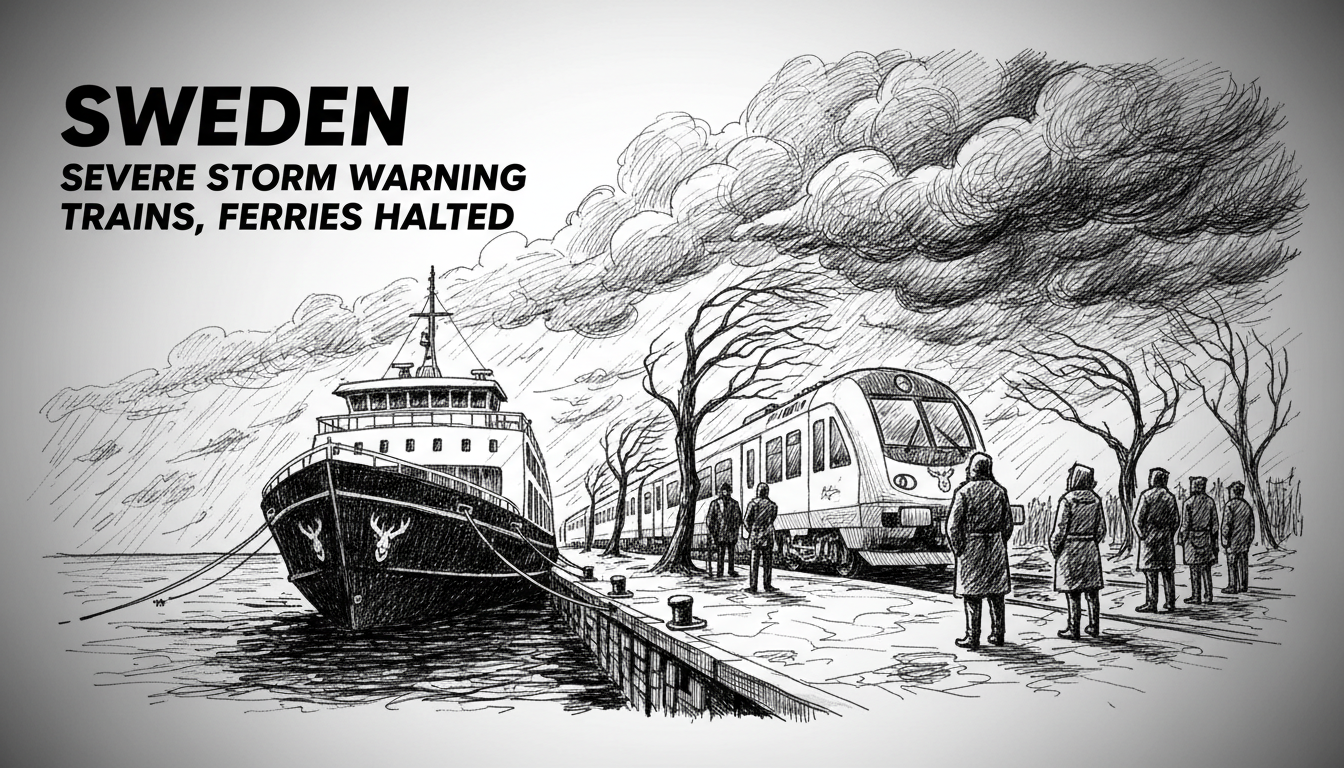
Sweden's national railway operator SJ has cancelled all trains between Duved and Stockholm, and between Bräcke and Storlien, following severe weather warnings. The Swedish Meteorological and Hydrological Institute (SMHI) issued an orange-level warning for strong winds combined with heavy snow across central and northern mountain regions. The disruption hits during a busy weekend, stranding travelers and forcing a major response from transport authorities.
“We have made the decision to cancel trains between Duved and Stockholm,” said Leila Fogelholm, a press officer for SJ. The cancellations affect a key route to the popular ski resort of Åre, leaving many weekend travelers scrambling. Ferry traffic along the coast is also impacted. The Swedish Transport Administration, Trafikverket, has urged the public to avoid all non-essential travel on roads in the affected areas.
A Weekend of Disruption in the Mountains
The orange warning, SMHI's second-highest alert, covers Jämtland, Dalarna, Norrbotten, and Västerbotten counties. It predicts a significant risk of blizzards and dangerously poor visibility. “The severe weather could have a major impact on traffic flow,” a Trafikverket spokesperson said. The agency has heightened its emergency preparedness, moving three tracked vehicles to the area around Åre and Östersund to assist if needed.
In Stockholm's Central Station, the atmosphere shifted from weekend bustle to frustration. Announcements echoed through the hall as departure boards flickered with cancellations. Emma Lindgren, a student from Uppsala hoping to reach friends in Åre, stared at her phone. “I checked the weather app, but I didn’t think it would be this bad,” she said, her backpack at her feet. “Now I have to figure out where to stay tonight. Everything up there is fully booked.” Her story is a common one this Saturday, reflecting a clash between planned leisure and unpredictable nature.
The Science Behind the Shutdown
Sweden's long, narrow shape creates dramatic weather contrasts. Coastal areas might see rain while the interior mountains are buried in snow. An orange warning from SMHI is not issued lightly. It signals conditions that pose a real threat to society and infrastructure. This particular warning for wind and snow is a classic recipe for transport chaos. Strong winds whip falling snow into blinding drifts, paralyzing roads and railways alike.
“The decision to preemptively cancel train services is a safety-first principle,” explains Lars Mårtensson, a professor of transport systems at Chalmers University of Technology. “A train stranded in a blizzard in a remote area is a serious rescue operation. It’s far better to disrupt plans early than to risk lives later.” He emphasizes the coordination required between SMHI, Trafikverket, and operators like SJ. This system, while causing inconvenience, is designed to prevent accidents.
Trafikverket’s infrastructure is built for harsh winters, but extreme events test its limits. The key challenge is visibility and snow accumulation rates. When wind speeds exceed certain thresholds, snowplows and maintenance vehicles cannot operate safely. The agency’s decision to deploy bandvagnar—tracked, all-terrain vehicles—near Åre shows they are preparing for the worst. These vehicles can reach stranded motorists where regular emergency services cannot.
The Ripple Effect on Swedish Society
The cancellations reveal our deep reliance on predictable mobility. For the Swedish tourism and hospitality industry, especially in mountain towns like Åre, a weather shutdown has immediate economic consequences. Hotels face no-shows, restaurants lose reservations, and ski resorts operate with minimal staff. “A weekend like this hurts,” said Henrik Falk, manager of a lodge in Duved, reached by phone. “But safety is more important. We tell guests to listen to the authorities.”
There’s also a cultural dimension. The Swedish relationship with nature, or friluftsliv, is fundamental. Yet it comes with a respect for its power. The public broadcast of warnings and the general adherence to travel advice show a societal trust in official institutions. Most Swedes understand the concept of vädervarning and adjust their plans accordingly, even if it’s disappointing.
For immigrants and newer residents, such events can be particularly confusing. “Where I’m from, a snow warning might mean a delay, not a total shutdown,” said Arjun Patel, a software engineer from Mumbai living in Stockholm. “It’s impressive how seriously they take it here. It makes you feel secure, even when your trip is ruined.” This highlights how Sweden's approach to risk management is woven into its social fabric.
Looking Ahead: A Tested System
As the storm batters the mountain passes, the response will be analyzed. Could communication have been faster? Were alternative transport options provided? Experts like Mårtensson argue the system works precisely because it errs on the side of caution. “The goal is zero accidents,” he states. “A quiet weekend with cancelled trains is a success compared to a headline about a tragic derailment.”
The coming hours will see Trafikverket crews working in brutal conditions to assess damage and clear lines. SJ will face the complex task of rebooking thousands of passengers and repositioning rolling stock. The episode is a stark reminder that despite advanced infrastructure, nature remains in charge. It tests the resilience not just of steel rails, but of the entire chain of planning, communication, and public trust.
Will this become more common with a changing climate? SMHI data suggests winters are becoming more volatile, with intense snowfall events interspersed with milder periods. This puts greater pressure on maintenance budgets and emergency planning. The coordinated shutdown this Saturday may well be a model for future extreme weather responses.
For now, the message from authorities remains clear: stay home if you can. For those stranded in stations or rethinking their weekend, it’s an unexpected pause. Some will find a cozy Stockholm café, others will reschedule their mountain retreat. In a country accustomed to winter’s might, the collective sigh is one of understanding, not just frustration. The storm will pass, the trains will run again, and the delicate balance between modern life and ancient weather will reset—until next time.