
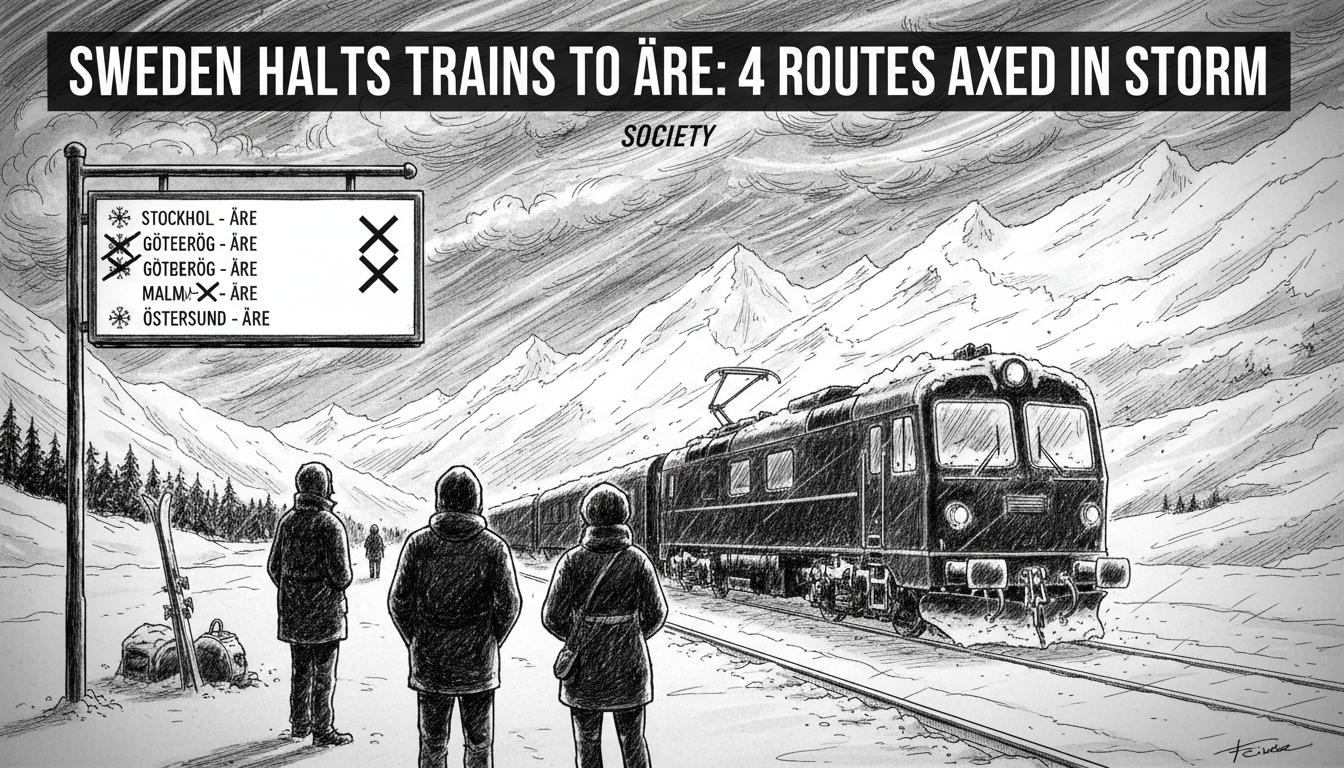
Sweden's crucial winter travel plans for thousands have been derailed by a severe weather warning. An estimated 2,000 passengers booked on four fully packed trains from Stockholm to the ski resort of Duved, near Åre, saw their weekend upended on Saturday. The Swedish Meteorological and Hydrological Institute (SMHI) issued an orange alert for parts of Jämtland, prompting the national rail operator SJ to cancel all service between Bräcke and Storlien. No replacement buses are guaranteed, leaving travelers stranded and highlighting the fragile dance between Sweden's famed outdoor culture and its formidable winter climate.
At Stockholm Central Station, the atmosphere shifted from one of weekend excitement to palpable frustration. Groups in colorful ski jackets, surrounded by gear bags and snowboards, huddled around information screens displaying stark red 'Inställt' (Cancelled) notices. "We booked this trip six months ago for my son's birthday," said Karl Lundgren, a Stockholm resident, checking his phone for alternatives. "Now we're trying to find a rental car, but everyone else is doing the same. It's a mess. The mountains call, but the weather has other plans."
The Warning That Stopped the Trains
The SMHI's orange warning is the second-most severe level on its four-tier scale. It signals a high impact on society, with significant risk of disruptions to infrastructure and travel. For the mountainous Jämtland region, such warnings often pertain to heavy snowfall, strong winds, or a dangerous combination of both. These conditions can lead to white-outs, drifting snow blocking rails and roads, and an elevated risk of avalanches. Halting train traffic is a standard preventative measure. SJ's decision underscores a primary safety rule: it is better to disrupt plans than to risk a stranded train or an accident in remote, harsh terrain.
"When SMHI issues orange for that region, we listen," said an SJ press officer in a statement. "The safety of passengers and staff is always the absolute priority. The challenge with providing bus replacements is that the same weather making rail travel unsafe will very likely also affect road conditions. We cannot in good conscience put buses and passengers on potentially treacherous roads." This leaves travelers with few official options, pushing them towards private car hires or last-minute flight changes to nearby Östersund, if those routes are still operational.
A Resort Braces for Quiet Slopes
The ripple effect extends beyond Stockholm's Central Station. Åre, one of Scandinavia's premier ski destinations, faces a sudden, weather-induced drop in visitor numbers on a key weekend. Local businesses, from hotels and restaurants to ski rental shops and guiding services, feel the immediate economic pinch. "A weekend like this in February is peak season," explained Lisa Ferm, a tourism consultant based in Åre. "When trains are cancelled, it doesn't just mean empty seats on a carriage. It means quieter hotel lobbies, fewer bookings for dinner, and less bustling activity on the slopes. For small businesses operating on thin winter margins, these disruptions have a real cost."
Ferm notes that the community is resilient and accustomed to nature's whims. Many travelers who make it here are seasoned Swedish winter sports enthusiasts who plan for contingencies. However, the incident highlights a growing tension. As Åre's international profile rises, attracting more visitors unfamiliar with Arctic weather volatility, clear communication and flexible booking policies become even more critical. The local tourism board often advises visitors to purchase flexible travel insurance and to monitor SMHI forecasts closely in the days leading up to their trip.
Expert Insight: Respecting the Mountain's Power
Weather experts stress that the SMHI warning system is a vital tool for modern life in a country where nature remains a dominant force. Dr. Elsa Moberg, a climatologist, explains the specific risks in the Åre region. "This isn't just about a lot of snow. It's about wind and accumulation. Strong winds can create massive snow drifts that block transport corridors in a matter of hours. They also increase the avalanche risk in the backcountry. An orange warning means the conditions for such hazardous situations are imminent."
She emphasizes that while cities like Stockholm might slow down in a snowstorm, the consequences in mountain areas are magnified. "The infrastructure is more exposed, distances between shelters are greater, and rescue operations become exponentially more difficult and dangerous in storm conditions. Cancelling trains is a proactive, necessary step. It's a societal decision that places safety above convenience, which is a core principle of managing life in the Nordic wilderness."
Navigating the New Normal of Weather Disruption
This event is part of a broader pattern of increasing travel disruptions linked to extreme weather. While Scandinavia is no stranger to harsh winters, the intensity and frequency of storms are shifting. This poses a long-term challenge for Sweden's transport infrastructure and its vital tourism economy. For SJ and other operators, it sparks discussions about resilience. Are there improvements to be made in how alternative transport is coordinated? Can communication with passengers be faster and more detailed, perhaps with direct advice on options rather than just cancellations?
For the average Swede, the response is often a mix of pragmatism and frustration. The concept of 'vädret' (the weather) is a central part of the national psyche, a force to be respected, not fought. Yet, the expectation of efficient, reliable public transport is also deeply ingrained. When the two clash, it creates a moment of cultural reckoning. Social media fills with both understanding sighs—"Typiskt svenskt väder!" (Typical Swedish weather!)—and angry demands for better solutions.
What Travelers Need to Know Now
For those caught in this weekend's disruption or planning future trips, the lessons are clear. First, always check SMHI forecasts and transport operator websites in the 24 hours before departure. Second, consider travel insurance that covers weather-related cancellations. Third, if heading to mountain regions, build in flexibility. Perhaps travel a day earlier if a storm is forecast. Finally, have a backup plan, whether it's knowing the bus operator alternatives or having a contact for local taxi firms in your destination.
The trains to Åre will run again, likely in a day or two once the storm passes and tracks are cleared. The slopes will be waiting, perhaps with a fresh layer of powder. But this weekend's orange warning serves as a powerful reminder. In Sweden, even the best-laid plans for winter adventure are ultimately subject to the ancient, unpredictable authority of the weather. It's a humbling reality that defines not just travel, but the very rhythm of life in the North. As the skies clear over Jämtland, will our approach to planning in an era of more extreme weather finally evolve?