
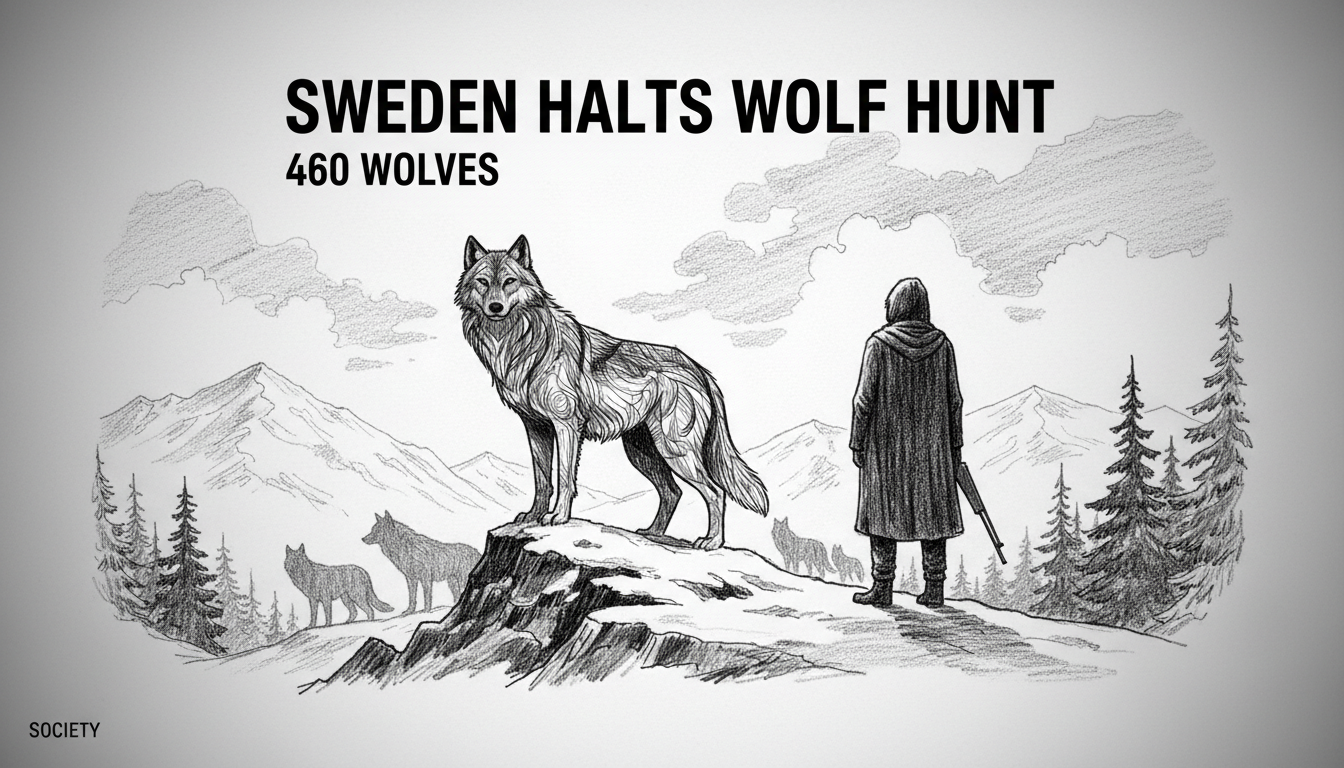
Sweden's wolf population of approximately 460 animals is at the center of a new legal and political storm. The Administrative Court in Luleå has blocked planned licensed hunts in five counties just weeks before they were set to begin. This decision intensifies a decades-long conflict between conservation objectives and rural management, testing the Swedish government's wildlife policy framework.
“It should not be everywhere,” said Lars Björk, a hunting consultant with the Swedish Hunters' Association, expressing a common rural sentiment. He argued the suspended hunt in Västmanland and Örebro counties was needed to control a growing local population. The court's ruling, however, found that county administrative boards failed to adequately justify why the culls would not hinder maintaining a favorable conservation status for wolves.
A Legal Barrier Rises
The court's intervention stops planned hunts in Dalarna, Södermanland, Västmanland, Västra Götaland, and Örebro. This action represents a significant victory for environmental organizations that routinely appeal such decisions. It underscores the rigorous legal scrutiny applied to Sweden's predator management, where every licensed kill must demonstrate strict adherence to conservation laws. The Swedish Environmental Protection Agency, operating under directives from the Riksdag, sets the national framework, but local county boards implement the plans.
This legal reversal creates immediate operational and political challenges. The Swedish government and the responsible minister must now navigate between fulfilling a parliamentary decision to maintain a population of 170-270 wolves and addressing the practical concerns of rural communities. The current population, estimated at 460 wolves, far exceeds the minimum target, fueling arguments for more active management.
The Conservation Counter-Argument
Environmental groups view the court's decision as a vital safeguard. “Hunting is a threat to the wolf's existence in Sweden,” argued the Swedish Society for Nature Conservation in a statement following the ruling. Their position is that Sweden's wolf population, while larger than in previous decades, remains genetically vulnerable. They contend that licensed hunting, even of a limited number of animals, can disrupt pack structures and reduce genetic diversity critical for long-term survival.
The legal basis for their appeals often hinges on the European Union's Habitats Directive, which grants strict protection to wolves. Sweden's system of licensed hunts operates under specific derogations from this protection, requiring robust scientific justification. The court in Luleå essentially found that justification lacking in the counties' submissions, highlighting a persistent tension between national management goals and EU-level conservation obligations.
The Risk of Illegal Killing
A central and troubling question now emerges: Could this ban increase poaching? When asked if the court's decision raises the risk of illegal wolf killing, Lars Björk of the Hunters' Association gave a cautious but telling response. “It is difficult to say. But many hunters are disappointed with the authorities' decision. So yes, thoughts have certainly turned to there being an increased risk,” he stated.
This fear is not abstract. Experts have long debated whether regulated, legal hunting can function as a pressure valve, reducing incentives for poaching by giving local communities a sense of agency and control. The opposite view warns that legitimizing any hunt normalizes killing. With legal avenues blocked, frustration in areas experiencing livestock predation or safety concerns could grow. Monitoring and enforcing against poaching remains a significant challenge for Swedish authorities.
Policy at a Crossroads
The halted hunt puts Stockholm politics and government policy in Sweden under a microscope. The Swedish Parliament's (Riksdag) established population target of 170-270 wolves is now a point of contention, as the actual number is nearly double the minimum. This discrepancy fuels arguments from rural MPs and interest groups that the policy is outdated and that populations in certain regions are too high. Conversely, conservationists argue the target itself is too low and scientifically unsound.
The government must now decide its next steps. It could accept the court's ruling, instructing county boards to prepare more substantiated applications for future seasons. Alternatively, it could explore broader political or legislative maneuvers to adjust the management system, though these would face intense debate in the Riksdag and likely further legal challenges. Decisions made in Rosenbad, the government headquarters, will directly impact the forest management and agricultural districts across central Sweden.
An Intractable Swedish Conflict?
This latest chapter reflects a fundamental Swedish dilemma: balancing modern conservation ethics with traditional land-use practices. The wolf's return from near-extinction is celebrated nationally as an environmental success. Yet, on a local level, its presence can symbolize a top-down imposition from Stockholm and Brussels, threatening livelihoods and a sense of security.
The administrative court's decision is procedurally focused, but its implications are deeply societal. It questions the efficacy of current bureaucratic processes in managing highly emotional wildlife conflicts. It also tests the Swedish model of consensus-driven policy, revealing stark divisions. The coming months will see increased pressure on both the Swedish Environmental Protection Agency and the government to clarify a path forward that can withstand both legal scrutiny and social unrest in the countryside.
Ultimately, the question remains: Can the Swedish government design a wolf management policy that its courts will approve, its EU commitments allow, its parliament supports, and its rural communities will accept? Until that balance is found, the deep forests of Sweden will remain a battleground for competing visions of nature.