
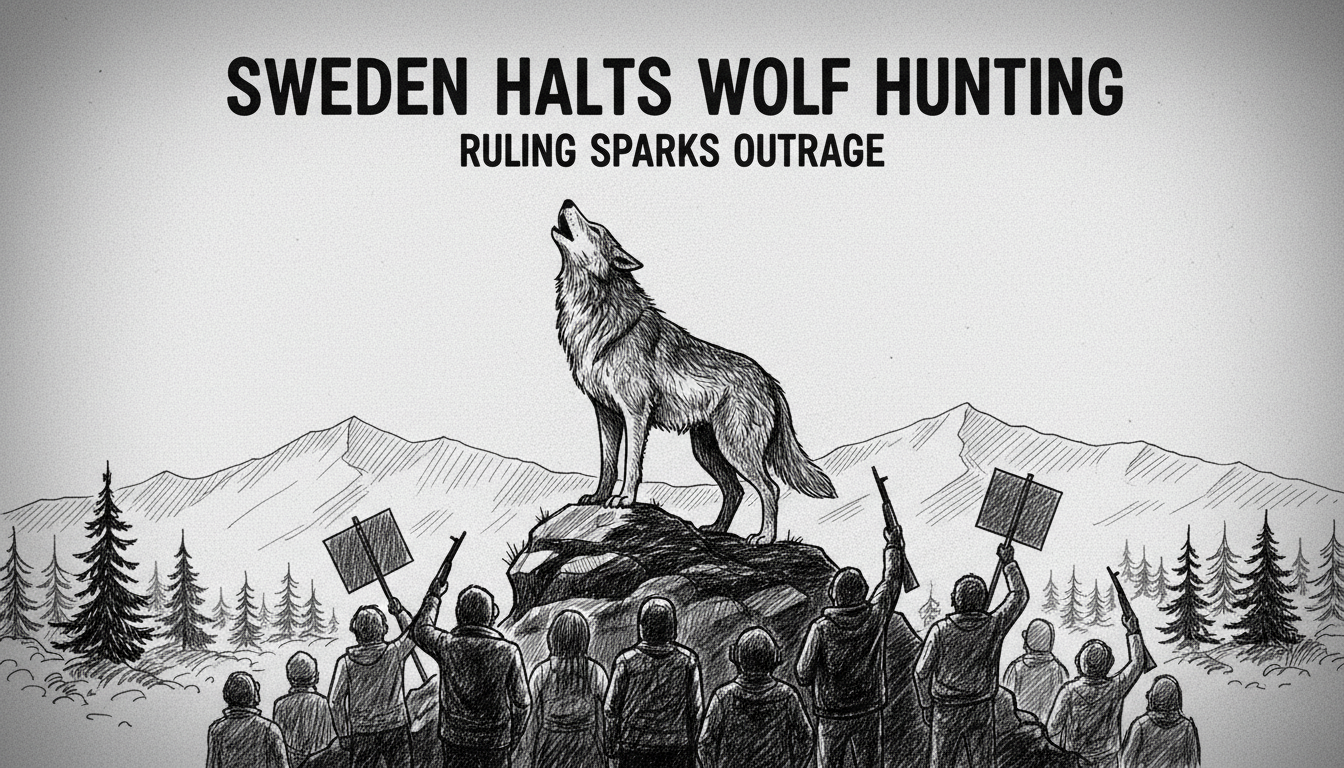
Sweden's wolf hunt has been stopped by a landmark court decision, a ruling the national hunters' association calls "astounding." The Administrative Court in Jönköping issued a definitive halt to the licensed hunt planned for this winter, siding with conservationists. The court found that county boards failed to prove the hunt would not endanger the wolf population's favorable conservation status, a core EU requirement.
"What you can say is that it's a rather peculiar decision-making process, where a government decision can be overturned due to a lack of evidence," said Anders Lindström, Secretary General of Jägarnas Riksförbund (The Swedish Association for Hunting and Wildlife Management). The decision represents a major victory for environmental groups and a significant setback for rural communities and hunters. It directly challenges the policy framework established by the Swedish government and Parliament (Riksdag) for predator management.
A Legal Victory for Conservation
The court's ruling centers on the legal concept of the burden of proof. Under the EU's Habitats Directive, which Sweden implements, authorities must demonstrate that activities like hunting do not harm a species' long-term survival. The court concluded that the county administrative boards (länsstyrelserna) did not meet this burden. They could not conclusively show that culling wolves, even in limited numbers, would not negatively impact the population's "favorable conservation status."
This legal interpretation introduces a new, higher hurdle for future hunting licenses. It shifts the presumption against hunting unless overwhelming evidence is presented. The Swedish Environmental Protection Agency (Naturvårdsverket), headquartered in Stockholm's government district, now faces pressure to revise its guidance to county boards. This decision effectively places the wolf population's status above immediate management concerns raised by livestock owners and hunters.
Clashing Perspectives from the Field
Reactions to the ruling highlight Sweden's deep urban-rural divide on predator policy. Anders Lindström expressed frustration over the decision's practical implications. "We must read the verdict and see where step two lies, but it is simultaneously quite astounding," he stated. From the hunters' perspective, the ruling undermines a carefully balanced system of licensed, regulated culling. They argue this system is essential for maintaining public acceptance of wolves in the countryside and protecting livestock and hunting dogs.
Conversely, the Swedish Society for Nature Conservation (Naturskyddsföreningen) welcomed the verdict as a potential turning point. They have long argued that Sweden's wolf population, while recovered from near extinction, remains fragile. With a current winter population estimated at just over 400 individuals, conservationists emphasize threats from inbreeding and legal hunting. They contend that non-lethal methods, like better livestock protection, are more effective and legally sound solutions to conflicts.
The Stockholm Policy Framework Tested
The court's decision sends a shockwave through Stockholm's political and bureaucratic circles. It questions the implementation of a policy crafted by the Swedish government and affirmed by Riksdag decisions. The current policy allows for licensed hunting as a population management tool, a position developed over years of heated debate in the Riksdag building. The ruling suggests the executive branch's directives, often coordinated from the government offices at Rosenbad, may not satisfy stringent judicial review under EU law.
This creates an immediate dilemma for policymakers. The government must decide whether to accept the court's stringent interpretation or seek to challenge it through appeals or legislative changes. Any move to amend legislation would require navigating a complex parliamentary process, potentially reopening one of Sweden's most contentious political issues. The decision also places county governors, who lead the länsstyrelserna, in a difficult position, caught between national policy and new legal restraints.
Science, Law, and Population Management
At the heart of the dispute is a scientific and legal debate over what constitutes a "favorable conservation status" for wolves. The population has grown from virtual extinction in the 1970s, but experts disagree on what number is sustainable. Geneticists warn that a population of around 400 is still too small for long-term genetic health, requiring connectivity with Finnish and Russian wolf packs. Demographers and wildlife managers, however, point to the population's growth and argue controlled hunting prevents overpopulation and reduces specific conflict zones.
The court's focus on evidence places new demands on the scientific data used by authorities. Future applications for hunting licenses will likely require extensive population viability analyses and genetic studies. This raises the bar for the scientific competence and resources of county administrative boards. It may centralize decision-making power with national agencies in Stockholm, diminishing the role of local assessments of predator conflicts.
Looking Ahead: The Political and Legal Battle
The immediate aftermath of the ruling involves legal analysis and strategic planning by all sides. Jägarnas Riksförbund is carefully reviewing the full verdict to determine grounds for an appeal to a higher administrative court. A reversal is possible but would require convincing arguments that the lower court misinterpreted the burden of proof. The Swedish government must also formulate an official response, weighing the court's ruling against its commitments to rural constituencies and its broader wildlife management agenda.
Long-term, this decision could redefine predator management in Sweden. It establishes a powerful legal precedent that extends beyond wolves to other protected species like bears, lynx, and wolverines. The principle that authorities must prove no harm from hunting, rather than opponents proving harm, represents a profound shift. It aligns Swedish practice more closely with the precautionary principle central to EU environmental law, potentially at the expense of national management autonomy.
For rural Swedes living with wolves, the ruling feels like a dismissal of their daily realities. For conservationists, it is a necessary enforcement of laws designed to protect biodiversity. The Swedish Parliament and government now face the difficult task of reconciling these irreconcilable positions within the bounds of European law. The halted hunt is not merely a pause in culling; it is a judicial intervention that demands a fundamental re-examination of Swedish government policy on large carnivores. The path forward will test the resilience of Sweden's political institutions and its ability to govern its wilderness.