
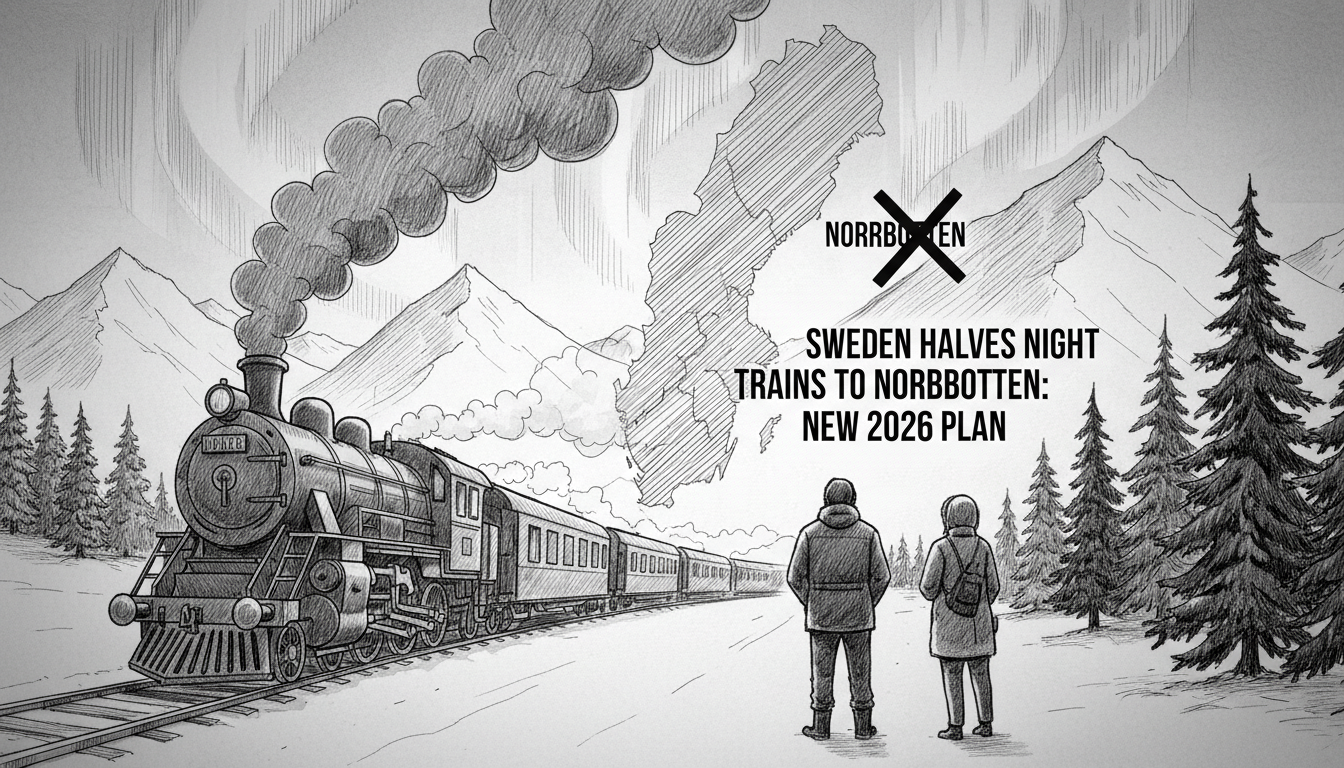
Sweden's night train service to its northernmost county will be cut in half starting April 13, 2026. The Swedish Transport Administration, Trafikverket, confirmed the Stockholm-Narvik route will be reduced to one train in each direction. A second night train will instead run between Stockholm and Umeå, leaving Norrbotten with significantly diminished direct rail connectivity.
This decision marks a major shift in Sweden's long-standing commitment to northern transport links. For decades, two night trains have connected the capital with the Arctic coast. The change prioritizes service to the larger Västerbotten region over the more remote Norrbotten. Trafikverket cites budget constraints and a need to free capacity on the critical Malmbanan iron ore line as key reasons.
“Beyond the procured traffic on the route, there is of course also the possibility for train operators to run commercial traffic and adjust trips during high and low season,” said Lennart Kalander, department head at Trafikverket. His statement points to a potential opening for private operators but offers little immediate solace to northern communities.
A Strategic Retreat from the North
The policy change represents a strategic retreat from state-guaranteed connectivity. Night trains are more than transport; they are lifelines for tourism, business, and regional cohesion in Sweden's vast north. Reducing service to Norrbotten, an area larger than many European countries but with a sparse population, risks deepening its isolation. The move signals a recalibration of public service obligations against hard economic realities.
Trafikverket's official statement frames the change as an adaptation. “Trafikverket is now adapting the requirements to secure continued traffic within the given economic frameworks and meet the needs and demand that exist. The changes also contribute to freeing up capacity on the Malmbanan.” The mention of the Malmbanan is crucial. This single-track railway is the artery for Sweden's iron ore exports from Kiruna and Malmberget to the port of Narvik. Passenger trains compete for slots with immensely profitable freight traffic.
The Iron Ore Line's Dominant Grip
The Malmbanan's economic importance cannot be overstated. It handles the majority of iron ore produced by state-owned LKAB, a cornerstone of Swedish industry and export revenue. Passenger trains, especially slower night services, can create scheduling bottlenecks. By halving the nightly passenger service to Narvik, Trafikverket directly addresses capacity pressures. This prioritizes national economic output over regional passenger convenience.
“This is a classic infrastructure conflict,” says a Stockholm-based transport analyst who requested anonymity due to ongoing work with government agencies. “The state faces a trilemma: maintain universal service, manage a tight budget, and keep the freight corridor fluid. Something has to give. In this case, it's the frequency of service to the farthest north. The political calculation is that Umeå's larger population justifies the shift.”
The new plan creates a clear tiered system. Umeå, a major university city and regional hub, retains a dedicated night train link. Norrbotten must share its single train with the entire Stockholm-Narvik corridor. This includes stops in Gävle, Uppsala, and key northern towns like Boden and Kiruna. The single service will face higher demand pressure, potentially making bookings more difficult and less flexible.
Regional Reactions and Economic Ripples
Local politicians and business leaders in Norrbotten are expressing deep concern. The county relies heavily on tourism, with visitors drawn to the Arctic landscape, the Icehotel in Jukkasjärvi, and the Northern Lights. The night train is a popular, sustainable travel option for tourists and a vital link for residents needing to travel to the capital for business, healthcare, or family visits.
“A reduction in reliable, direct transport is a blow to our attractiveness and competitiveness,” said a tourism board representative from Kiruna. “For many, the night train is the preferred choice. It’s eco-friendly and efficient. Cutting it in half sends a message that the north is less of a priority.” The fear is that reduced access could stifle investment and accelerate demographic decline in already vulnerable municipalities.
Trafikverket's suggestion that private operators could step in offers a theoretical solution. However, the economics of running commercial night train services in the European north are challenging. Seasonal demand is peaky, and the market is small. Without significant subsidies, which the state is seemingly unwilling to provide, profitable private operation is a high-risk venture. Kalander's comment may be more about political deflection than a viable near-term alternative.
A Broader European Context
Sweden's move contrasts with a nascent night train renaissance elsewhere in Europe. Countries like Austria, Germany, and France are investing in new overnight routes and rolling stock to offer a greener alternative to short-haul flights. The European Union has identified cross-border night trains as a key part of its sustainable transport strategy. Sweden's decision to contract a major domestic route appears counter to this trend.
However, the Nordic context is unique. Extremely long distances, harsh winters, and thin populations make night trains exceptionally costly to operate per passenger. Sweden has historically subsidized them as a public service. The 2026 change indicates the government is redrawing the boundaries of that service commitment. It is choosing to consolidate service on a more populous route rather than spread it thinly across two.
Looking Ahead to 2026 and Beyond
The new timetable takes effect in April 2026, giving communities and operators over two years to adjust. The coming period will test Trafikverket's assumptions about demand and capacity. Will the single Stockholm-Narvik train be perpetually overbooked? Will freight efficiency gains on the Malmbanan materialize as predicted? Most importantly, will the socio-economic cost to Norrbotten outweigh the budgetary savings for the state?
This decision is more than a schedule change; it is a statement of priorities. It places the unimpeded flow of mineral wealth and the connectivity of a larger regional capital above the guaranteed mobility of Sweden's most remote citizens. The night train's gentle rhythm through the northern forests has been a constant for generations. From 2026, that rhythm will beat half as often for those at the end of the line, leaving them to wonder if their link to the south is slowly being uncoupled.