
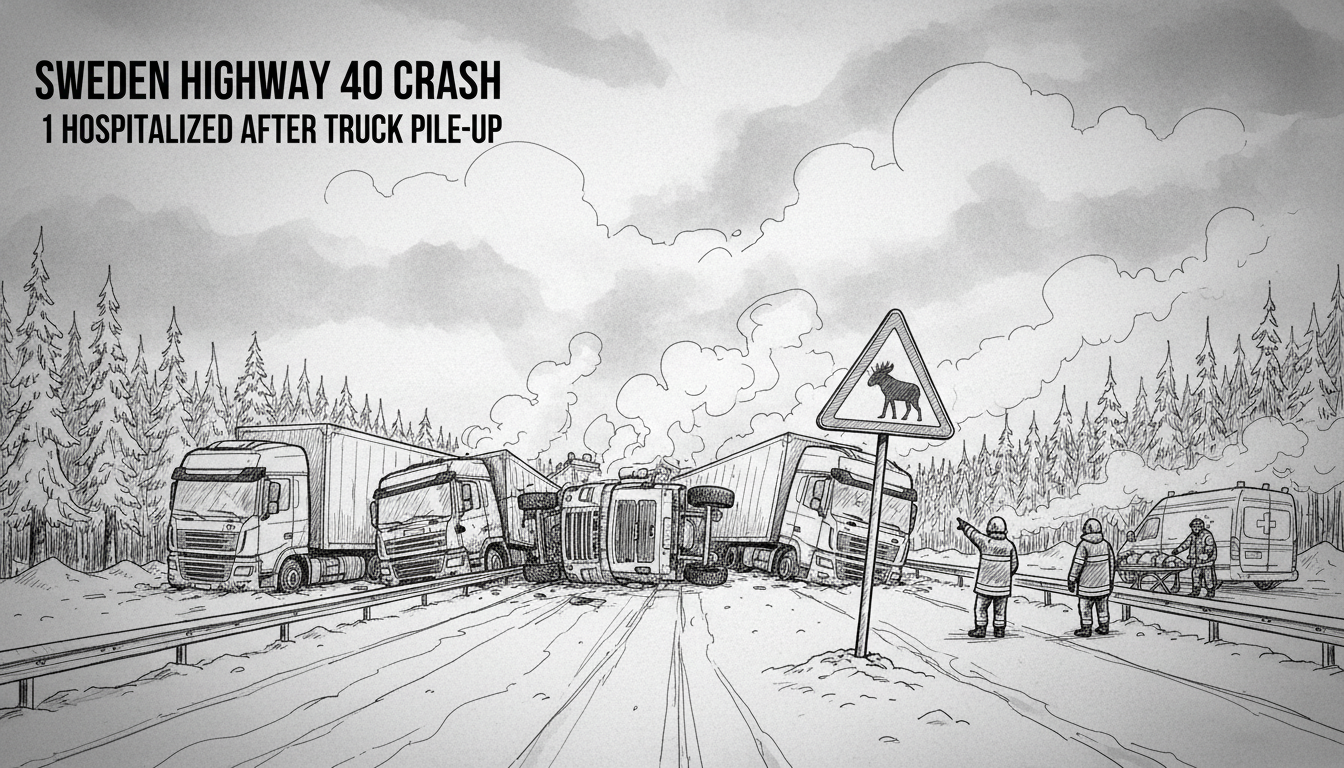
Sweden's Riksväg 40, a vital artery connecting Gothenburg to Jönköping, was the scene of a major disruption on Friday morning. A truck with a trailer veered into the central barrier near Ulricehamn, triggering a chain-reaction crash involving three passenger cars. The incident, occurring just before 11 AM, caused total gridlock in both directions and sent one person to the hospital with minor injuries.
For hours, the eastbound lanes toward Jönköping were at a complete standstill. Westbound traffic toward Borås crawled as heavy vehicles struggled to ascend the hill from Ulricehamn. 'Several vehicles have been recovered from the scene, but the work is still ongoing,' said police spokesperson Thomas Fuxborg in a statement. He confirmed that while several people were hurt, none of the injuries were believed to be serious.
This single event underscores the fragility of Sweden's transport networks. Riksväg 40 is not just a road for commuters; it is a crucial freight corridor. Every hour of stoppage has a ripple effect on deliveries, business schedules, and the plans of countless individuals. The Friday morning timing, during a busy travel period, maximized the disruption.
A Recurring Problem on a Key Corridor
Accidents on Riksväg 40 are, unfortunately, not isolated events. The highway's mix of high-speed traffic, frequent heavy goods vehicles, and varying weather conditions creates a complex risk environment. Traffic safety experts consistently point to a familiar trio of contributing factors: driver fatigue, excessive speed, and insufficient safe distance, particularly involving trucks.
'High-volume routes like this are where systemic risks become visible,' says Lars Bengtsson, a retired traffic safety analyst I spoke with. He emphasizes that while Swedish roads are among the world's safest, the concentration of traffic on certain corridors increases the consequence of any single error. 'A truck losing control isn't just one vehicle in an accident. It becomes an immovable object that transforms the road into a trap for others.'
The area near Ulricehamn, where Friday's crash occurred, is known to locals as a segment that can be challenging, especially in poor weather. While the cause of this specific incident remains under investigation, the pattern is recognized.
The Human Cost Behind the Headlines
The official report lists 'minor injuries.' But that clinical term masks a morning of fear, frustration, and sudden upheaval for those involved. Imagine the shock for the drivers in the three passenger cars, a routine journey suddenly interrupted by crashing metal. Think of the ambulance crew navigating the stalled traffic to reach the scene. Consider all the people stuck in the resulting miles of queues, late for work, missing appointments, or anxiously waiting to hear from loved ones known to be on that road.
This is the broader societal impact of traffic incidents often missed in brief news bulletins. It’s the strain on emergency services, the economic cost of delays, and the lingering anxiety that can follow even a 'minor' collision. For the person transported to the hospital, the day became a visit to the emergency room, phone calls to family, and dealing with insurance—a profound personal disruption.
In Sweden, where personal mobility is deeply woven into the fabric of daily life, such disruptions are felt acutely. The reliance on cars, especially in regions outside the major urban cores of Stockholm, Gothenburg, or Malmö, is significant. Public transport alternatives along routes like Riksväg 40 are often less frequent, making the highway indispensable.
Infrastructure and the Safety Debate
Every serious accident reignites the debate about road safety infrastructure. Sweden pioneered the Vision Zero policy, aiming to eliminate road fatalities and serious injuries. This philosophy has led to tangible improvements: safer car designs, extensive median barriers, and lower urban speed limits.
Yet, on older stretches of major highways like Riksväg 40, challenges remain. The question often arises: are investments in rail freight and public transport robust enough to alleviate the pressure on these roads? Could more dynamic speed limits, adjusted for traffic volume and weather, help? The conversation often turns to technology, such as advanced driver-assistance systems in trucks, and stricter enforcement of rest periods for commercial drivers.
'Vision Zero is a continuous process, not a finish line,' Bengtsson notes. 'Each incident provides data. The goal is to learn and adapt the system—the road, the vehicles, the regulations—so that human error doesn't lead to tragedy.' The investigation into Friday's crash will add another piece to that puzzle.
Moving Forward from a Friday Morning Jam
By late afternoon, the wreckage on Riksväg 40 was cleared. Traffic began to flow again, the digital traffic maps turning from red to green. The news cycle moved on. But for the authorities, the work continues. Police investigators will piece together the final moments before the truck hit the barrier. The Swedish Transport Administration will likely review the crash site.
The incident serves as a stark reminder as the busy summer travel season approaches. Sweden's highways will see caravans of families heading to summer cottages, an influx of tourist vehicles, and constant freight movement. Safety depends on systemic resilience and individual responsibility—well-rested drivers, maintained vehicles, and respect for the speed and conditions.
This crash on Highway 40 was, by all accounts, a lucky escape given the potential for worse outcomes. But it highlights a simple truth: in our interconnected society, a single moment on a stretch of asphalt near Ulricehamn can send waves of consequence far and wide. It prompts us to ask not just 'what happened?' but 'what can we learn to ensure it doesn't happen again, or with worse results?' The pursuit of those answers is what defines a society's commitment to safety on the road.