
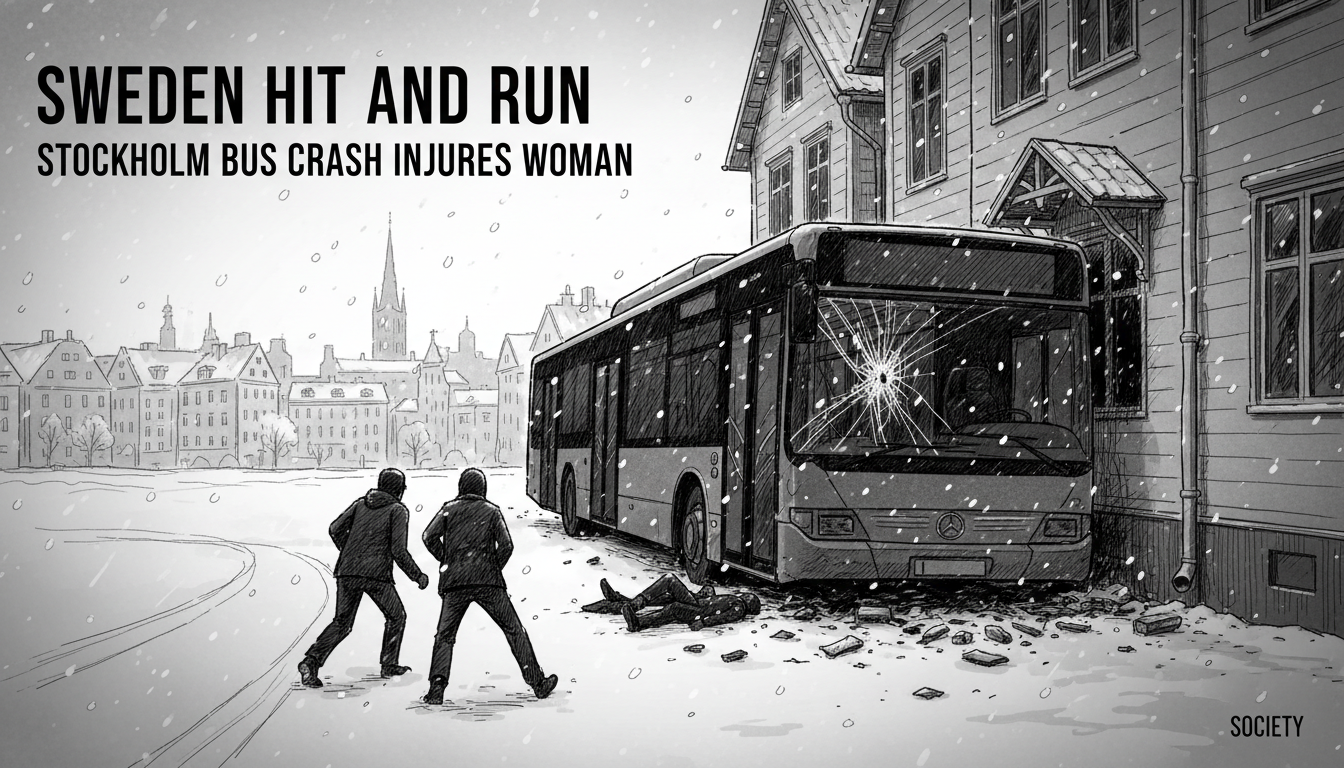
Sweden traffic accident investigators are searching for a driver who fled after causing a crash in central Stockholm. The incident, a 'smitningsolycka' or hit-and-run, occurred at 13:26 on a city bus route. Police say a car intentionally braked hard in front of the bus, causing a collision that injured a female passenger. The driver of the car then left the scene.
"The driver has fled and a woman on the bus has been injured," said police spokesperson Mats Eriksson. Officers are currently searching for the vehicle in Stockholm but lack a license plate number. The injured woman received medical attention. For the dozens of other passengers on board, the sudden crash was a shocking disruption to an ordinary Tuesday afternoon.
A Growing Urban Problem
This incident is not an isolated case. In 2022 alone, Swedish authorities recorded 14,374 hit-and-run incidents involving personal injury. Stockholm County, with its dense traffic and high population, accounts for a significant share of these reports. The term 'smitningsolycka' carries a specific legal and cultural weight in Sweden. Drivers are legally required to stop, provide assistance if needed, and exchange information after any accident. Fleeing the scene is a crime that can lead to fines, license suspension, or even imprisonment, depending on the severity.
"Every driver who flees creates a dual victim," says traffic safety analyst Lena Karlström. "First, the person directly injured. Second, our collective sense of security and trust in the traffic system. It's a breach of the fundamental social contract we have on the roads." The motivations for such flights are often fear: fear of legal consequences, high insurance premiums, or perhaps driving without a valid license. Experts note that immediate panic often overrides legal and moral obligations.
The Ripple Effect on a Stockholm Afternoon
While the police search focuses on forensic evidence and potential traffic camera footage, the human impact of the crash spreads outwards. Bus routes were delayed, affecting commuters across the city. The incident occurred in 'innerstan,' the vibrant, bustling heart of Stockholm where trams, buses, bicycles, and cars share tight spaces. Safety in these mixed-traffic zones is a constant topic among urban planners.
For Stockholm residents, such news triggers a familiar anxiety. The city's public transport is generally safe and reliable, a point of pride in Swedish society. A deliberate act that compromises that safety feels particularly jarring. It transforms a routine journey into a moment of vulnerability. Passengers on the affected bus, now witnesses, must reconcile their memory of a normal day with a sudden violent jolt and the sight of an injured neighbor.
The Legal and Social Reckoning for Hit-and-Run Drivers
Swedish law is clear on the consequences for a driver who is found. The penalty for a hit-and-run is separate from, and often more severe than, penalties for the actual traffic violation that caused the accident. The courts view the act of fleeing as an aggravating factor, a conscious choice to evade responsibility. In cases involving injury, it almost certainly means a driving ban and a substantial fine. If the injured party's condition is serious, prison time is a real possibility.
Beyond the courtroom, there is a social dimension. Swedish culture places a high value on collective responsibility and the principle of 'folkhemmet' – the idea of the society as a home for all. A hit-and-run is seen as the antithesis of this; it is an individual abandoning their duty to the collective. "It's one of the few truly condemned actions on the road," notes sociologist Erik Lund. "Even speeding has its defenders. But fleeing an accident you caused? There's no cultural excuse for that."
Can Technology Close the Net?
The investigation will likely rely heavily on technology. Stockholm's network of traffic cameras, along with potential dashcam footage from other drivers, offers the best chance to identify the vehicle. Public appeals for witnesses are standard procedure. In an increasingly connected city, the space for a driver to disappear is shrinking. However, the immediate aftermath of a crash is chaotic, and if a driver chooses backstreets over main arteries, the trail can still go cold.
This reality frustrates police and safety advocates. "The technology exists to solve most of these cases," Karlström states. "But it requires resources, time, and often a bit of public luck. The stronger deterrent is the cultural one: the understanding that fleeing makes everything worse, legally and morally." The hope is that the driver in this case, perhaps gripped by post-panic guilt, will choose to come forward before being found.
A City's Resilience in the Face of Random Danger
As the investigation continues, Stockholm moves on. The bus route has returned to normal. The injured woman's path to recovery begins. The incident, however brief, leaves a mark. It serves as an unwelcome reminder that safety in public spaces is fragile, dependent on the conscientious actions of every individual in the system.
These events prompt difficult questions for a society proud of its order and safety. How do you prevent a single moment of poor judgment or outright recklessness from causing harm? Can infrastructure or law enforcement ever fully eliminate the risk posed by a driver who decides to brake check a bus and then run? For now, Stockholm police continue their search, and a city is left to reflect on the trust we place in strangers behind the wheel every day. The ultimate cost of this driver's decision—measured in trauma, legal fees, and broken trust—has yet to be fully tallied.