
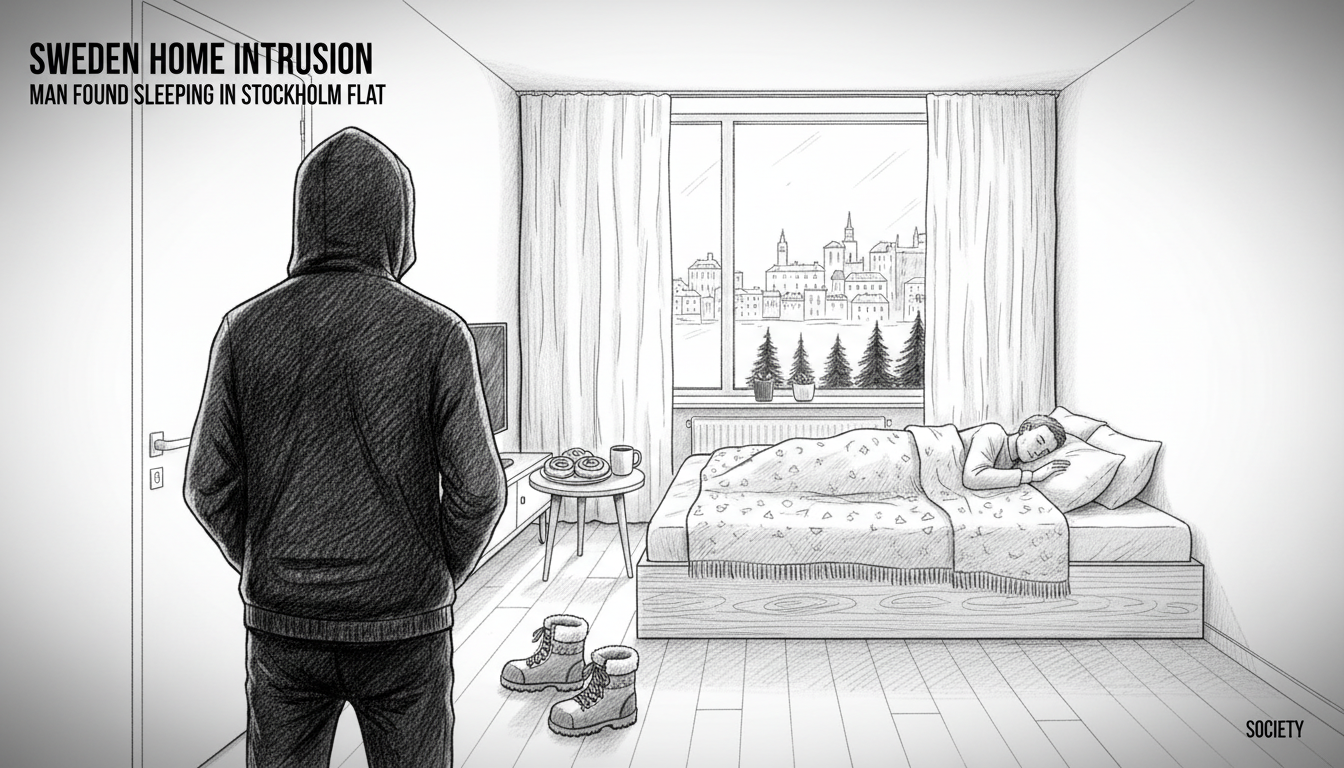
Sweden's capital was the scene of a bizarre and unsettling crime late last Friday evening. A Stockholm woman returned to her apartment to discover an unknown man sleeping soundly in her bed. The incident, which began with a suspected burglary and ended with an arrest under Sweden's laws for intoxicated persons, has shaken a local neighborhood and highlights broader conversations about safety, intoxication, and property crime in Swedish cities.
The woman, who has chosen to remain anonymous, called police to report a potential break-in at her residence. While on the phone with the emergency operator, she made the startling discovery: a stranger was asleep in one of the beds. Officers were dispatched immediately to the address in central Stockholm. The resident wisely left her apartment to wait safely on the street for the arriving patrol. Police then entered and arrested the man. According to official statements, the suspect was taken into custody under the Law on the Care of Intoxicated Persons (Lag om berusade personer, LOB) and is formally suspected of unlawful intrusion ('olaga intrång') and property damage ('skadegörelse').
A Violation of the Home
In Swedish culture, the concept of 'hemfrid'—the peace and sanctity of the home—is deeply ingrained. An unlawful intrusion is not just a property crime; it's a profound personal violation. 'Olagt intrång' is defined in Sweden's Penal Code (Brottsbalken) as entering a dwelling or other premises without permission. The crime does not require theft; the unauthorized entry itself is the offense. For the victim, the psychological impact can be significant and lasting. "It's the ultimate violation of privacy," says Karin L., a long-time resident of Södermalm, the island district where many such central apartments are located. "Your home is your castle, as the saying goes. To have that safety broken is terrifying."
The suspect's level of intoxication will be a key factor in the legal proceedings. Legal experts note that establishing criminal intent is crucial for an 'olaga intrång' conviction. The prosecution must show the man knowingly entered the property without right. Severe intoxication can sometimes complicate the assessment of intent, but it does not automatically absolve responsibility. The simultaneous suspicion of property damage suggests something in the apartment was broken during the entry, which could provide clearer evidence for the case.
Stockholm's Property Crime Landscape
This strange event occurs against a backdrop of evolving property crime statistics in Sweden. In 2023, there were 93,700 reported burglaries across the country, which marks a 6% decrease from the previous year. This is a positive trend, yet the numbers remain high. Stockholm County, which includes the capital and its suburbs, accounts for roughly a quarter of all reported property crimes in Sweden. This means the region sees a disproportionate share of incidents ranging from petty theft to home intrusions.
The nature of property crime in Stockholm often reflects the city's structure. Dense inner-city neighborhoods with older apartment buildings, like Vasastan, Kungsholmen, and Östermalm, can be targets for opportunistic crimes. Meanwhile, the law surrounding intoxicated persons (LOB) is frequently invoked in urban centers. It allows police to take individuals into protective custody if they are deemed a danger to themselves or others due to substance influence, separate from any criminal suspicion. Its use in this case indicates the man was in no state to be released.
Between Alarm and Compassion
The incident sparks a complex conversation in a society that values both security and a strong social safety net. Swedes generally pride themselves on a high-trust society, yet statistics and stories like this prompt discussions about policing, social services for substance abuse, and urban safety. "We have to look at this from two sides," reflects Erik M., a social worker who operates in central Stockholm. "There is the clear crime and the victim's right to security. There is also often a person in crisis, potentially grappling with addiction or homelessness, who ends up in these situations. The system needs to address both."
Local police have reiterated standard safety advice in the wake of the incident: ensure doors and windows are locked, be aware of your surroundings, and report any suspicious activity immediately. The swift response by both the victim and the police in this case is being highlighted as a positive example. By leaving the apartment and meeting officers outside, the woman avoided a potential direct confrontation, which could have escalated dangerously.
The Human Story Behind the Headline
While the crime report is clinical—suspected unlawful intrusion, arrest under LOB—the human reality is messier. For the woman, the return home has been permanently altered. The sense of security in her own space will take time to rebuild. For the man, the path that led him to stumble into a stranger's bed likely involves personal struggles that extend far beyond this one night. Stockholm's social services and legal system now intersect around him, tasked with determining accountability while assessing any need for care or treatment.
These kinds of incidents, though statistically a small part of overall crime, resonate deeply. They touch on fundamental fears and challenge the communal ideals of Swedish society. They happen not in a vacuum, but in a city celebrated for its design, its culture, and its quality of life. As Stockholm continues to grow and change, the balance between open, livable communities and the right to individual security remains a constant focus for residents and policymakers alike.
Will the recent decrease in burglary rates continue, and will it be felt equally across all neighborhoods? How does a society effectively intervene in the cycles of intoxication and crime that lead to such bizarre and alarming violations? The image of a sleeping stranger in a private bed is a powerful and disturbing one. It serves as a stark reminder that behind every crime statistic is a story of a disrupted home, a life in crisis, and a community grappling with how to protect and care for all its members.