
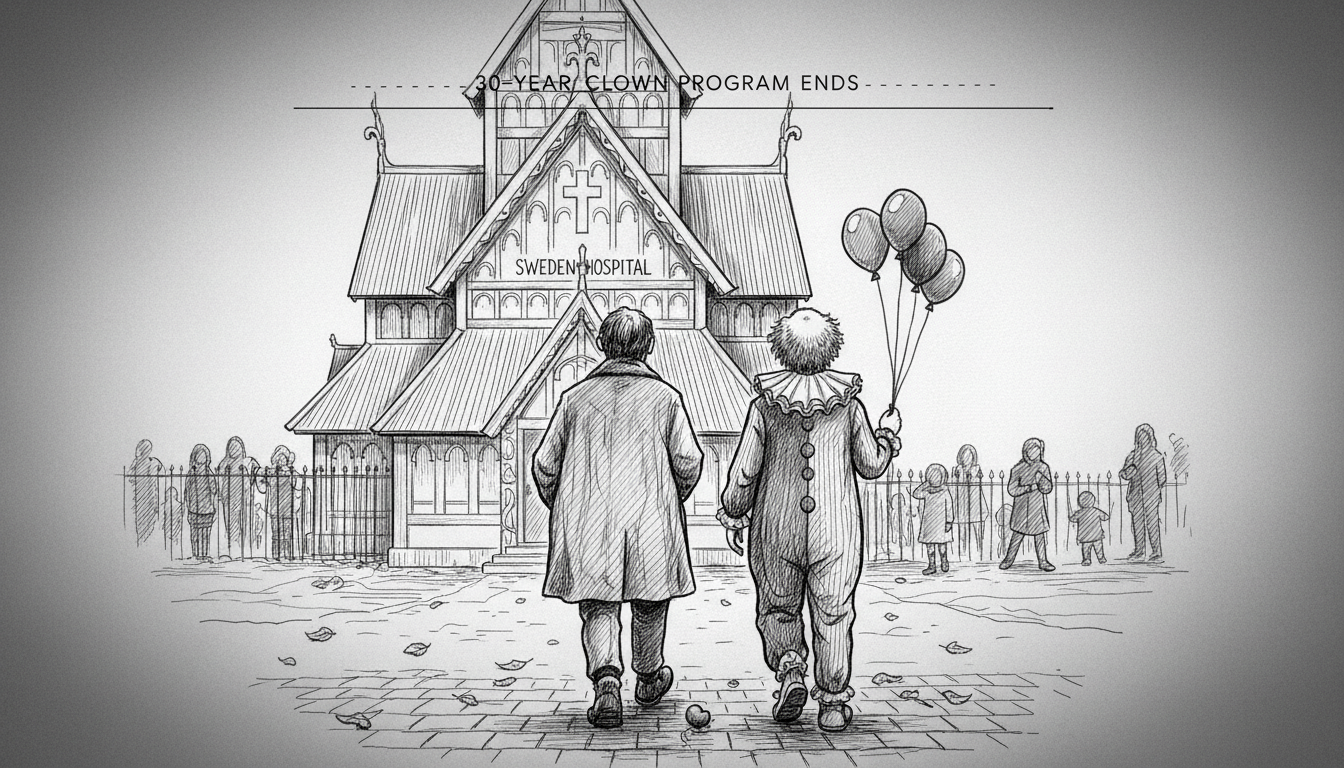
Sweden's healthcare system faces a cultural shift as Sahlgrenska University Hospital ends its three-decade clown program. The decision by hospital administrators in Gothenburg has ignited public debate and a petition with thousands of signatures. Politicians on the hospital's governing board, however, are backing the management's choice to redirect resources. Cecilia Dalman Eek, the Social Democratic chair of Sahlgrenska's board, stated the move was not a political decision. "Personally, I think it sounds completely reasonable that they want to expand the offering and provide it to more days," Dalman Eek said. This statement underscores a central tension in Swedish public administration between professional management and political oversight.
The End of an Era at Scandinavia's Premier Hospital
Sahlgrenska University Hospital, one of Northern Europe's largest medical centers, has hosted clowns for thirty years. The program, often involving partnerships with non-profit organizations, became a familiar part of the hospital's pediatric care environment. Its termination marks the close of a chapter for staff, patients, and families who viewed the clowns as a fixture. Hospital leadership has not publicly detailed all specific reasons for the change. Standard justifications in such administrative reviews typically include evolving therapeutic approaches, infection control protocols, and budget reallocations. The decision follows internal evaluations of patient services and their clinical impact.
Political Oversight Defers to Managerial Expertise
The reaction from elected officials on Sahlgrenska's board reveals a defining principle of Swedish public sector management. Politicians set broad budgetary and policy frameworks, but operational decisions reside with appointed civil servants and experts. Cecilia Dalman Eek's comment that the clown decision "is not a political decision" explicitly reinforces this division. This model, designed to insulate daily operations from short-term political pressures, is now being tested by public sentiment. The board's support signals trust in the hospital directorate's assessment of patient needs and resource optimization. It reflects a consensus that healthcare professionals, not politicians, should determine the composition of therapeutic care teams.
Weighing the Evidence on Therapeutic Humor
Hospital clowning has a documented history in pediatric care, with roots in the late 20th century. Proponents argue it reduces anxiety and creates a more positive environment for children facing stressful procedures. A 2016 meta-analysis in Evidence-Based Child Health concluded clown interventions may reduce anxiety in children undergoing medical procedures. Research published in The Journal of Pediatrics also indicated clowning can lower distress levels in hospitalized children. These studies contribute to an international body of evidence supporting the psychosocial benefits of such programs. However, healthcare administrators must balance these findings against other proven interventions, finite resources, and the specific demographics of their patient population.
Public Sentiment Clashes with Administrative Rationality
The strong public reaction, including a rapidly growing petition, highlights a gap between institutional logic and community attachment. For many, the hospital clowns symbolize compassion and humanity within a clinical setting. Their removal is perceived not just as a service change but as a loss of institutional warmth. This emotional response presents a communication challenge for hospital management. Administrators must justify a decision framed in terms of efficiency and evidence to an audience that values tradition and perceived care quality. The controversy shows how changes in service delivery, even those backed by managerial rationale, can trigger significant public relations challenges for major institutions.
The Future of Non-Medical Care in Swedish Hospitals
This decision at Sahlgrenska prompts broader questions about the role of complementary psychosocial support in Sweden's publicly funded healthcare system. As medical technology advances and cost pressures mount, hospitals continually assess which services deliver the greatest benefit. The shift away from a long-standing clown program suggests a move towards diversifying or formalizing such offerings. Dalman Eek's reference to expanding offerings "to more days" may indicate a move towards more integrated, perhaps more clinically structured, forms of recreational therapy. The outcome could set a precedent for other regional hospitals reviewing their own similar programs.
A Case Study in Swedish Governance
The Sahlgrenska clown decision is a microcosm of Swedish public policy execution. It involves elected politicians deferring to state-employed experts, transparent decision-making processes facing public scrutiny, and the re-evaluation of traditional services. The process exemplifies how Sweden's famously stable administrative state operates, even when choices prove unpopular. The board's unified support for management indicates the decision followed proper internal channels and review. This episode demonstrates that in the Swedish model, professional autonomy within the public sector often outweighs immediate political populism, a principle maintained across the government district from Rosenbad to agency offices.
Navigating Change in Institutional Culture
Replacing a beloved three-decade program requires careful management of institutional culture. Hospital staff who have worked alongside the clowns for years may also feel the loss. Successful implementation of new therapeutic activities will depend on staff buy-in and clear communication about the benefits for patients. The administration's next steps will be crucial. They must effectively introduce and champion whatever new or expanded services are planned to fill the perceived void. Failure to do so could damage staff morale and public trust, while success could validate the difficult decision as a forward-looking improvement.
The Bottom Line for Patient Care
Ultimately, the core question remains whether this change improves overall patient outcomes at Sahlgrenska. Hospital leadership has staked its reputation on the belief that redirecting these resources will provide greater or more equitable benefit. The proof will be in the hospital's ability to demonstrate enhanced patient well-being through new initiatives. While the clowns provided a specific type of joy, the administration is betting on a more versatile or far-reaching model of psychosocial support. This recalibration is the constant, unending work of a large public healthcare system tasked with doing the greatest good for the greatest number within its means. The closure of this chapter at Sahlgrenska is not merely about ending a service, but about how a society continually redefines care itself.