
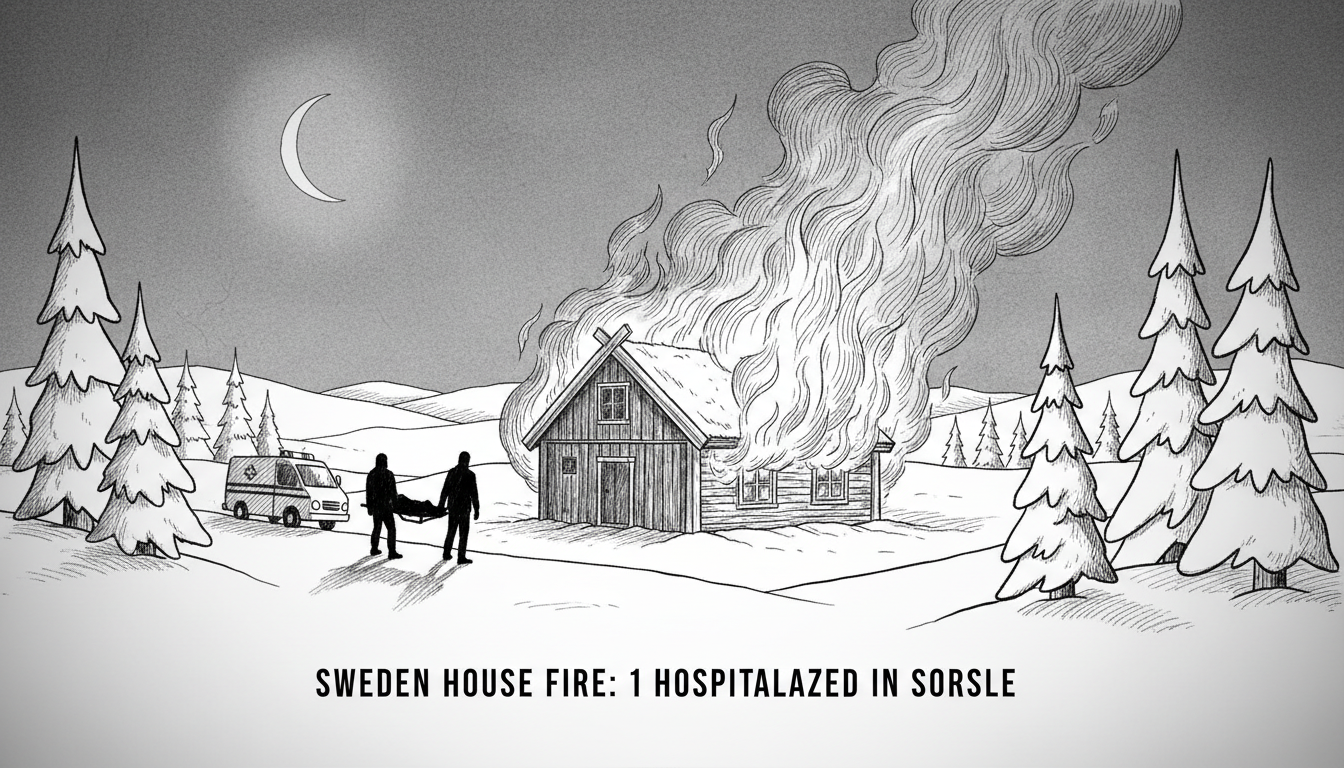
Sweden house fire in the remote municipality of Sorsele has left at least one person hospitalized. The blaze in a single-story villa began around midnight on Wednesday. Emergency services, facing the harsh reality of rural firefighting, made the difficult decision to let the home burn. They focused their efforts on containing the flames and preventing the fire from spreading to the surrounding forest. The condition of the injured person remains unclear, casting a shadow over the small northern community.
This incident, while a personal tragedy for those involved, highlights a broader challenge across Sweden's vast northern landscapes. It raises quiet questions about emergency response in areas where neighbors are few and kilometers are many. The silence of the midnight alarm in Sorsele speaks to a different kind of Swedish experience, far from the well-serviced urban centers.
A Midnight Alarm in the Northern Silence
The call came in around midnight, breaking the deep quiet of a weeknight in Sorsele Kommun. Flames had taken hold of a villa, a family home nestled in the sparsely populated inland of Swedish Lapland. For the local rescue services, the race against time is always measured in distance. Sorsele, with a population density of less than one person per square kilometer in some areas, presents a unique logistical puzzle. Fire stations are few, and crews often cover immense territories. By the time the first responders arrived, the situation was already dire. The villa, engulfed, was beyond saving. The strategic priority shifted from rescue to containment—preventing the wildfire risk of flames jumping to the dry boreal forest.
“In these circumstances, the calculus changes,” explains Lars Pettersson, a retired fire safety officer with experience in northern regions. “The primary mission becomes protecting life first, then preventing an ecological and economic disaster. A house fire can quickly become a forest fire, which is a catastrophe of another magnitude entirely.” The decision to let a property burn is never taken lightly. It is a sober acknowledgment of limited resources and the overwhelming power of fire. For the homeowners, it is a total loss unfolding in real time, witnessed by the very people who came to help.
The Human Cost Behind the Headline
While the physical structure was a loss, the human cost is still being tallied. One person was transported to hospital, a stark reminder that fire is a personal crisis before it is a municipal incident. The specific injuries and their severity have not been disclosed, respecting patient privacy—a hallmark of the Swedish approach. Yet, this single hospitalization represents a profound disruption. In close-knit northern communities, everyone is connected. A crisis for one family resonates through the entire social fabric.
“You don't just lose your things in a fire like this,” says Anna-Karin Lundström, a community support worker in Vilhelmina, a neighboring municipality. “You lose your history, your photographs, the small treasures that anchor a life. In the north, your home is also your refuge against the elements. Losing it creates a deep sense of vulnerability.” The support for the affected family will now come from this network—local social services, the community, and organizations like the Swedish Red Cross. The process of rebuilding is as much about community as it is about construction.
Fire Safety in Sweden's Rural Heartland
This fire brings Sweden's national fire safety conversation into sharp focus, particularly for its rural heartland. Swedish building codes are stringent, and the national emphasis on prevention is strong. Smoke detectors are mandatory and have dramatically reduced fatalities over decades. Yet, the geography of the north introduces variables that a Stockholm apartment block never faces. Response times are longer. The nearest advanced medical care can be hours away by road or air. The houses themselves, often older wooden villas surrounded by trees, present different risks than modern city buildings.
“Prevention is even more critical here,” Pettersson emphasizes. “It’s about defensible space around the property, about ensuring heating sources like chimneys and electrical systems are impeccably maintained. It’s about having a plan, because when you call for help, you are also the first responder.” Many northern municipalities run community preparedness programs, encouraging residents to have fire extinguishers and to understand basic containment. It’s a form of self-reliance woven into the culture, born from an understanding of the distances involved.
The Unseen Challenge of Rural Emergency Services
The Sorsele fire is a case study in the quiet, daily heroism and hardship of Sweden's rural emergency services. The local rescue service, or räddningstjänst, is typically organized at the municipal level. In a region like Sorsele, it may rely heavily on part-time or on-call firefighters—local shopkeepers, foresters, and mechanics who drop everything when the alarm sounds. Their training is excellent, but their resources are finite. A single major incident can stretch a small brigade to its limits, especially during the dry summer months when wildfire risk is high.
These services operate in a constant balance of hope and preparation. They hope for the best but train for the worst-case scenario: a fire in a remote location with high winds. Coordination with neighboring municipalities is essential, as is the use of helicopters for water bombing in inaccessible areas. The financial burden on small municipalities to maintain this readiness is significant, often requiring state subsidies. Every alarm tests a complex, stretched system built on local commitment.
Looking Ahead: Resilience in the Aftermath
As the smoke clears over Sorsele, the process of recovery begins. For the injured individual, it is a path of physical healing. For the family, it involves navigating insurance, finding temporary housing, and facing the emotional toll of loss. For the community, it is a moment to check in on neighbors, to review personal safety plans, and to silently acknowledge a shared vulnerability.
This event will likely prompt local authorities to reiterate fire safety advice. It may lead to conversations about resource allocation for northern rescue services. But more than anything, it underscores a fundamental truth about life in Sweden's vast north: community is the ultimate safety net. The resilience of places like Sorsele isn't found just in emergency protocols, but in the knowledge that people look out for one another. The charred remains of the villa will tell a story of destruction. The community's response in the coming weeks will tell a deeper story of endurance. In the land of the midnight sun, even the darkest hours are met with a determination to rebuild.