
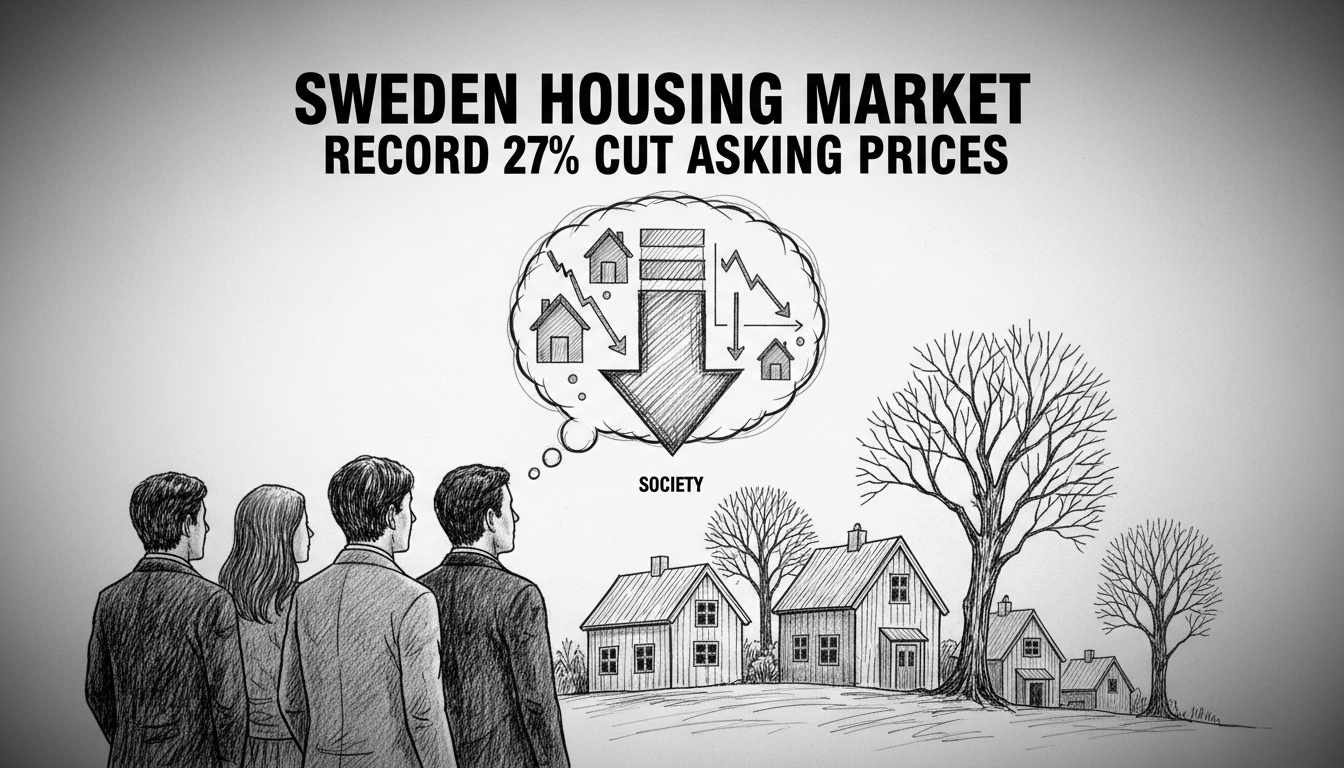
Sweden's real estate market is experiencing a significant correction as a record number of sellers are forced to lower their asking prices. Over 27 percent of home sellers reduced their initial price last month, the highest level ever recorded by property analysts. The average reduction hovers around nine percent, signaling a shift in power from seller to buyer across the country.
For many Swedes, their home is not just a property but a cornerstone of personal finance and family security. This trend of price cuts is more than a statistic; it represents dashed expectations and recalculated futures. In Stockholm neighborhoods like Södermalm and Vasastan, 'Pris Sänkt!' (Price Reduced!) stickers are becoming a common sight on online listings, a quiet testament to a changing market mood.
A Market Adjusts to New Realities
The current wave of price reductions follows a period of rapid growth. For years, low interest rates and intense demand, particularly in major cities, pushed prices upward. Many homeowners came to view consistent annual increases as a given. Now, the economic landscape looks different. Rising interest rates, persistent inflation, and global uncertainty have cooled buyer enthusiasm. "It can be a sign that more people want to sell," said Jennie Leffler, a housing market expert at Booli, whose data revealed the record. "During the autumn, sellers have set their prices a bit too high, given the large supply."
This creates a classic imbalance. Sellers, perhaps remembering last year's prices or needing a certain sum to finance their next purchase, are testing the market with optimistic figures. Buyers, facing higher mortgage costs and a broader selection, are holding their ground. The result is a standoff that increasingly ends with the seller conceding. The current 27% figure is a clear jump from just over 24 percent a year ago, illustrating how quickly sentiment has shifted.
The Human Stories Behind the Statistics
Behind the percentage points are individual calculations and stresses. Take Mikael and Lena, a couple trying to sell their two-bedroom apartment in Stockholm's trendy Hammarby Sjöstad to move to a house in the suburbs. They priced it based on a sale in their building six months ago. After three weeks of viewings and no bids, their agent suggested a 10% cut. "It was a tough pill to swallow," Mikael admits over coffee. "We had already mentally spent that money on garden furniture. Now we're recalculating everything, maybe settling for a smaller renovation budget."
Their experience is echoed in suburbs and smaller cities. In Gothenburg's Majorna district and Malmö's Västra Hamnen, similar negotiations are unfolding. The psychological impact is significant. Swedish culture has a deep connection to property ownership, seen as a key to stability and a reliable pension supplement. A softening market challenges that sense of security.
Economic Forces Reshape the Dream
Several interlinked factors are driving this adjustment. The most direct is the rise in interest rates. The Swedish central bank, the Riksbank, has raised rates to combat inflation. This makes mortgages more expensive, reducing how much buyers can borrow and, therefore, what they can pay. A family that qualified for a 4 million SEK mortgage a year ago might now only be approved for 3.5 million SEK. This fundamental change in purchasing power ripples through the entire market.
Inflation also plays a role. The cost of living has risen sharply, from food to energy. This squeezes household budgets, leaving less room for ambitious housing bids. Furthermore, new construction in many areas, which accelerated during the boom years, has added to the supply. Buyers are no longer fighting over scarce listings; they can afford to be choosy and wait for the right price.
Expert Perspectives on the Road Ahead
Market analysts are watching these trends closely. "We are in a normalization phase," explains financial commentator Erik Huss. "The years of double-digit annual gains were an anomaly. What we see now is a market searching for a sustainable level, where prices better reflect income levels and financing costs." He emphasizes that this is not a crash akin to the 1990s crisis, but a necessary and expected correction.
The big question is how long this phase will last. Much depends on the broader economy. If inflation cools and interest rates stabilize, buyer confidence could slowly return. However, if economic headwinds persist, the period of price adjustments may continue. The high percentage of sellers cutting prices suggests the market has not yet found its floor. Sellers are gradually learning that the pricing strategies of 2021 no longer work in 2024.
Navigating a Buyer's Market
For potential buyers, this environment presents both opportunity and caution. The opportunity lies in increased negotiating power and more choice. It's becoming possible to bid below asking price, a rare feat in recent years. The caution comes from the economic uncertainty. Is now the right time to buy, or will prices dip further? Mortgages are more expensive, so careful budgeting is essential.
For sellers, realism is the new imperative. Pricing a home correctly from the start, based on recent comparable sales in the immediate area, is crucial to avoid a stale listing. A property that sits on the market for months often ends up selling for less than if it had been priced attractively initially. Working with an agent who understands the local micro-market is more valuable than ever.
This shift is more than a financial adjustment; it's a cultural moment. The Swedish housing market, long a topic of dinner party conversation and a source of national pride, is entering a new chapter. It is moving from a speculative frenzy back toward its core function: providing homes. The record number of price cuts is a painful but clear signal of that transition. As the long, dark Swedish winter gives way to spring, the market will reveal whether this is a brief chill or a lasting new season.