
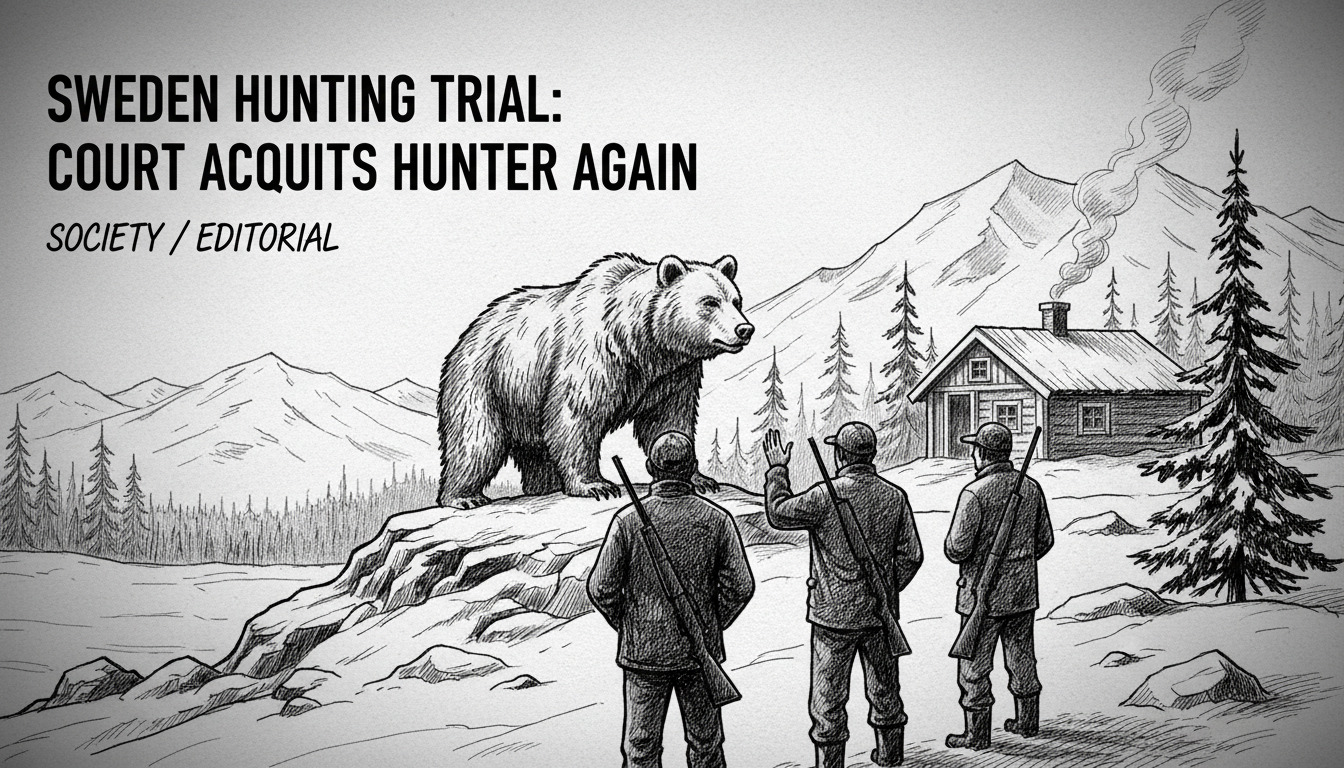
Sweden hunting laws are under scrutiny after a high-profile acquittal in Lycksele District Court. The court cleared hunting personality Robert Salomonsson and a companion of aggravated hunting crimes related to a lynx hunt in Strömsund. This marks the second time Salomonsson has been acquitted of serious hunting charges, raising questions about enforcement, evidence, and the complex relationship between tradition, conservation, and law in Sweden's vast northern forests.
A Second Acquittal in the Northern Woods
The case centered on a March 2022 lynx hunt in Strömsund municipality, Jämtland County. Prosecutors alleged Salomonsson and his hunting companion illegally pursued and killed a lynx within the boundaries of a protected Sami village area. They were also charged with improperly using a snowmobile to track and intercept the animal. The charges carried significant weight, as Sweden's hunting regulations are designed to protect vulnerable species and respect indigenous land rights. Yet, in a press release, Lycksele District Court dismissed the case. The court stated the prosecutor failed to prove the hunters' guilt beyond a reasonable doubt. It was a clear-cut legal decision with murky cultural implications.
"The prosecution is dismissed as the prosecutor has not been able to prove that the defendants have committed a crime," the court wrote. This formal language belies the heated debates simmering beneath the surface of Swedish wildlife management. The court acknowledged the lynx was killed within a Sami village area. However, it accepted the hunters' defense that they believed they were operating in a permitted zone. Furthermore, judges found insufficient evidence to prove the snowmobile was used for the illegal pursuit, a key component of the charge.
The Fine Lines on a Frozen Map
This case highlights a perennial challenge in rural Sweden: the clarity, or lack thereof, of hunting boundaries. The northern landscape is a patchwork of private land, state-owned forests, and Sami reindeer herding territories. Boundaries on a map can be difficult to translate to the featureless, snow-covered terrain of a March forest. "Intent is everything in these cases," explains a Stockholm-based environmental law scholar who requested anonymity due to the topic's sensitivity. "Proving someone knowingly crossed an invisible line in the wilderness is incredibly difficult. The law requires proof of intent, not just the act itself. This creates a high bar for prosecutors."
For the Sami community, whose village area was involved, the decision is likely frustrating. Their land rights and management of reindeer herds, which can be threatened by lynx predation, are central to their culture and livelihood. A hunting violation on their land is not a simple trespass; it's an infringement on a recognized cultural and legal space. The case subtly touches on the ongoing national conversation about Sami rights and the Swedish state's obligation to protect them.
The Lynx: A Protected Predator
The other central figure in this drama is the lynx itself. With an estimated population of only 1,500 individuals in Sweden, the Eurasian lynx is a protected species. Its hunting is strictly regulated through annual quotas set by the Swedish Environmental Protection Agency. Licensed hunters can participate in controlled culls, primarily to manage predation on semi-domesticated reindeer and to address local livestock conflicts. This system aims to balance conservation goals with the practical realities of life in predator territories.
Conservation groups monitor these legal hunts closely. An illegal kill represents a direct threat to a fragile population. "Every individual counts for a species like the lynx," says a representative from the Swedish Society for Nature Conservation. "While regulated hunting has its place in wildlife management, poaching or illegal takes undermine the scientific models and conservation efforts. It erodes public trust in the entire system." The Strömsund case, while ending in acquittal, puts a spotlight on the potential for conflict and the constant pressure on this elusive cat.
A Pattern of Legal Challenges
For Robert Salomonsson, this is familiar territory. In 2019, he was acquitted of similar charges related to a bear hunt in Dorotea. That case also involved questions of location and procedure. To his supporters, two acquittals suggest he is a careful hunter who operates within the gray areas of complex regulations, areas where the state's case repeatedly fails to hold up in court. To critics, it suggests a pattern of pushing boundaries, relying on the inherent difficulty of proof in remote areas to avoid conviction.
His profile as a known hunting figure adds a layer of public interest. In a country where hunting is a widespread tradition, especially in the north, cases like these are watched closely. They are seen as tests of the system. Hunting advocates argue for clearer, more practical regulations and better marking of zones. Law enforcement and conservationists call for stronger tools to prosecute clear violations. The hunter becomes a symbol in a larger debate about access, tradition, and stewardship of the wild.
The Cultural Crossroads of Hunting in Sweden
To understand this story, one must look beyond the courtroom. Hunting in Sweden is not merely a sport; it's a deeply embedded cultural practice, a means of connecting with nature, and for some, a source of food. It is woven into the fabric of allemansrätten, the right of public access. Yet, this freedom comes with great responsibility. The Swedish model is built on trust and a widespread ethic of sustainability. A high-profile trial, regardless of the verdict, shakes that trust.
In Stockholm's urban cafes, the reaction might be one of distaste for hunting altogether. In a stuga (cottage) in Jämtland, the perspective is different. There, people speak of population control, of the thrill of the chase, of meat in the freezer. They talk about the real danger lynx pose to their pets and livestock. The trial in Lycksele is a report from the front lines of this cultural divide. It's about more than one lynx; it's about who gets to decide what happens in the Swedish forest, and how we prove wrongdoing when the only witnesses are trees and snow.
What Happens Next?
The prosecutor's office now faces a decision: to appeal or to let the acquittal stand. An appeal would send the case to a higher court, prolonging the legal saga and amplifying the debate. Either way, the outcome will be dissected in hunting magazines, conservation newsletters, and Sami community meetings. The case underscores a need for potential reforms. Could GPS data from hunting licenses be used to better establish location? Should boundary education for hunters be mandatory? Is the current legal standard for intent workable for protecting sensitive areas and species?
For now, the law has spoken. Two men walked free, their hunt deemed legal in the eyes of the court. A lynx is dead, taken in a zone that holds different meanings for different people. And Sweden's ongoing negotiation with its wild spaces continues, as complex and contested as the frozen landscape of Strömsund itself. The silence after the verdict is not an end, but a pause in a much longer conversation about belonging, nature, and justice under the vast northern sky.