
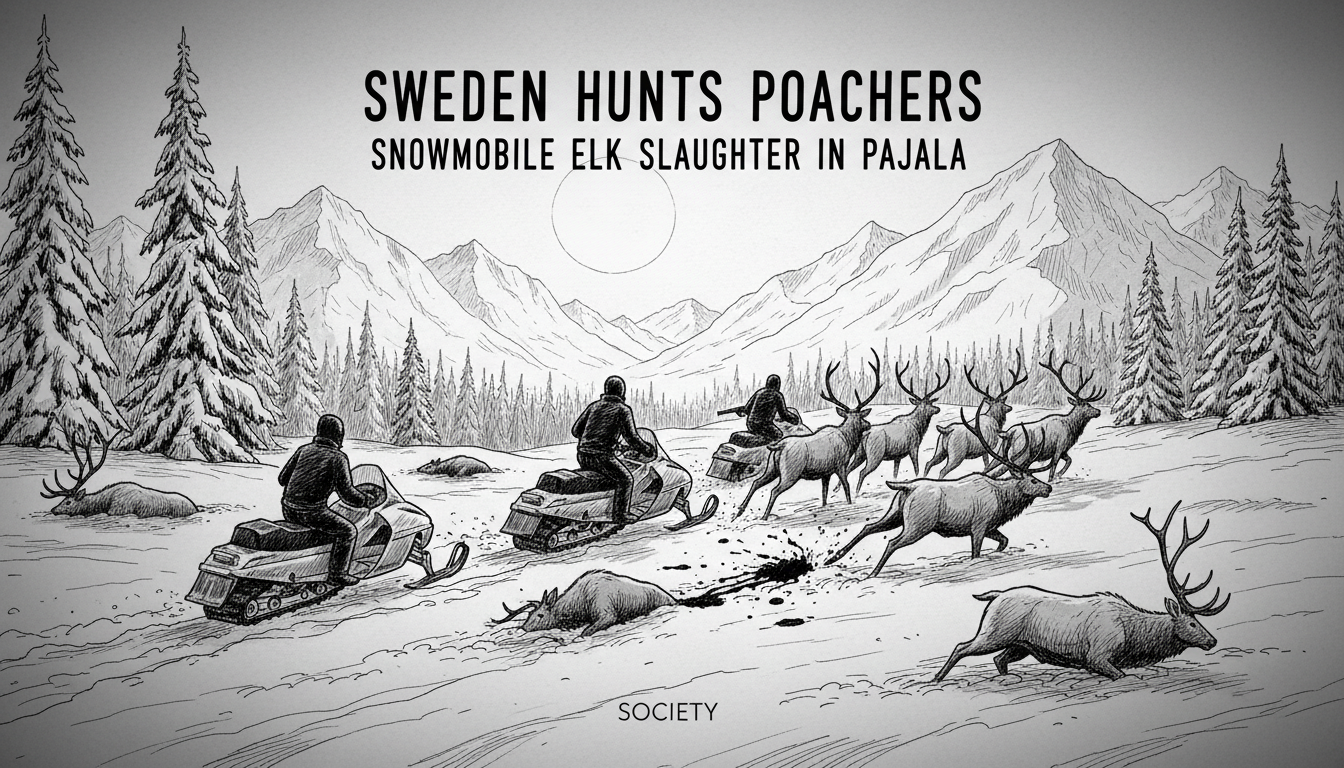
Sweden's northern wilderness is at the center of a major poaching investigation after police discovered multiple illegal elk slaughter sites in Pajala municipality. During a weekend hunting surveillance operation in the public forests west of Tärendö, officers uncovered evidence of what they describe as a serious and organized illegal hunt. The discovery points to a brutal violation of Sweden's strict hunting laws, with snowmobiles used to chase down and kill elk before perpetrators tried to cover their tracks.
A Scene of Disturbing Evidence
Police focused their investigation on an area near Roavaara mountain, where the evidence was particularly clear. Authorities confirmed that at least two snowmobiles were used to pursue elk across the terrain. Hunters then shot two elk directly from their moving vehicles—a practice strictly forbidden under Swedish law. In a deliberate attempt to hide their crime, the individuals then drove their snowmobiles back and forth over the elk tracks and other evidence. The sheer volume of snowmobile tracks in the area suggests this was not an isolated incident. "Given how many snowmobile tracks were in the area, this has probably occurred on a large scale," police stated in their report. The operation has now escalated into a full investigation for aggravated hunting offenses.
The High Stakes of Wildlife Crime in Sweden
In Sweden, hunting is deeply woven into cultural traditions, particularly in northern regions like Norrbotten. It is also tightly regulated. The Swedish Environmental Protection Agency notes that illegal hunting poses a direct threat to wildlife management and biodiversity. Elk are among the most commonly hunted game animals, with seasons and methods strictly controlled to ensure sustainable populations. Using motorized vehicles to hunt gives poachers an unfair advantage, causes severe stress to animals, and disrupts the natural balance authorities work hard to maintain. "The penalty for an aggravated hunting offense is imprisonment for at least six months and at most four years," said Nicklas Berglund, the wildlife crime coordinator for the Norrbotten police region. "If convicted, you get your weapons confiscated and your licenses revoked. Other equipment used in the hunt can also be declared forfeit."
This case in Pajala highlights a persistent conflict between respect for tradition and the rule of law. For many locals, hunting is a way of life and a means of putting food on the table. However, actions like those alleged near Tärendö cross a clear line, moving from subsistence or sport into what authorities classify as serious wildlife crime. The potential consequences are severe, extending beyond prison time. A conviction means losing the right to hunt, potentially for life, and the forfeiture of expensive equipment like snowmobiles and rifles.
The Challenge of Policing Vast Wilderness
The Pajala incident underscores the practical difficulties of enforcing hunting laws in Sweden's expansive northern forests. The terrain is vast, remote, and often inaccessible except by specialized vehicles like the snowmobiles allegedly used in the crime. Police rely heavily on scheduled surveillance operations, tips from the public, and cooperation with local hunting associations. This makes the role of community watchfulness crucial. After announcing the investigation, police immediately appealed for tips from the public, recognizing that locals are often the first to notice suspicious activity in these sparsely populated areas.
Wildlife crime experts often stress that public cooperation is the most effective tool against poaching. Suspicious snowmobile activity out of season, gunshots at odd hours, or the unauthorized butchering of game are typical red flags. In a close-knit community, however, reporting a neighbor carries social weight, creating a barrier to enforcement. The police must balance rigorous investigation with maintaining community trust, a delicate task in rural areas where everyone knows each other.
Cultural Context and the Modern Hunter
To understand the gravity of this crime, one must understand the Swedish concept of "allemansrätten"—the right of public access. The public forests of Pajala where this occurred are land everyone has the right to enjoy responsibly. Poaching violates this collective trust. It also tarnishes the reputation of the vast majority of hunters who follow the rules meticulously, who take marksmanship courses, track quotas, and view hunting as a stewardship of nature rather than a conquest.
Modern Swedish hunting culture emphasizes ethics, sustainability, and respect for the animal. The method alleged in Pajala—chasing an elk with a roaring snowmobile before shooting it—contradicts every one of those principles. It represents a shift from hunting to mere killing, motivated by ease or perhaps the thrill of the chase, with no regard for legal or ethical boundaries. This case will likely reignite debates within hunting associations about self-policing and education to root out such behavior within their own ranks.
What Happens Next in Pajala
The Norrbotten police are now deep into their investigation. They will be examining physical evidence from the slaughter sites, attempting to identify tire and track patterns from the snowmobiles, and following any forensic leads. The charge of "aggravated hunting offense" requires proof that the crime was committed in a particularly reckless or systematic way, which the scale and method of the Pajala incident seem designed to meet. Convictions can set important precedents and act as a deterrent in a region where the wilderness can feel far from the reach of the law.
For the community of Pajala, the news is unsettling. It paints a picture of lawlessness in their backyard forests and creates a rift between those who uphold the law and those who might silently condone or ignore such poaching. The outcome of the case will be watched closely, not just by law enforcement, but by hunters, conservationists, and residents across Norrbotten. It serves as a stark reminder that Sweden's cherished natural landscapes require constant vigilance to protect. The silent, snow-covered forests hold stories, and in this case, they held evidence of a crime that challenges the very ethos of Swedish outdoor life.
Will the vast, quiet landscapes of the north continue to hide such crimes, or will a renewed focus on community and conservation bring them into the light? The answer depends on the ongoing investigation and the values of those who call this wilderness home.