
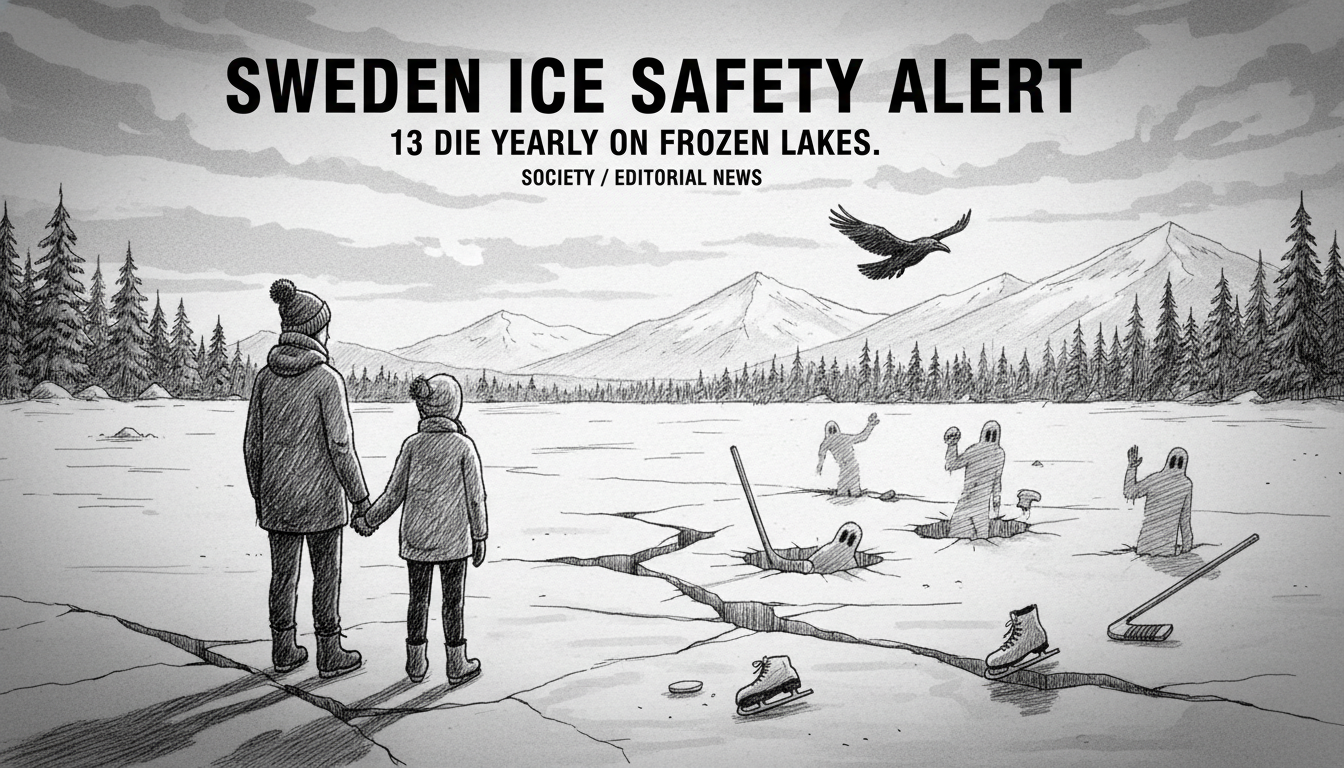
Sweden records around 13 ice-related drowning deaths annually, a stark reality that followed an emergency call on a Småland lake this Wednesday. At 3:20 PM, rescue services and an ambulance raced to the shores of Lake Vidöstern, between the towns of Värnamo and Åminne. A distress call reported someone shouting for help, with initial information suggesting a person had broken through the ice. The tense wait ended around 4:00 PM when a rescue operator confirmed the individual was out of the water and on land, transported to a hospital with no immediate details on their condition released.
This incident on the picturesque Vidöstern, a central feature of the Småland landscape, highlights the precarious dance Swedes have with their frozen winters. The lake, like thousands across the country, transforms into a communal space for skating, ice fishing, and the simple joy of a winter walk. Yet, this familiar tradition carries inherent risks that every Swede learns about, often from childhood. The fluctuating temperatures of a typical Swedish winter—with thawing days and freezing nights—create unstable, unpredictable ice conditions that can betray even the experienced.
A Narrow Escape on Vidöstern
The rescue operation mobilized quickly, a testament to the well-drilled protocols for such alarms. In Sweden, where access to nature is a fundamental right (Allemansrätten), the responsibility for personal safety on ice rests heavily on the individual. "The ice is never 100% safe," says Mats Karlsson, a veteran ice safety instructor based in Jönköping County. "We have a saying: 'Isen bär, tills den går'—the ice holds, until it doesn't. This winter has been particularly tricky with mild spells. What was 20 centimeters thick and safe last week could be 5 centimeters of rotten ice today."
Local residents in Värnamo often frequent Vidöstern for winter activities. Johan, a local fisherman who preferred not to give his last name, was near the lake earlier that day. "You see people out there all the time," he says, gesturing towards the expanse of white. "Families skating, people with ice augers. We all know the risks, but it's part of life here. You learn to read the ice—the color, the sounds. But sometimes, it's just bad luck." The area between Värnamo and Åminne is not known as a particular trouble spot, which underscores the universal nature of the danger.
The Cultural Context of Ice in Sweden
To understand the incident, one must understand the cultural weight of winter in Swedish society. It's not just a season; it's a series of rituals. From the iconic Vasaloppet ski race to neighborhood ice rinks flooded on soccer fields, embracing the cold is a point of pride. In Stockholm, parks like Kungsträdgården host bustling public skating rinks, while the archipelago's frozen waterways become ice-skating highways. This deep cultural embrace makes safety messages both critical and challenging. The Swedish Civil Contingencies Agency (MSB) and the Swedish Society for Rescue Services (Räddningssällskapet) run perennial campaigns. Their core advice is simple: never go alone, tell someone where you are going, check official ice reports, and carry ice picks and a life buoy.
Expert recommendations are specific. For walking alone, a minimum of 10 centimeters of clear, solid ice is required. For a small group to gather, it should be at least 15 centimeters. Snowmobile riders need at least 25 centimeters. "The problem is, you can't judge by looking," explains Karlsson. "You need to check with an ice auger every 20 meters. And be especially cautious near streams, currents, or where reeds stick through—these areas freeze last and thaw first."
When Tradition Meets a Changing Climate
This near-tragedy arrives amid growing discussions about how a warming climate is altering Swedish winters. Milder, shorter freeze periods are becoming more common, leading to less stable ice over shorter seasons. "The patterns our grandparents relied on are less predictable," notes climate researcher Elin Strand, who studies winter ecology. "We're seeing more freeze-thaw cycles within a single week. This creates layered ice, which is much weaker than solid, clear ice formed during a steady cold spell. The risk profile is changing."
This adds a new layer of complexity to a traditional Swedish lifestyle. Municipalities across the country, from the northern lakes of Lappland to southern hubs like Värnamo, face increasing costs and challenges in maintaining safe, designated winter activity areas. Many now use technology, like satellite ice-thickness mapping, to inform public warnings. However, for the vast majority of Sweden's 100,000 lakes, the responsibility remains personal.
The Aftermath and the Way Forward
As the individual from the Vidöstern incident recovers, the event serves as a somber, real-time reminder for communities across Småland and beyond. It’s a story that replays with tragic regularity each winter. The Swedish Society for Rescue Services reports that, in addition to the roughly 13 annual deaths, many more non-fatal incidents occur, often going unreported. They emphasize the "life chain" method: if someone falls in, the rescuer should never stand up on the ice near the hole but instead lie flat to distribute weight, use a rope or extended object, and call 112 immediately.
In Värnamo, life will continue alongside the frozen lake. Children will still lace up their skates, and fishers will still drill their holes. But for a moment this week, the community was reminded of the thin line between a cherished winter pastime and a crisis. The incident reinforces a core tenet of the Swedish relationship with nature: freedom comes with profound responsibility. As the light fades early over Vidöstern, the hope is that this story ends only as a warning heeded, not a tragedy mourned. Will the shifting climate force a fundamental change in how Swedes interact with their frozen landscapes, or will adaptation and respect for ancient dangers be enough?