
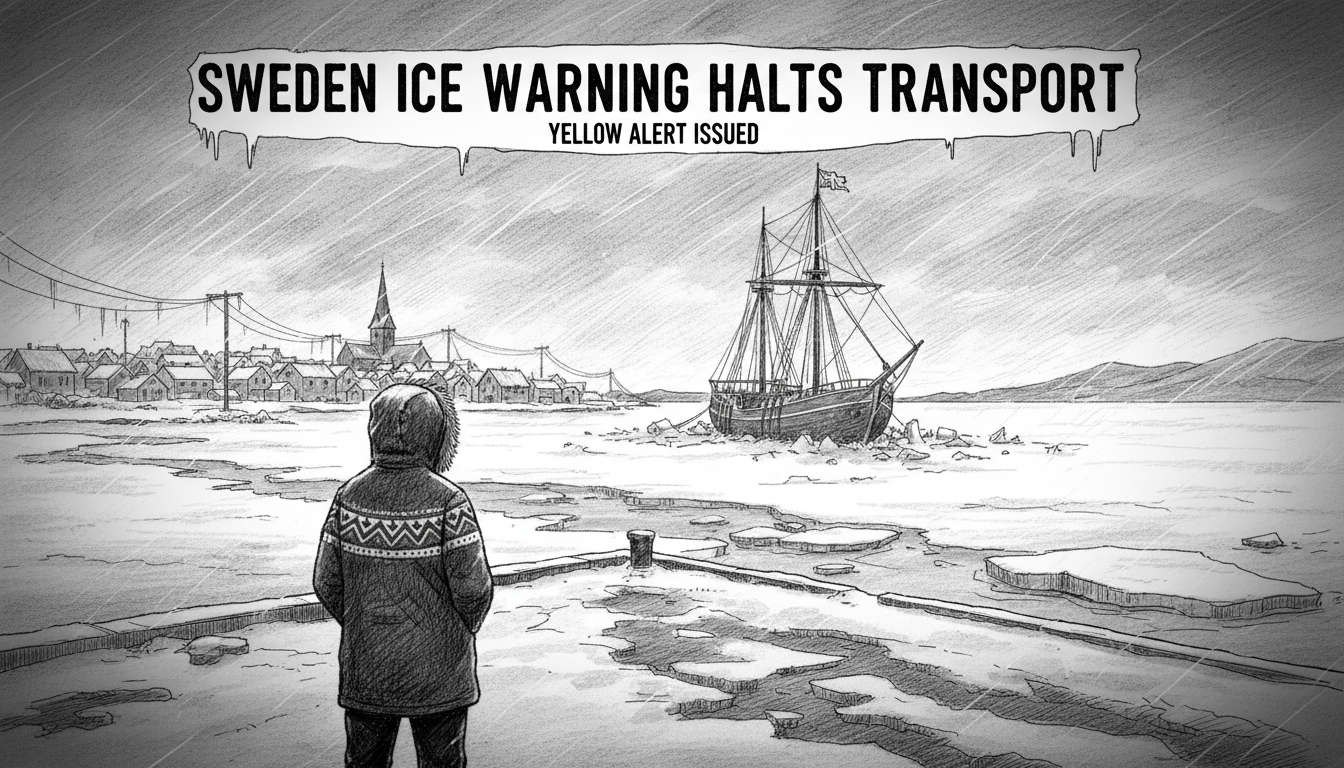
Sweden's sudden ice warning has brought public transport to a standstill in the north. The Swedish Meteorological and Hydrological Institute (SMHI) has issued a yellow warning for treacherous black ice across coastal Norrbotten, with bus services in Luleå suspended indefinitely. The alert extends to large parts of Jämtland, Västernorrland, and northern Värmland, Dalarna, and Gävleborg, as rain threatens to freeze instantly on cold road surfaces.
For residents like Luleå commuter Anna Pettersson, the announcement meant an unexpected change of plans. "I heard the buses were cancelled just as I was leaving work," she said, wrapping her scarf tighter against the damp chill. "It's this time of year—you think you're past the worst winter weather, and then the ice comes back. Now I'm waiting for a taxi, hoping the roads aren't too slick already." Her experience echoes across the affected regions, where the simple act of getting home becomes a calculated risk.
The Silent Hazard of Spring Ice
This phenomenon, known as 'plötslig ishalka' or sudden ice slip, is a notorious feature of the Swedish climate during seasonal transitions. While deep winter brings predictable snow and cold, the shoulder seasons of late autumn and early spring create perfect conditions for black ice. Warmer rain falls onto road surfaces that have remained below freezing, creating an invisible, glass-smooth layer that offers almost no traction. "It's one of the most dangerous weather situations for drivers," explains meteorologist Erik Lundqvist, who has analyzed Nordic weather patterns for fifteen years. "The ice forms so quickly that road treatment crews can't keep up. One minute the asphalt looks wet, the next it's a skating rink."
The SMHI's color-coded warning system is a critical tool for public safety. A yellow warning, like the one currently active, signifies a potential threat to the public. It advises caution and prompts municipalities and transport operators to take preventative action. The decision by Luleå's public transport authority to halt all bus traffic is a direct and standard response to such a warning, prioritizing passenger and driver safety over schedule adherence.
A Society Forced to Pause
The impact of the 'gul varning' ripples through daily life. Beyond cancelled buses, schools in some rural areas of Jämtland have sent alerts to parents about potentially hazardous conditions for walking or cycling. Local delivery services are reporting delays, and event organizers are nervously checking forecasts. In a society known for its efficiency and punctuality, the weather forces an uncharacteristic pause. This collective slowdown is a recurring, if frustrating, part of the Swedish relationship with nature. There's a cultural acceptance, a recognition that the environment ultimately sets the terms.
This is reflected in the practical adaptations Swedes make. The legal requirement for winter tires (vinterdäck) remains in effect until a date determined by region, often well into April, precisely for these unpredictable icy patches. Many drivers also keep a set of studded tires for the harshest conditions. The national transport administration runs constant weather station monitoring on major highways, but on secondary and municipal roads, the responsibility falls heavily on individual caution.
Expert Advice for Navigating the Glare Ice
Road safety organizations are reiterating core advice for those who must travel. The key is extreme moderation in speed and movement. "Increase your following distance to at least triple the normal amount," advises Sara Lindholm from the Swedish National Road Safety Council. "Avoid any sudden actions—no sharp steering, hard braking, or rapid acceleration. If you do start to skid, steer gently in the direction you want the front of the car to go and try not to panic." For pedestrians, the advice is to wear shoes with good grip and to assume that any wet-looking pavement could be icy.
The economic cost of such weather disruptions is significant but rarely quantified in the moment. Lost work hours, cancelled commercial deliveries, and the strain on emergency services all add up. However, the Swedish approach is firmly rooted in a precautionary principle. The cost of a major multi-vehicle collision on an icy highway, both in human and financial terms, far outweighs the cost of suspending bus services for a day.
Living with Nature's Unpredictability
This event is a stark reminder of the power of natural forces, even in a highly modernized nation. It highlights the infrastructure and societal systems built to manage these forces, from SMHI's forecasting to municipal crisis protocols. For new residents and immigrants, experiencing a sudden ice warning is a rite of passage into Swedish life. It's a lesson in respecting the climate and adapting one's rhythm to its demands.
As the afternoon light fades over Luleå, the temperature is expected to drop further, solidifying the risk. Maintenance crews are on standby, ready to salt and sand the roads once the precipitation passes. For now, the community waits. The suspended bus services will only resume when transport officials deem the roads consistently safe again—a decision made with patience, not haste.
Will this be the last ice warning of the season, or is winter offering a final, slippery challenge before spring truly takes hold? The uncertainty itself is part of the seasonal shift. In Sweden, you learn to check the weather forecast, to heed the yellow warnings, and to understand that sometimes, the only sensible thing to do is to simply ställa in allt—cancel everything—and wait for safer ground.