
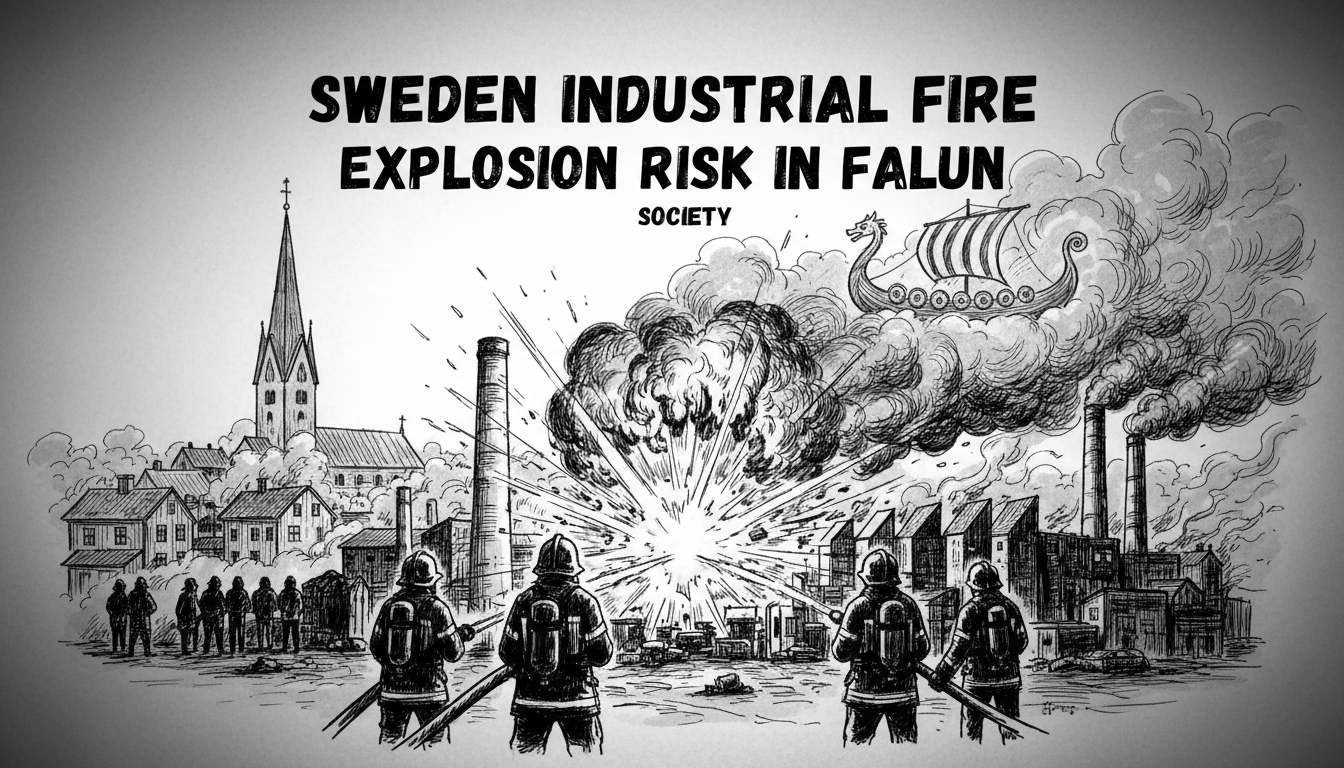
Sweden's emergency services are battling a major industrial fire in Falun, with officials warning of a significant explosion risk. The blaze, involving open flames, broke out in an industrial facility containing welding equipment and oxygen tanks. Rescue commander Henrik Eriksson confirmed the dangerous situation, stating the presence of such materials creates a volatile environment. This incident throws a spotlight on the safety protocols within Sweden's industrial heartlands, far from the cosmopolitan buzz of Stockholm.
For residents of this historic city, the sight of emergency vehicles racing towards the industrial zone is a stark contrast to its usual calm. Falun is better known for its UNESCO-listed copper mine and picturesque landscapes than for industrial emergencies. The immediate area around the fire has been secured, with a safety perimeter established to protect the public. The specific industry involved has not been disclosed, leaving locals anxious for details.
A Tense Afternoon in Dalarna
The alarm sounded in Falun, the capital of Dalarna county, a region deeply woven into Sweden's cultural and industrial identity. This is not just any Swedish town; it's the home of the iconic Falu red paint that colors countless countryside cottages. Today, that familiar hue is overshadowed by the orange glow of flames and the blue lights of emergency responders. The community is holding its breath, hoping the expertise of the rescue services will prevent a catastrophe.
Local reports describe a response involving multiple fire crews, all coordinating under a unified command. Their primary focus is cooling the site and preventing the ignition of the oxygen tanks, a standard but critical procedure in such hazardous material fires. "When you have compressed gases and open flames, the situation can change in seconds," a former fire safety inspector, who wished to remain anonymous, explained. "The teams on the ground are trained for this, but it's always a high-stakes operation."
Understanding the Industrial Landscape
Falun's economy, like many in central Sweden, has long been tied to industry and manufacturing. While the great copper mine is now a museum, the area hosts a variety of smaller manufacturing plants, workshops, and logistics hubs. These businesses are the backbone of the local economy but come with inherent risks. The presence of welding equipment is common in many such facilities, used for everything from metal fabrication to machinery repair.
This incident raises quiet questions about safety inspections and preparedness in smaller industrial units. Sweden has stringent workplace safety laws governed by the Swedish Work Environment Authority. However, compliance and risk management can vary. "Every facility using gases like oxygen must have clear emergency plans," said Karin Lindström, a safety engineer based in Gävle. "The key is not just having the plan, but regularly drilling it. Human error or equipment failure can quickly escalate a small fire into a major threat."
The Human Element of a Community on Alert
Beyond the technical response, there's a human story unfolding. Families living near the industrial zone have been advised to stay indoors and keep windows closed as a precaution against potential smoke or debris. For the workers who clock in at these facilities every day, it’s a chilling reminder of the dangers that can lurk in a familiar workplace. This isn't a abstract news story for them; it's about their livelihood and their community's safety.
Swedish society places immense trust in its public institutions, from healthcare to rescue services. An event like this tests that trust in real-time. Residents are relying on the clear communication and professional competence of the responders. The cultural expectation is one of transparency and efficiency, a standard the authorities are now working to meet under intense pressure. The community will later seek answers on how this started and how to prevent a repeat.
A Look at Sweden's Broader Safety Record
Sweden generally boasts a strong industrial safety record, with fatal workplace accidents becoming increasingly rare. This is attributed to a robust model of cooperation between employers, unions, and regulators. However, serious fires and near-misses still occur, often serving as critical learning moments for entire sectors. The aftermath of this fire will likely involve a detailed investigation by both the rescue services and the Work Environment Authority.
Comparatively, the Swedish approach to industrial risk is considered proactive, focusing on prevention rather than just response. Yet, today in Falun, the response is everything. The success of their efforts won't be measured in headlines, but in the absence of an explosion. It will be measured by workers returning to their families tonight, and by a community that can breathe a sigh of relief instead of dealing with tragedy.
The Road Ahead for Falun
As the firefighting operation continues, the immediate danger will hopefully be contained. The longer-term process will then begin. For the business affected, the path involves assessing devastating damage, navigating insurance, and supporting displaced employees. For the town of Falun, it’s a moment of reflection. How does a community that treasures its deep history and natural beauty balance the economic necessities of industry with the paramount need for safety?
This fire, now a plume of smoke over a Dalarna afternoon, is a disruption to the Swedish ideal of trygghet—a sense of security and predictability. It’s a reminder that safety is a daily practice, not a guarantee. The people of Falun, known for their resilience, will now watch closely. They will watch the smoke clear, listen for the all-clear signal, and then ask the necessary questions about how to better protect the quiet rhythm of their lives from the sudden chaos of an industrial flame.