
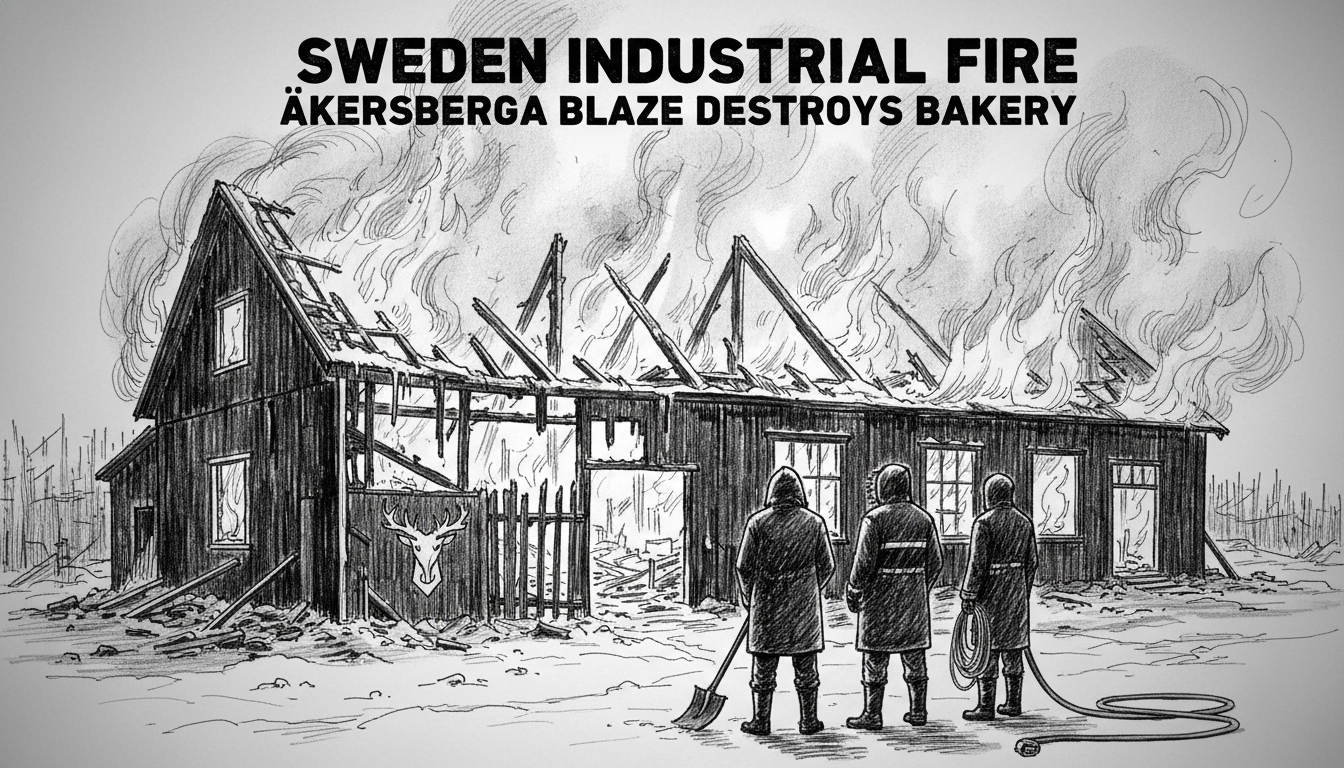
Sweden's emergency services are battling a major industrial fire in Åkersberga that they say is beyond saving. The blaze erupted in a former bakery on Centralvägen early this morning, with crews now focused on preventing its spread to neighboring buildings in the industrial area. For residents of this quiet Stockholm archipelago community, the plume of smoke visible for miles marks a startling disruption.
"It was 5:21 when the alarm came in," a spokesperson for the rescue service said. "A building on Centralvägen, likely an old bakery, was on fire." By 7 a.m., a large-scale operation was underway. Firefighters face a prolonged battle. Officials have no estimate for when the flames will be fully extinguished and expect crews to remain on site for many hours.
A Community Awakened by Flames
Åkersberga, the administrative heart of Österåker Municipality, is typically known for its residential calm. Located about 30 kilometers northeast of Stockholm city center, it's a place of commuters and archipelago access. The industrial zone along Centralvägen, with its mix of workshops and storage units, represents a smaller part of the local economy. This morning, it became the center of a crisis. The specific cause of the fire is unknown, and no injuries have been reported. The primary goal now is containment.
"The main effort is to stop the fire from reaching other buildings in the industrial area," the rescue service confirmed. This strategy is common in large industrial fires where the original structure is a total loss. The focus shifts to creating firebreaks and protecting exposures. For the 47,000 residents of Österåker Municipality, the event is a rare and alarming spectacle. Social media feeds filled with images of the dark smoke against the dawn sky, a jarring sight in a community more associated with pine forests and water views.
The Challenges of an Industrial Blaze
Fighting an industrial fire presents unique hurdles. These buildings are often large, with open spaces that allow fire to spread rapidly. They can contain unknown or hazardous materials, from chemicals to stored fuels. Old structures, like the suspected former bakery, may not have modern fire compartmentalization. Fire safety expert Lars Pettersson, who has worked with municipal safety boards, explains the tactical shift.
"When a building is fully involved and deemed unsavable, the operation changes fundamentally," Pettersson says. "You move from an offensive, interior attack to a defensive, exterior one. Water is applied from a safe distance to cool adjacent structures and control the fire's path. The priority is life safety first, then preventing a domino effect." The environmental risk is also a concern. Burning materials can release pollutants into the air, and runoff water from firefighting can contaminate soil and local waterways. Specialized environmental units often join these incidents to monitor and mitigate such damage.
The Human and Economic Impact
Beyond the flames, the fire's impact will ripple through the local community. The building's owner faces a total loss. Any businesses operating within it have seen their assets destroyed. Neighboring industrial units may face disruption due to road closures, smoke damage, or utility shut-offs. For employees, there is immediate uncertainty. While industrial zones are less populated at night, preventing potential tragedy, the economic aftermath is significant.
Local resident Anna Karlsson, who lives a few kilometers from Centralvägen, spoke of the community's reaction. "You never expect this here. You see the news about big fires in other places, but not in Åkersberga. It's shocking. My first thought was for the people who might work there, and then for the firefighters taking such a risk." This sentiment echoes across a municipality where people often know each other, directly or indirectly. The sight of emergency vehicles from multiple stations converging on a familiar road is deeply unsettling.
A Long Haul for Firefighters
The rescue service's statement that work will continue for "several hours" underscores the scale of the task. After the main body of fire is knocked down, the mop-up phase begins. This involves excavating hot spots within the rubble to ensure no hidden fire reignites. It is labor-intensive, slow, and dangerous work. Investigators will also need to wait until the site is cool and safe enough to enter to begin determining the fire's origin and cause—a process that could take days or weeks.
Industrial fires, while less common than residential ones, often demand more resources. They can drain local fire department capacities, requiring mutual aid from surrounding districts. This collaboration is a key part of Sweden's emergency response framework, ensuring that even smaller municipalities can access the manpower and equipment needed for a sustained fight. The response in Åkersberga likely involves this coordinated effort.
Prevention and Lessons in the Ashes
Every major fire prompts questions about prevention. For industrial properties, this includes regular safety inspections, clear storage protocols for flammable goods, and maintained fire suppression systems like sprinklers. Building age is a factor; older structures were built under different codes. Pettersson notes that community awareness is also crucial. "These events are a stark reminder for all business owners to review their fire safety plans. Do employees know evacuation routes? Are flammable materials stored correctly? Is electrical equipment in good order? Complacency is the enemy."
For Österåker Municipality, the coming days will involve supporting the affected business owners, managing environmental assessments, and reviewing local response protocols. The community will watch as the smoke clears, revealing the charred skeleton of a local landmark. The bakery, a piece of the area's commercial history, is gone.
Looking Ahead in Åkersberga
The fire on Centralvägen will be the topic of conversation in Åkersberga's cafes and supermarkets for weeks. It is a disruptive event in a community built on stability and quietude. The resilience of the community will show in how it supports those impacted and how local authorities learn from the incident. The firefighters, working their long shift in the industrial zone, embody the public service that often goes unnoticed until crisis strikes.
As the operation continues, the questions will slowly shift from "How did this happen?" to "What comes next?" The plot of land on Centralvägen will eventually be cleared. New plans will be drawn. But for now, the focus remains on the slow, grueling work of putting the last of the flames to rest and ensuring the safety of the surrounding neighborhood. In the Stockholm archipelago, a community is reminded that safety can never be taken for granted, and that sometimes, the morning sky brings an unexpected and harsh light.