
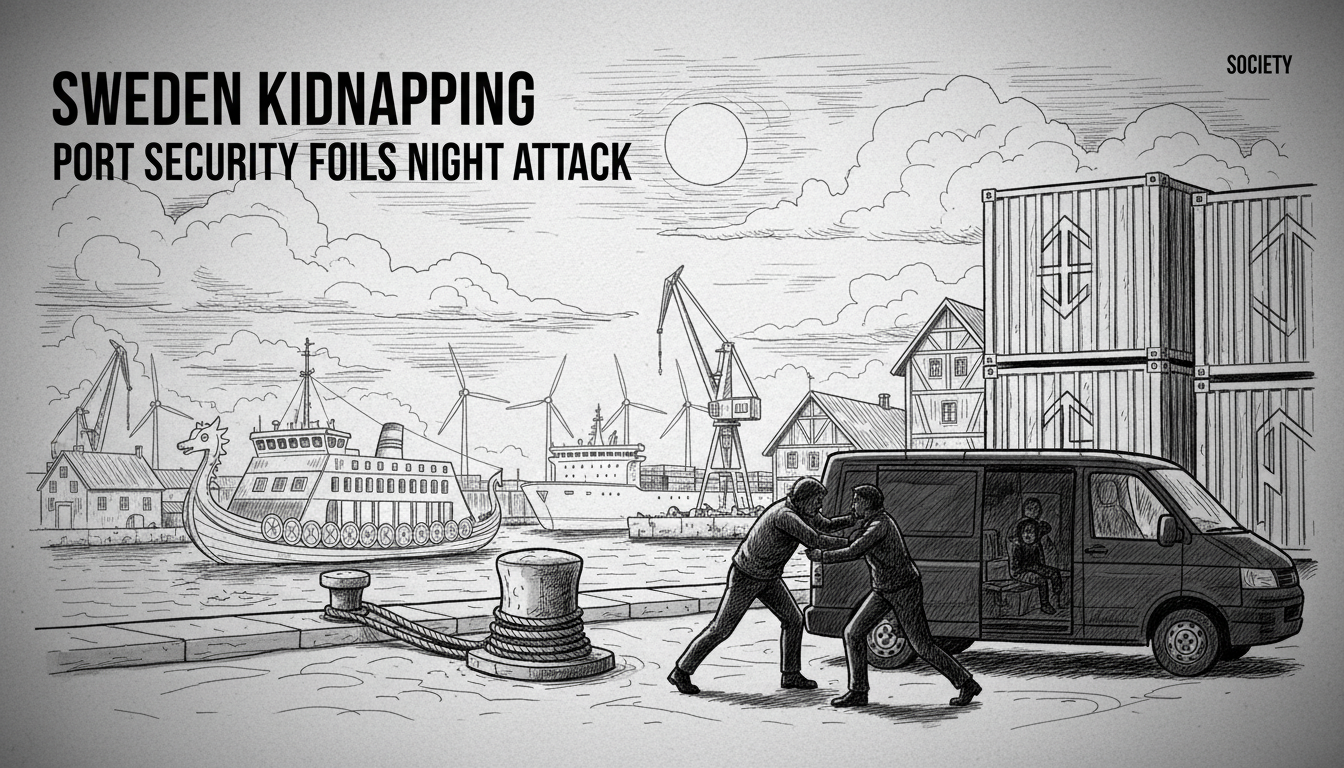
Sweden kidnapping cases grab headlines, but the story of one Gothenburg woman ended not in tragedy, but thanks to the vigilance of port security guards. A man forced a woman into a car against her will in the early hours of Saturday morning. His plan unraveled minutes later in the industrial maze of the Port of Gothenburg, leading to a dramatic arrest. This incident offers a stark look at random violence, swift police response, and the quiet heroes of Sweden’s second city.
A Night Interrupted in Gothenburg's Port
Just after 2 a.m. on Saturday, the sprawling Port of Gothenburg was quiet. Security guards on their routine patrol noticed a car that seemed out of place. It had no apparent business in the secure port area. Adam Isaksson Samara, press spokesperson for the local police, described the scene. “They didn’t seem to have any business in the Port of Gothenburg, but had ended up there by chance,” he said. When the guards approached to check the vehicle, the driver panicked. The car suddenly accelerated, crashing into a fence before reversing into the security guards' own vehicle. In the chaos that followed, the true nature of the situation became clear. The female passenger told the guards she had been forced into the car against her will.
The Legal Reckoning for Deprivation of Liberty
The man was swiftly apprehended by police called to the scene. He is now suspected of a range of crimes, with unlawful deprivation of liberty—Sweden's legal term for kidnapping—at the core. Under Swedish law, this crime carries penalties that vary greatly. The severity depends on the duration of the confinement, whether violence or threats were used, and the level of suffering inflicted on the victim. Legal experts note that a conviction in a case like this, with a quick intervention, would be judged differently than a prolonged abduction. “The law recognizes degrees of severity,” explains Lena Månsson, a Stockholm-based legal scholar. “An abduction lasting minutes, while terrifying, is legally distinct from one lasting days. The use of coercion to force someone into a vehicle is, in itself, a very serious act.” The suspect remains in custody as the investigation continues.
The Human Story Behind the Crime Statistics
While Sweden maintains a relatively low rate of violent crime overall, incidents like this resonate deeply. They shatter the sense of safety many associate with Swedish society. The victim, whose identity is protected, experienced a terrifying violation of her personal freedom. Crime analysts often point out that most kidnappings in Sweden are not random. They frequently occur in contexts of domestic disputes or organized crime. This appears to be a more random, opportunistic attack, which is particularly unsettling for the public. “When a crime like this seems random, it challenges our fundamental understanding of risk,” says criminologist Erik Dahlström. “People can’t rationalize it by saying ‘don’t get involved with certain groups.’ It makes everyone feel more vulnerable.” The quick resolution, however, is a positive sign of effective systems working.
Port Guards: The Unexpected First Responders
This story highlights a crucial, often overlooked, layer of urban security: private security personnel. The guards in the Port of Gothenburg were not police, but their trained suspicion and protocol-driven approach triggered the entire intervention. Their decision to investigate an anomalous vehicle in a restricted area set off the chain of events that freed the woman. In many Swedish cities, especially in transport hubs and industrial zones, these guards form a vital network of observant eyes. “This is a perfect example of collaboration between private security and the police,” says security analyst Petra Holmgren. “The guards identified a threat, contained the situation as best they could, and immediately brought in the authorities. It’s a model that works.” Without their action, the car might have slipped back into the night streets of Hisingen or central Gothenburg.
Gothenburg's Context: Industry and Community
Gothenburg, or Göteborg, is Sweden's proud second city. Known for its friendly locals, iconic trams, and maritime history, it’s a city of industry and culture. The port itself is the largest in the Nordic countries. Incidents of violent crime here are rare enough to cause significant alarm. The city, currently buzzing with preparations for summer events like the Göteborg Culture Festival, is now grappling with this darker headline. The incident occurred far from the cozy cafes of Haga or the bustling Avenyn boulevard, in a functional industrial landscape. Yet, it reminds residents that safety is a shared responsibility. Local community leaders often stress the importance of reporting suspicious activity, a principle that the port guards embodied perfectly.
A Look at Sweden's Broader Crime Landscape
This case will inevitably feed into ongoing debates about crime and safety in Sweden. Politicians and policymakers frequently discuss resource allocation for police, sentencing guidelines for violent crimes, and support services for victims. While international headlines sometimes exaggerate trends, the Swedish government's own statistics show that reported cases of unlawful deprivation of liberty have seen fluctuations over the past decade. Each number represents a personal story of trauma. The efficiency of the response in Gothenburg will be cited as an example of successful policing and surveillance. However, experts caution against drawing broad conclusions from single events. “One case does not make a trend,” Dahlström notes. “But it does provide a critical data point on response times, inter-agency cooperation, and the importance of securing rapid victim testimony.”
The woman involved is now receiving the support she needs. The suspect faces a rigorous legal process. As the investigation moves from the port to the prosecutor’s desk, the city continues its rhythm. The story is a jarring mix of modern urban fear and classic Swedish efficiency—a crime was attempted, and within moments, it was stopped. It leaves behind a simple, uncomfortable question for residents of any city: How much do we rely on the watchful eyes of strangers, and what happens when they look away?