
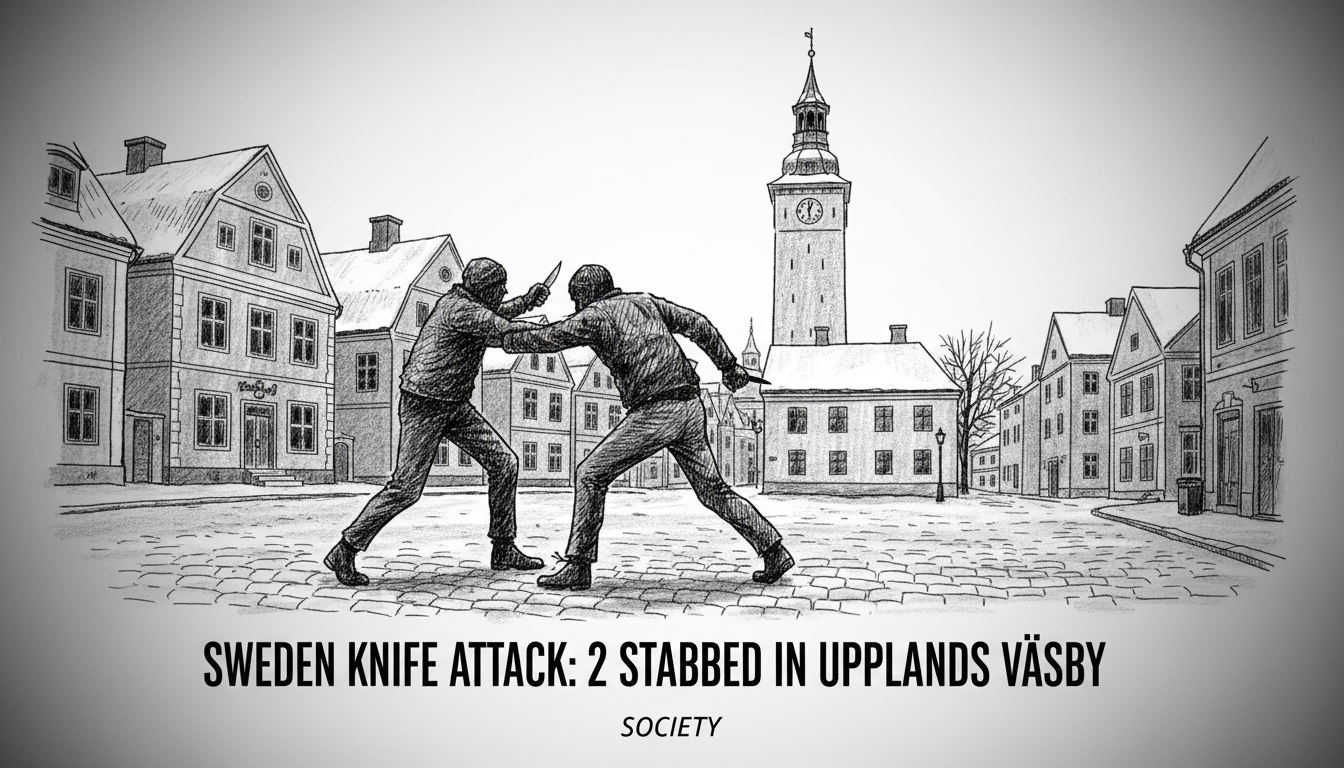
Sweden knife crime concerns resurfaced this morning after two people were stabbed in Upplands Väsby, a municipality just north of Stockholm. The police alarm came in at 7:30 AM, casting a shadow over what should have been an ordinary Tuesday commute. Details remain sparse, but the incident has already sparked conversations about safety in Stockholm's suburbs.
"Right now it's too early to say if we will initiate a criminal investigation or not," said police spokesperson Anders Bryngelsson in a brief statement. The victims' conditions and the circumstances leading to the attack are still unclear. For residents of Upplands Väsby, a community of over 50,000 people known for its mix of residential areas and shopping centers, the news brought a jarring sense of disruption.
A Suburban Morning Shattered
Upplands Väsby is typically a quiet commuter town. Many residents work in Stockholm, just a 25-minute train ride away. The morning stabbing occurred as people were heading to work or school. Local shops near the suspected area were opening their doors. The swift police response and cordoned-off scenes created an atmosphere of unease. This kind of violent incident feels alien here, yet it taps into a broader national anxiety.
Sweden has generally low levels of violent crime internationally. However, recent years have seen a troubling focus on knife violence and gang-related conflicts, often spilling into public spaces. While this specific incident's motives are unknown, it inevitably touches a nerve. People are asking if their neighborhoods are changing.
The Numbers Behind the Headlines
To understand the context, we must look at the data. In 2023, Sweden reported 117 homicides, according to the Swedish National Council for Crime Prevention (Brå). That was a decrease from 124 in 2022. Yet, reports of assault resulting in bodily harm increased by 6% in the same period. These statistics paint a complex picture. Overall deadly violence may fluctuate, but reports of serious physical attacks are rising.
Knife crime is a specific part of this puzzle. It is not as prevalent as in some other European nations, but its visibility and impact are profound. Attacks often involve young people, both as perpetrators and victims. They occur in schools, outside fast-food restaurants, and on public transport. Each incident fuels a debate about root causes and solutions.
Experts Point to Deeper Social Currents
Criminologists and social workers point to a confluence of factors. Socioeconomic segregation is a recurring theme. Many suburbs north and west of Stockholm, while not impoverished, struggle with higher unemployment and lower educational outcomes compared to inner-city districts. This can create fertile ground for alienation.
"We cannot view these incidents in isolation," says Lena Korsell, a researcher who has studied youth crime. "They often connect to deeper issues of identity, belonging, and opportunity. When young men feel they have no future, conflict can become a currency of respect." Gang recruitment is a real concern in certain areas, offering a twisted sense of community and income where legal paths seem blocked.
Mental health support is another critical piece. Police responses are crucial, but prevention requires early intervention by social services and schools. The challenge is immense, requiring coordination between municipalities, police, and non-profit organizations.
Life in Stockholm's Commuter Belt
Returning to Upplands Väsby, the incident disrupts a specific Swedish lifestyle. This is the land of the villa – the detached family home – and the daily pendeltåg (commuter train) ride. It represents a middle-class dream: green spaces, good schools, and a quick connection to the capital's culture and jobs. A violent stabbing clashes violently with that image.
Residents I spoke to expressed shock and sadness. "You hear about these things in other places, not here on your doorstep," said Anna, a local teacher who asked not to use her full name. "My students will have questions. How do we explain this while making them feel safe?" This is the human impact beyond the crime statistics. It's about the erosion of a fundamental sense of security.
A National Conversation Revisited
Every incident like this reignites a fierce national debate. Some call for tougher policing and stricter sentencing. Others advocate for massive investment in social programs, youth centers, and job creation in vulnerable areas. The political landscape is polarized around these questions.
The truth likely lies in a balanced approach. Effective law enforcement is necessary to address immediate threats and bring perpetrators to justice. As Anders Bryngelsson's statement indicates, the police process is just beginning. But long-term change requires tackling the social conditions that allow violence to take root.
Community initiatives are already working on this. In suburbs like Tensta and Rinkeby, local heroes run boxing clubs and mentorship programs to steer youth away from trouble. These efforts rarely make headlines, but they are essential. They build resilience from the ground up.
Looking Ahead: Safety and Solidarity
As the investigation in Upplands Väsby continues, two families are coping with trauma. A community is grappling with fear. Sweden is confronting a stubborn social challenge. The path forward is not simple.
It requires honesty about the problems without resorting to alarmism. Sweden remains a very safe country for most of its residents. Yet, ignoring the pockets of intense violence does a disservice to those living there. The solution must combine a firm legal response with compassionate social investment.
Will this morning's stabbing become a forgotten statistic or a catalyst for meaningful action in Upplands Väsby? The answer depends on what happens next – not just in the police investigation, but in the community meetings, school classrooms, and political halls where Sweden's future safety is being shaped. The goal is clear: to ensure that a morning commute is just a commute, not a moment of danger.