
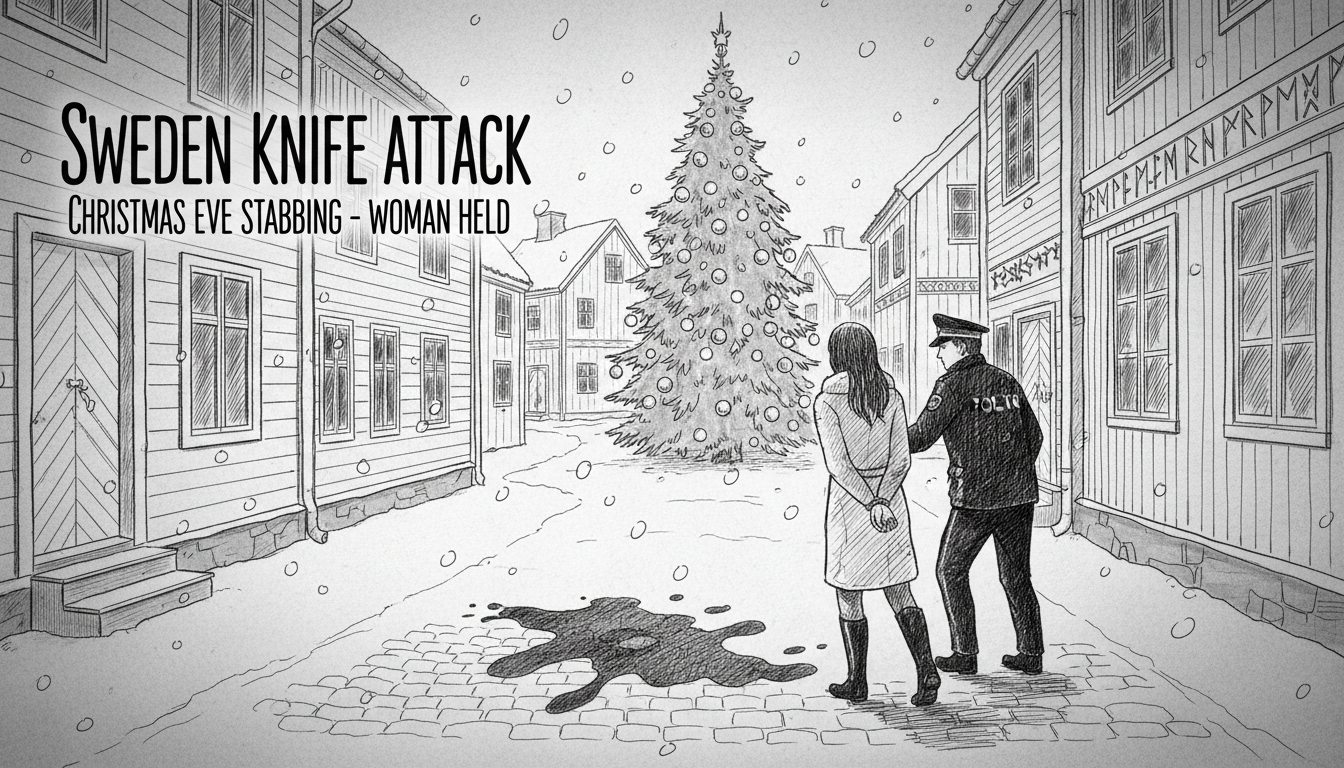
Sweden knife crime is under scrutiny after a man was stabbed in central Trelleborg on the night before Christmas Eve. The 50-year-old victim sustained wounds to his upper body. Police arrested a 35-year-old woman at the scene. The incident has shaken the quiet coastal town during what is typically a peaceful holiday season.
A Violent Interruption to Christmas Peace
Trelleborg, a municipality of about 45,000 people in Sweden's southernmost Skåne region, is known for its ferry port and tranquil atmosphere. The attack occurred in the town center, an area usually bustling with last-minute holiday shoppers. Instead, it became a crime scene. Police officer Ted Eriksson confirmed the arrest. “We have the weapon in our possession, a knife,” Eriksson said. The victim was taken to a local hospital with injuries described as minor, a fortunate outcome given the nature of the assault.
This violent act stands in stark contrast to the Swedish tradition of 'julfred' – Christmas peace. For many Swedes, the days leading up to Christmas are a time of calm reflection, family gatherings, and the soft glow of advent candles in windows. A stabbing cuts through that cultural fabric. It forces a community to confront a reality that feels distant from the idealized, safe society often portrayed.
The Broader Context of Violence in Sweden
While isolated, this attack in Trelleborg touches on a persistent national conversation. Sweden violent crime, particularly incidents involving knives, receives significant media and political attention. According to data from the Swedish National Council for Crime Prevention (Brå), trends in knife-related assaults have fluctuated in recent years. Each incident fuels debate about root causes and solutions.
Experts point to a complex mix of factors. “We cannot look at a single stabbing and draw conclusions about national trends,” says Dr. Lena Karlsson, a criminologist at Lund University. “But we must ask what drives interpersonal violence to this level. Is it social friction, psychological distress, or simply conflict that escalates? In a small community like Trelleborg, the impact is deeply personal and the questions become very local.”
Trelleborg crime statistics are generally low compared to larger metropolitan areas. However, its location in Skåne places it in a region that has experienced gang-related violence in cities like Malmö, about 50 kilometers north. Police are quick to state there is no indication this Christmas Eve attack is connected to organized crime. It appears to be an isolated incident between individuals.
The Human Story Behind the Headline
Beyond the police statement lies a human story. Who were these two people? What circumstances led a woman, on the cusp of Christmas, to allegedly wield a knife? These are questions the investigation will seek to answer. For now, the community is left with unease.
Local resident Mikael Berg, who lives near the town center, expressed his shock. “You hear about these things in big cities, but not here on Christmas. It feels wrong. Everyone is supposed to be home with their families, drinking glögg. It makes you wonder what happened,” he said, referring to the traditional Swedish mulled wine. This sentiment is common in towns where violent crime is rare. It disrupts the sense of security and shared social contract.
The Swedish approach to crime often focuses on prevention and rehabilitation. Yet, incidents like this put pressure on that model. People demand immediate safety and clear answers. The arrested woman will face the judicial system, while the victim recovers from his physical wounds. The psychological impact on both, and on the witnesses, will linger far longer.
Policing and Prevention in Focus
The Trelleborg police response was swift, leading to an arrest at the scene. This efficiency will be noted. In the broader Swedish society trends, there is an ongoing discussion about police resources and community policing strategies. Can presence deter such spontaneous violence? How do authorities balance reactive measures with proactive social work?
Some analysts argue that focusing solely on policing misses deeper societal issues. Integration challenges, economic disparities in certain neighborhoods, and mental health support systems are part of the conversation. Sweden immigration news often gets entangled in debates about crime, though there is no evidence to suggest this was a factor in the Trelleborg case. It remains a sensitive and politically charged topic.
For Trelleborg, the immediate path forward involves the legal process. The suspect is presumed innocent until proven guilty. The police investigation will work to establish motive and sequence of events. The court will then determine guilt and any sentence.
A Community's Resilience
As the news spread on Christmas Eve, it cast a shadow over the holiday. Yet, Swedish culture is also marked by resilience and a strong sense of community. The Swedish lifestyle, especially in smaller towns, involves knowing your neighbors and looking out for one another. This event will likely reinforce that instinct.
In the coming days, as the Christmas decorations come down and the new year begins, Trelleborg will return to its normal rhythm. But the memory of the stabbing will remain. It serves as a sobering reminder that no community is entirely immune to sudden violence. It also raises a fundamental question: in a society that values equality and safety, how do we better address the moments when those values fracture, not in statistics, but on a dark street on the night before Christmas?