
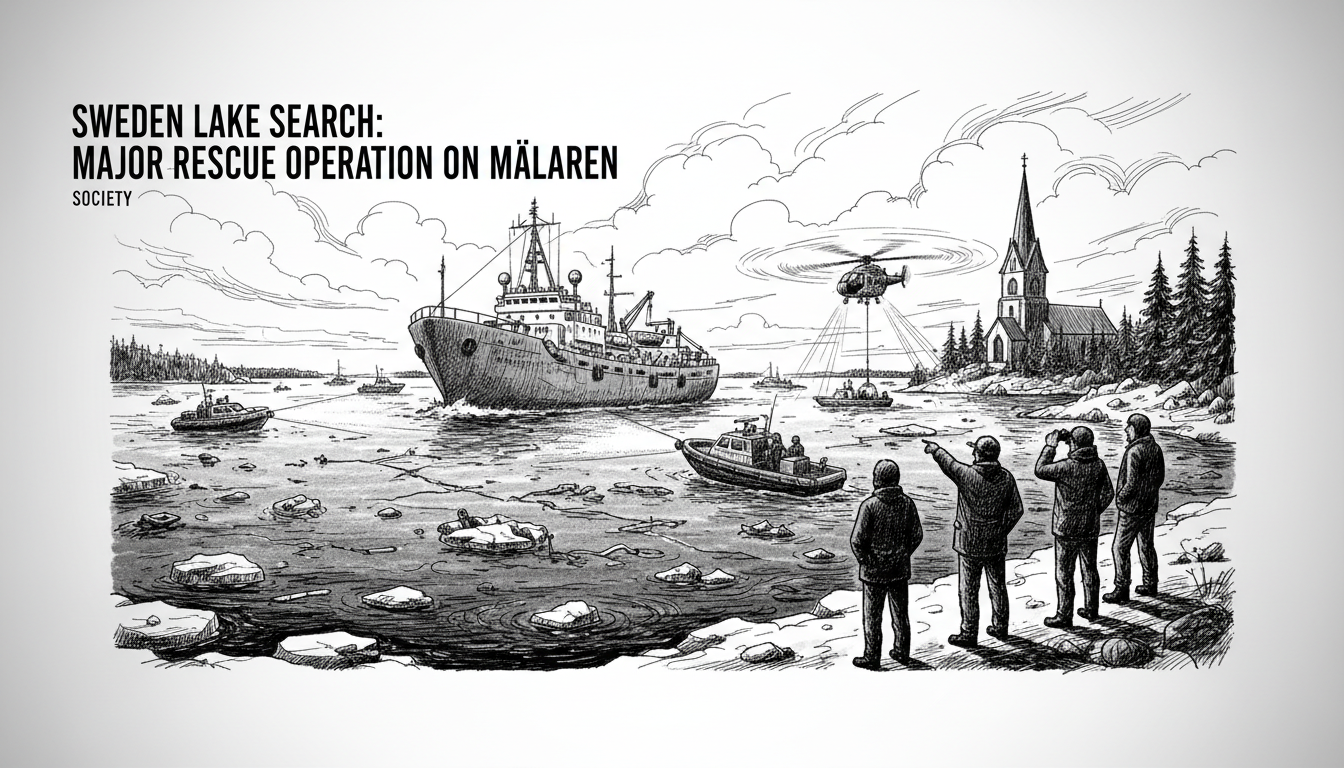
Swedish police launched a major search and rescue operation on Lake Mälaren this morning after an empty boat was found adrift. The alarm came in just before 9 AM, triggering a multi-agency response near the island municipality of Ekerö in Stockholm County. Marine police, a helicopter, dog patrols, and patrol cars are scouring the water and shoreline for the missing driver. Police currently have no suspicions of a crime.
A Morning Alarm on the Water
The scene on Lake Mälaren this morning was one of focused urgency against a backdrop of serene autumn beauty. A lone boat, engine off, was spotted drifting. Who was onboard? Where had they gone? These questions propelled the rescue mission into action. The operation is concentrated in the waters around Ekerö, a collection of islands west of Stockholm city known for historic sites like Drottningholm Palace and quiet, family-oriented communities. For residents, the sight of a police helicopter circling low over the water is a jarring contrast to the usual peaceful mornings.
"It's always unsettling when something like this happens so close to home," says Lars Bengtsson, a longtime Ekerö resident who was walking his dog along the shore. "The lake is part of our daily life here—for commuting, fishing, just enjoying nature. You never expect it to become the scene of a rescue mission."
The Complexities of a Water Search
Search and rescue operations on a body of water as vast as Lake Mälaren are inherently challenging. As Sweden's third-largest lake, Mälaren covers over 1,100 square kilometers with a complex coastline of bays, inlets, and thousands of islands. The water temperature in late September is cold, a critical factor that drastically limits survival time. Currents, often deceptively strong, can move objects and people significant distances. Visibility underwater can be poor.
The deployment of such diverse resources—from the air, on the water, and along the land—illustrates the standard, thorough protocol for a missing person case on the water. The helicopter provides a wide-area visual search, marine police units can traverse the lake systematically, dog patrols are exceptionally skilled at scent detection along shorelines, and ground units can access remote jetties and wooded coastal areas.
"Time is the most critical factor in cold water incidents," explains Mikael Lindström, a former Swedish Sea Rescue Society (SSRS) volunteer, speaking generally about lake rescues. "The coordination between different agencies is vital. They will be working from a calculated last-known-position point, but wind and current models are constantly updating that search area. It's a massive logistical puzzle."
Life Alongside Lake Mälaren
This incident highlights the deep, everyday relationship Swedes have with their waterways. Lake Mälaren is not just a scenic backdrop; it's a transportation route, a recreational hub for boating and swimming, and a cultural touchstone. For the many who live on its islands, a boat is as common as a car. The annual summer exodus to country homes, or 'sommarstugor', sees the lake's traffic swell with everyone from seasoned sailors to weekend boaters.
This accessibility and integration into daily life mean safety on the water is a perennial topic, especially as the busy summer season winds down. The Swedish Maritime Administration and organizations like the SSRS continuously campaign for life jacket use. Despite this, many seasoned boaters admit to not always wearing one, a casual attitude that rescue officials have long worked to change.
A Community Holds Its Breath
In Ekerö, the mood is one of concerned waiting. Local social media groups are filled with messages of support for the rescue teams and hope for a positive outcome. There is a shared understanding of the risks that come with the beauty of island living. The incident serves as a sobering reminder as the region transitions into darker, colder autumn days.
The police have been careful to state there are no current suspicions of a crime. This framing suggests the operation is purely a rescue mission, focusing efforts on finding a missing individual rather than investigating a potential crime scene. It directs public thought toward an accident or a medical emergency on the water—a sudden fall, an unexpected illness—scenarios every boater quietly fears.
The Broader Picture of Swedish Safety
Sweden boasts a strong culture of 'Allemansrätten'—the public right of access—which encourages people to enjoy nature freely, including its lakes and coasts. With this freedom comes a strong emphasis on personal responsibility and a well-funded, professional rescue infrastructure. Operations like today's demonstrate the capacity of that system, mobilizing significant assets at a moment's notice.
Yet, each operation also prompts reflection. How can water safety be improved? Are life jacket regulations or public awareness campaigns sufficient? As boats become more powerful and accessible, these conversations continue within Swedish society. The commitment to rescue, however, is never in question. The resources dedicated to finding one missing person on a large lake speak to a fundamental societal value: every life is worth an exhaustive search.
As the search continues into the day, the people of Ekerö and across Stockholm will be watching for updates. The sight of the rescue helicopter has become a symbol of both anxiety and hope. The empty boat on Mälaren poses a haunting question that an entire community, and a fleet of rescuers, are now striving to answer. Will the lake give up its secret, and will the story have an ending that brings relief, or sorrow, to the quiet islands of Ekerö?