
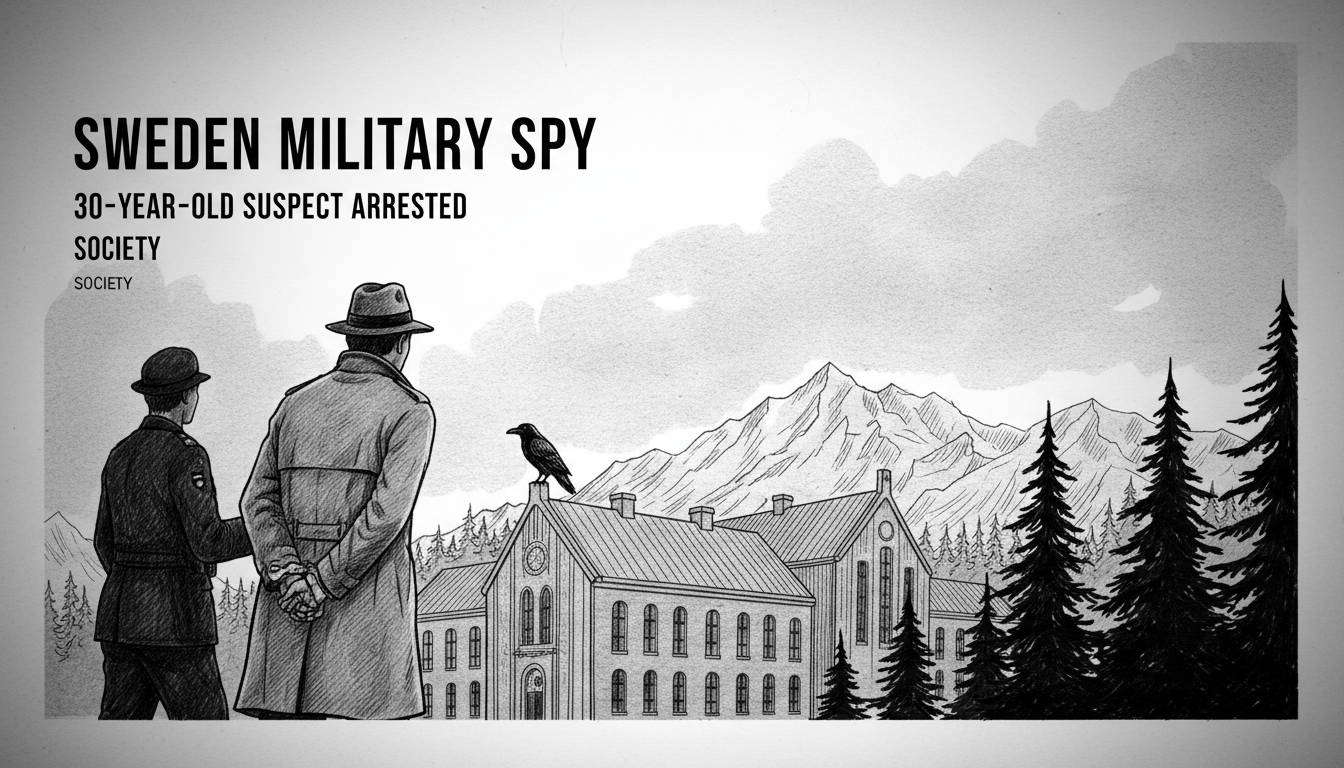
Sweden's security service has arrested a man in his 30s employed by the Swedish Armed Forces, Försvarsmakten, on suspicion of espionage. The suspect, apprehended in Stockholm on Sunday, is now facing a formal detention request for alleged spying activities that prosecutors say occurred between January 2025 and January 2026. This case sends shockwaves through Sweden's defense establishment at a time of heightened national security concerns.
"We can confirm that information," wrote the Armed Forces press chief, Jonas Beltrame-Linné, regarding the suspect's employment. The exact department where the man worked and the duration of his employment remain unclear. The Swedish Security Service, Säkerhetspolisen (SÄPO), has been investigating the matter for an extended period.
A Long-Running Investigation
Prosecutors revealed the investigation covers a broader timeframe, from January 1, 2022, to January 4, 2026, though the criminal activity leading to the arrest request is confined to the final year. The suspected crimes all took place within Stockholm County. This suggests investigators may have been monitoring the individual for some time before moving to arrest.
Åklagare Per Lindqvist, the lead prosecutor, has been tight-lipped about the international dimensions of the case. "We cannot disclose which country or countries, or which intelligence or security services, he is alleged to have assisted," Lindqvist stated earlier this week. This silence fuels intense speculation within diplomatic and security circles in the capital.
A Breach at the Heart of Defense
The confirmation that the suspect was inside Försvarsmakten represents a significant breach. Sweden's military is a prime target for foreign intelligence services, especially given the nation's strategic Baltic Sea location, its advanced defense technology sector, and its recent NATO accession. Access to internal communications, strategic assessments, or technical data could be devastating.
"This is the kind of case that keeps security chiefs awake at night," says Karl Linder, a Stockholm-based security analyst and former diplomat. "An insider within the Armed Forces has potential access not just to secrets, but to the patterns of thinking, the vulnerabilities, and the future plans of the entire defense establishment. The damage assessment will be complex and lengthy."
Espionage convictions are relatively rare in Sweden, making this case particularly notable. However, concerns about aggressive foreign intelligence operations, particularly those linked to Russia and China, have grown substantially in recent years. SÄPO's annual reports consistently highlight these states as the primary intelligence threats to Swedish interests.
The Human Factor in Espionage
The case immediately raises questions about motive and method. Why would an employee of the Swedish state betray their country? Experts point to a mix of potential factors: financial gain, ideological persuasion, coercion, or personal vulnerability exploited by a foreign handler.
"Recruitment is often a slow process," explains Dr. Elin Våger, a researcher at the Swedish Defence University specializing in counterintelligence. "It might start with an innocent-seeming contact at a conference, or a cultivated friendship. The handler identifies a need—money, recognition, a personal crisis—and offers a solution. By the time the target realizes they're providing classified information, they're already compromised."
This human element is the critical weakness in any security system. Våger notes that while Sweden has strong technical security protocols, the insider threat is perpetually challenging. "You can have all the firewalls and encrypted systems in the world, but if a trusted person decides to walk out with secrets in their head or on a USB stick, the system has failed. Vigilance and a strong security culture are paramount."
Geopolitical Shadows Over Stockholm
While the prosecutor has not named any foreign power, the geopolitical context is inescapable. Sweden's decision to join NATO marked a historic shift in its security policy, ending centuries of formal non-alignment. This move was a direct response to Russia's full-scale invasion of Ukraine and has fundamentally altered the security calculus in Northern Europe.
Stockholm now hosts more international military collaborations and planning sessions than ever before. Information about Swedish defense readiness, NATO integration processes, or assessments of regional threats would be of immense value to a hostile state seeking to counter the alliance's expansion.
"The timing is sensitive," Linder observes. "Sweden is integrating into NATO command structures, sharing intelligence, and coordinating defense plans. A mole within the Armed Forces could potentially access information that goes beyond Swedish national secrets to touch upon allied security. This case will undoubtedly be discussed in Brussels and other allied capitals."
The Response and the Road Ahead
The Swedish Armed Forces have stated they are cooperating fully with SÄPO. An internal review of security clearances and access protocols is likely already underway. The incident will prompt difficult questions about vetting procedures for personnel in sensitive positions.
For SÄPO, the arrest represents a significant operational success, demonstrating their ability to run long-term counterintelligence investigations. However, it also highlights the persistent and sophisticated nature of the threat. The service has repeatedly warned that foreign intelligence agencies are more active in Sweden than at any point since the Cold War.
The judicial process will now take over. The suspect will face a detention hearing, where the court will decide if he should be held in custody pending a formal indictment. Espionage is a serious crime under Swedish law, carrying the potential for a lengthy prison sentence.
For the public, the case is a stark reminder that the shadowy world of spies and secrets is not confined to thriller novels. It operates in the offices of Stockholm, targeting the very institutions tasked with keeping Sweden safe. As the nation settles into its new role within NATO, the imperative to protect its secrets has never been greater. This arrest may be just one visible sign of a hidden, ongoing war of intelligence that plays out daily in the heart of the Nordic region.