
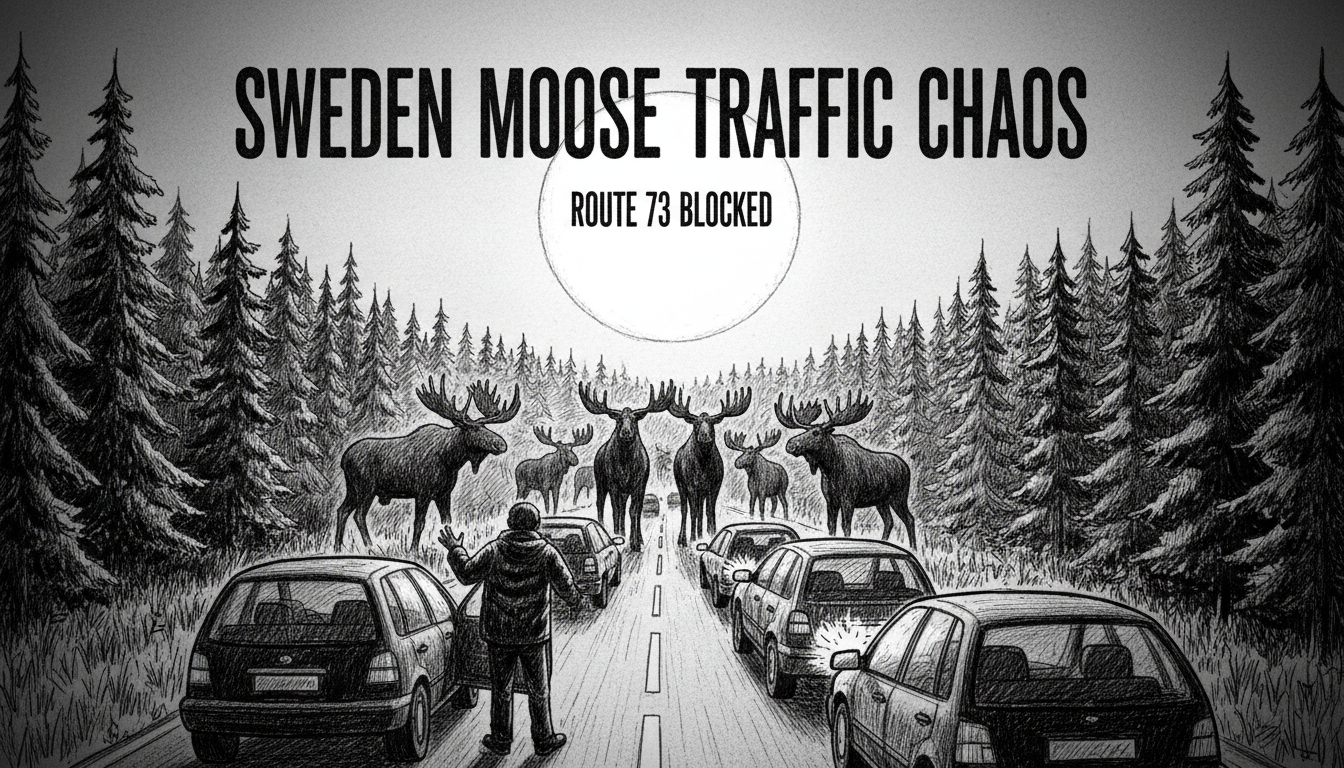
Sweden's moose population caused major traffic disruptions on a key highway south of Stockholm this morning. Two large moose were reported moving near the roadside on Route 73, Nynäsvägen, near the Jordbro exit, prompting a flood of calls to police and warnings from the Swedish Transport Administration. The incident affected traffic in both directions between Västerhaninge and Jordbro junctions, highlighting a perennial Swedish safety challenge.
"New people are calling all the time," said Mats Eriksson, a press spokesperson for Stockholm Police, describing the steady stream of reports from concerned motorists. The authorities' primary concern was preventing a collision. Moose, or 'älg', are majestic but dangerous roadside visitors. Their size and tendency to walk into traffic make them a leading cause of serious road accidents in the Swedish countryside and even on the fringes of the capital.
A Routine Emergency on Swedish Roads
For international readers, this might seem like a curious local story. In Sweden, it is a routine emergency. The scene on Nynäsvägen this morning is repeated hundreds of times across the nation every year. Route 73 is no quiet backroad; it is a major artery connecting Stockholm to the important port of Nynäshamn, a gateway for ferries to Gotland and the Baltics. A moose on this road isn't just a wildlife sighting—it's a major traffic hazard.
Drivers in the Stockholm region are increasingly encountering this risk. As urban areas expand, the traditional territories of Sweden's estimated 300,000-400,000 moose are fragmented. Animals cross roads in search of food, mates, or new habitats, especially during the autumn rutting season and deep winter. "It's a reminder that we share this landscape with very large wild animals," says Lena Karlsson, a wildlife biologist based in Södertälje. "The highways we build are barriers through their world. Sometimes, they cross."
The Physics of a Moose Collision
The danger is a matter of simple, terrifying physics. The moose is the largest species in the deer family. An adult can weigh over 500 kilograms and stand over two meters tall at the shoulder. In a collision, this mass typically impacts the windshield and roof of a passenger car, not the bumper. The legs are swept from under the animal, and its enormous body crashes through the front window.
This results in a high risk of severe injury or death for vehicle occupants. The Swedish National Road and Transport Research Institute (VTI) records thousands of reported moose-vehicle collisions annually. These accidents peak from September through January, a period covering the mating season and the early winter months when food becomes scarce and moose move more frequently.
"The advice is always the same, but it bears repeating," says traffic safety expert Erik Lundgren. "Reduce speed in areas marked with moose warning signs—the yellow triangle with a moose silhouette. Use your high beams when possible at night to catch the reflection of their eyes. And if one appears on the road, brake firmly and steer to avoid it if safe, but never swerve uncontrollably into the opposite lane or a ditch. A collision with a moose is often less catastrophic than a head-on collision with another vehicle."
Mitigation Efforts and Costly Encounters
The Swedish Transport Administration, Trafikverket, employs several strategies to reduce these encounters. Along high-risk stretches of highway like parts of Route 73, you'll find extensive wildlife fencing designed to guide animals toward purpose-built crossings. These can be green bridges over the road or culverts beneath it. Warning signs are placed in known crossing hotspots, and some areas even have sensor-activated flashing lights that activate when an animal is near the road.
Despite these efforts, collisions remain a costly fact of life. Beyond the human tragedy, the economic impact is significant. Insurance companies handle thousands of claims each year for vehicles totalled by moose strikes. Repair costs can be astronomical, and medical bills for injuries add to the total societal cost, which runs into hundreds of millions of Swedish kronor annually.
For the moose, the encounter is almost always fatal. The incident on Nynäsvägen this morning had a relatively positive outcome for the animals involved. According to police reports, the two moose eventually moved away from the roadway and back into the surrounding woodland near Jordbro, avoiding injury and allowing traffic to normalize. This is not always the case. Often, police are forced to call in hunters to euthanize injured animals, a grim but necessary task for animal welfare and public safety.
A Cultural Coexistence
The moose holds a special place in Swedish culture—it's a symbol of the deep forest, a popular game animal, and even a kitschy souvenir for tourists. Yet, its relationship with modern infrastructure is fraught. This morning's disruption is a small, common symptom of a larger national balancing act. Swedes pride themselves on their access to nature and 'Allemansrätten'—the right of public access. That nature includes large, unpredictable wildlife.
Drivers, particularly those new to Sweden, must adapt. "I've lived here for five years, and I still get a shock when I see the moose warning signs," says Anya Petrova, a resident of Haninge who commutes on Route 73. "Where I'm from, we worry about deer. Here, it's like a horse with antlers. You learn to be very alert, especially at dawn and dusk."
As Stockholm continues to grow, pushing its suburbs further into forested areas, these interactions will likely continue. The work of Trafikverket to improve fencing and crossings is ongoing, but it's a vast and expensive undertaking. Public awareness remains the first and most immediate line of defense.
The Road Ahead
The two moose near Jordbro have wandered off, and the news cycle will move on. But for the engineers, biologists, and policy makers, the problem persists. Research continues into more effective deterrents, from improved fencing materials to olfactory repellents. The dream is a transportation network that allows both humans and moose to move safely through the landscape.
For now, the solution is a blend of technology, infrastructure, and driver vigilance. The next time you drive on a Swedish highway, pay attention to the yellow signs. They're not decorative. They are a direct warning that you are entering a shared space, where a moment's inattention can lead to a life-changing encounter with one of the Nordic forest's most iconic inhabitants. The message from today's incident is clear: in Sweden, you must watch for more than just the traffic.