
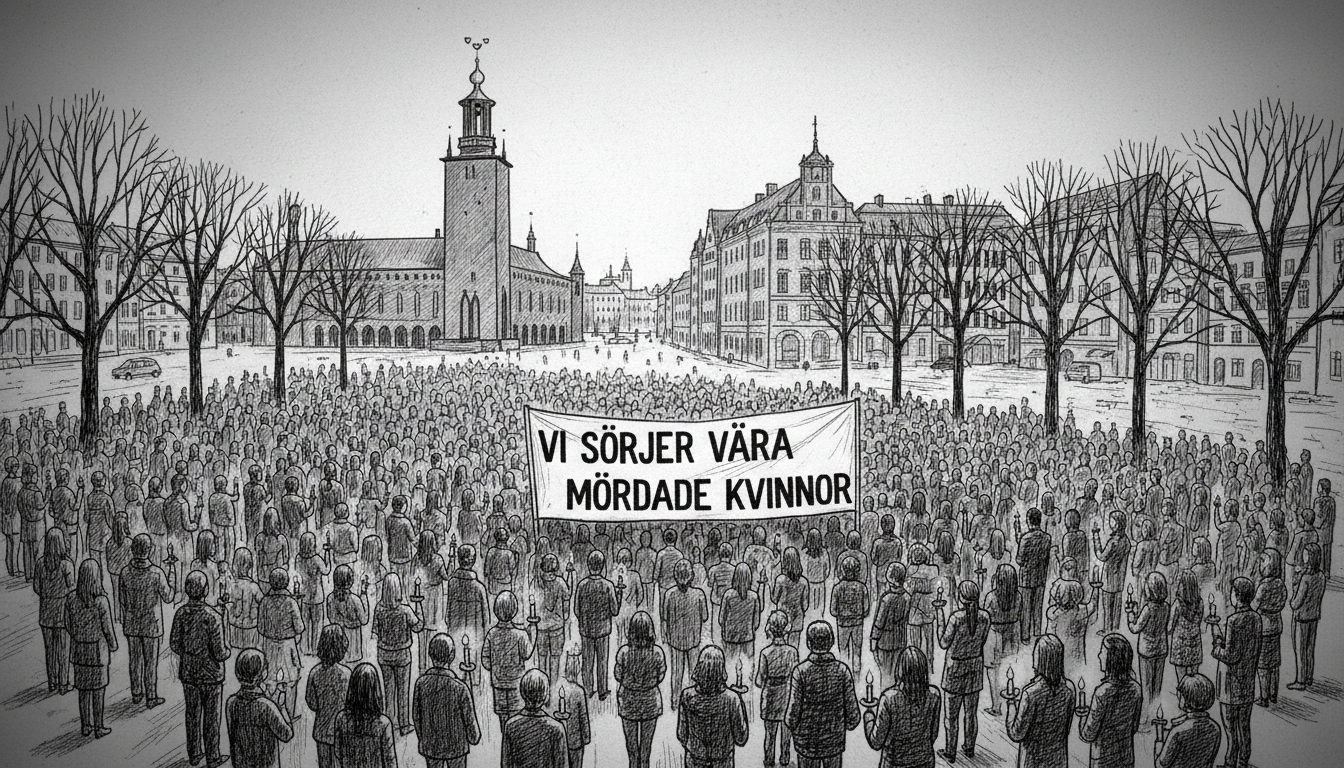
Sweden's struggle with domestic violence was illuminated by candlelight on Sergels torg Sunday night. Hundreds gathered in the iconic Stockholm square to honor women murdered in Boden and Rönninge during the recent Christmas holiday period. The silent crowd held a minute's silence at 6 PM, their candles piercing the winter darkness in a powerful act of collective grief and solidarity.
Eva Andersson was among them. She felt compelled to attend. "You have to show your sympathy and compassion," she said, her voice quiet but firm against the backdrop of the square's famous glass obelisk. "We are here to honor them." Her sentiment echoed through the crowd, a mix of young students, older couples, and families, all united by a shared sense of loss and a demand for change. This public mourning in the heart of the capital underscores how gender-based violence continues to shock Swedish society.
A Public Outpouring in the City's Heart
Sergels torg is more than just a transportation hub. It is Stockholm's traditional stage for public protest and collective emotion. From political demonstrations to spontaneous gatherings after national tragedies, the square absorbs the city's mood. On this Sunday evening, its brutalist concrete geometry was softened by the warm, flickering light of hundreds of tea lights and pillar candles placed carefully on the ground. There were no loud slogans, just the murmur of conversations and the occasional sniffle. A woman knelt to adjust a photograph of one of the victims beside her candle. A man held his daughter's hand tightly.
This vigil follows a specific and grim pattern in Swedish public life. In recent years, high-profile cases of femicide—the killing of women because they are women—have repeatedly drawn people into squares and parks. These gatherings are rarely organized by large political parties. Instead, they often emerge through word-of-mouth and social media, a grassroots response to a perceived failure of systemic solutions. "It feels like we are here too often," said Karin Lundström, a 34-year-old teacher from Södermalm. "We light candles, we feel terrible, we go home. Something more must happen."
The Persistent Shadow of Domestic Violence
The murders that prompted this vigil are part of a larger, distressing national reality. According to the Swedish National Council for Crime Prevention (Brå), the long-term average shows approximately 15 women are killed by a current or former partner each year in Sweden. This figure has remained stubbornly consistent over time, despite increased public debate and policy initiatives. In 2022, the most recent year with complete published data, police reported approximately 25,700 incidents of crimes classified as violence against women, a number that includes but is not limited to intimate partner violence.
Experts see vigils like the one on Sergels torg as having a dual function. They provide crucial communal space for grief and solidarity, but they also serve as a barometer of public frustration. "These gatherings are a testament to heightened awareness," says Dr. Lisa Wallin, a sociologist at Uppsala University who studies gender-based violence. "There is now widespread recognition that these are not private 'family tragedies' but a structural societal problem. The public is ahead of the politics in many ways, demanding concrete, effective prevention and better protection for victims."
Dr. Wallin points to legislative changes like the 2018 law that made sex without consent a crime, but she argues the harder work lies in changing attitudes and improving inter-agency cooperation. "We have good laws on paper," she notes. "The challenge is in the application—ensuring police, social services, and healthcare providers have the resources and training to identify risk and act decisively."
From Seasonal Peace to Violent Tragedy
The timing of the murders, during the Christmas holiday, adds a particularly painful layer. In Swedish culture, the julhelg (Christmas weekend) is sacrosanct—a time for mys, coziness, and family. The violent rupture of this peaceful ideal shocks the national conscience. It transforms a period associated with safety and warmth into one marked by tragedy, a contrast that fuels public outrage. News of the deaths in the northern town of Boden and the commuter town of Rönninge spread quickly, disrupting the post-holiday lull and prompting immediate calls for a public memorial.
This cultural context is key to understanding the scale of the response. The violation of a deeply held seasonal tradition makes the violence feel not just personal, but also national. It becomes an attack on a shared idea of Swedish society. The vigil, therefore, is not only about mourning the individual women but also about reclaiming a sense of security and community that feels under threat.
The Path Forward: More Than Candles
As the last candles guttered out on the damp stone of Sergels torg, the question hanging in the cold air was 'What next?' For many attendees, the act of gathering is a first step, but an insufficient one. There is growing impatience for measurable action. Proposals frequently discussed in Swedish media include increased funding for women's shelters (kvinnojourer), mandatory risk assessments in all reported domestic violence cases, and stricter enforcement of restraining orders.
Some advocacy groups are pushing for a specific national action plan against men's violence against women, with clear annual targets and ministerial accountability. The emotional resonance of the candlelight vigil creates political pressure, but translating that momentum into lasting policy change is the ongoing challenge. The Swedish model, often praised for its gender equality, is grappling with a dark contradiction within its own society.
The women remembered on Sergels torg join a tragic list. Their names become hashtags, their faces appear in news articles, and their stories briefly become national focal points. The silent crowds with their candles ensure they are not just statistics. They are mothers, daughters, sisters, and friends whose loss is felt collectively. The light in the darkness is a symbol of remembrance, but for a growing number of Swedes, it must also become a beacon for relentless, tangible change. How many more candles must be lit before the number of lights finally begins to dim?