
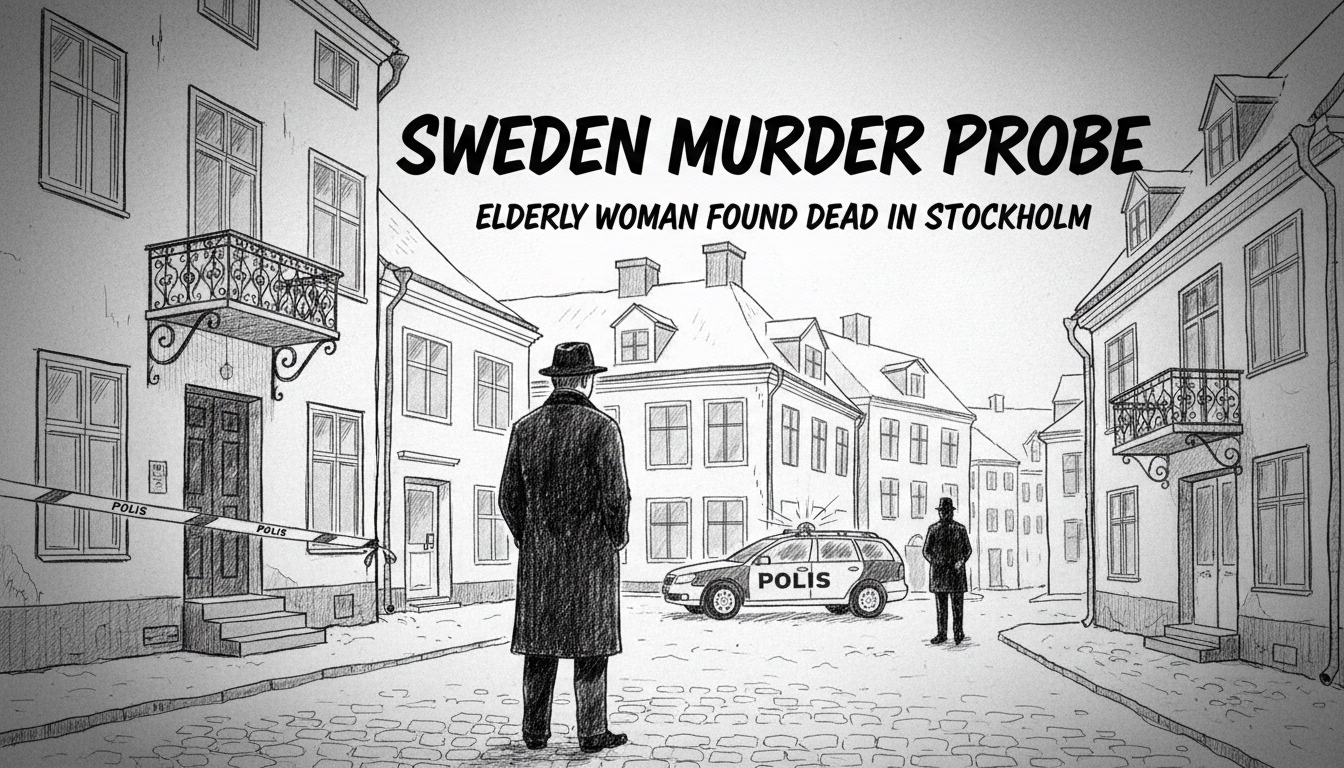
Sweden police have launched a murder investigation after a woman in her 70s was found dead below a residential building on Södermalm in Stockholm. A man, also in his 70s, has been arrested. The discovery was made early Tuesday morning, sending a ripple of unease through the normally tranquil neighborhood known for its cobblestone streets and artistic vibe.
"We do not yet know how she died, whether she fell, jumped herself, or was pushed," said police spokesperson Mats Eriksson. Because a crime cannot be ruled out, a preliminary investigation into murder has begun. The scene, near the intersection of Götgatan and Skånegatan, was cordoned off with blue-and-white police tape for hours as forensic teams worked.
Neighbors described a quiet street disrupted by flashing blue lights. "It's shocking," said Lena, a resident who asked only for her first name. "This is a close-knit area. You know faces, you say hello. To have something like this happen here... it feels very wrong." The building in question is a classic Stockholm apartment block, its pale yellow facade now the center of a grim mystery.
A Meticulous Process Begins
The immediate arrest of a suspect follows standard Swedish procedure when foul play is suspected. "The priority is to secure the scene, secure any potential evidence, and secure the individual who may be involved," explains criminologist Professor Anna Kjellgren. "This allows the investigation to proceed without evidence being lost or a suspect fleeing. It is a protective, not accusatory, first step."
In Sweden, any unexplained or violent death triggers a thorough legal process. A forensic medical examination will now determine the exact cause of death. Detectives will interview witnesses, examine the victim's apartment, and review any available CCTV footage from the area. The arrested man can be held for questioning before a prosecutor must decide on formal charges.
This case stands out due to the age of both the deceased and the suspect. While violent crime in Sweden often focuses on gang conflicts among younger men, domestic incidents or conflicts between older individuals are less visible in headlines. "Each case is unique," Professor Kjellgren notes. "The investigation will look at the relationship between these individuals, their history, and the precise circumstances. Age does not preclude tragedy."
Södermalm's Contrasting Reality
The incident casts a shadow over Södermalm, or "Söder," a district beloved for its village-like atmosphere within the capital. It's a place of trendy cafes in Mariatorget, vintage shops on SoFo's streets, and stunning views from Fjällgatan. The island embodies a specific Swedish lifestyle: design-conscious, socially liberal, and community-oriented.
News of the death spread quickly through local networks and social media groups. At a café on Bondegatan, the talk was subdued. "You don't expect this," said Erik, a barista. "Söder is about life, culture, people sitting outside. This is a dark thing to happen. Everyone is wondering what really occurred behind those walls."
This contrast—between the district's vibrant, open culture and a private, tragic event—resonates deeply. It touches on a fundamental aspect of Swedish society: the trust in a safe, orderly environment within one's own home. A breach of that safety, especially resulting in death, causes profound communal distress.
The Broader Context of Crime in Stockholm
In 2023, Swedish police secured convictions in approximately 115 cases of murder and manslaughter. Each one represents a deep personal and social rupture. The overall crime rate in Stockholm shows complex trends, with gang-related shootings drawing significant policy attention. However, isolated interpersonal violence, often occurring behind closed doors, constitutes a substantial portion of these serious crimes.
"The public narrative often focuses on organized crime," says Professor Kjellgren. "But a significant number of homicides occur between people who know each other, within families or relationships. These cases are no less devastating and require the same rigorous investigative resources."
The police's careful wording—"we do not yet know how she died"—reflects this rigorous approach. They will not speculate. The investigation will rely on physical evidence and factual reconstruction. This methodical pace can be frustrating for a public seeking immediate answers, but it is designed to build a case that withstands legal scrutiny.
A Community Awaits Answers
As the investigation continues, life on Södermalm moves on, but with a palpable sense of waiting. The police tape is gone, but the questions remain. Local community watch groups have posted messages urging residents to support one another and report any relevant information to the authorities.
The woman, whose identity has not been publicly released, was a part of this community. Her loss is felt. The coming days will see the police piece together her final hours, seeking to understand the role of the arrested man. The prosecutor will assess the evidence to decide between charges of murder, manslaughter, or possibly dropping the case altogether.
For now, the district is left with an unsettling void where there should be clarity. The story is no longer just about a crime statistic; it is about a neighbor, a familiar face on a Stockholm street, and the hidden stories that can exist in even the most peaceful apartments. The quest for truth continues, one careful piece of evidence at a time, in a system designed to value precision over speed. The ultimate goal is not just a legal resolution, but an answer for a community wondering how such a thing could happen in their midst.
What will the forensic evidence reveal about those final moments? The answer lies in the meticulous work now underway, work that seeks to translate a terrible mystery into something understandable, and in doing so, perhaps restore a fragment of peace to a shaken neighborhood.