
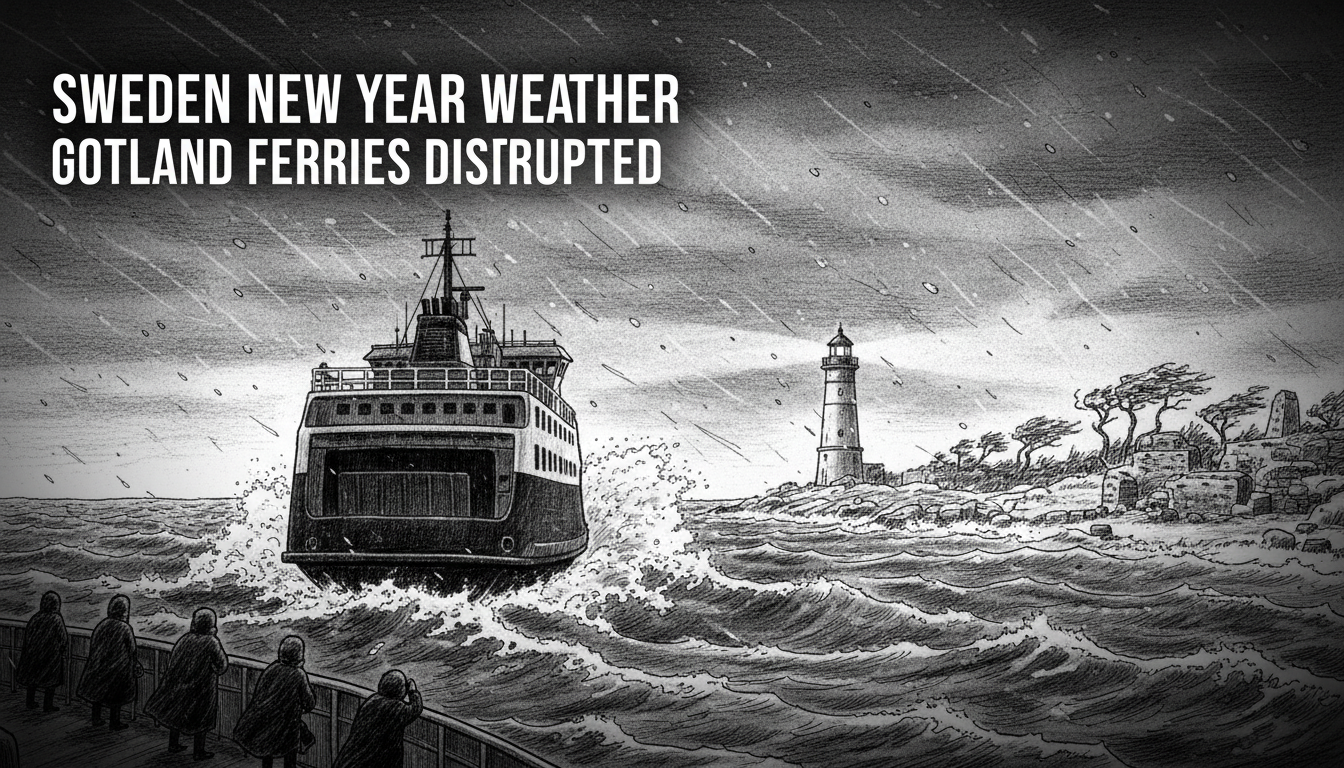
Sweden New Year weather is shaping up to be turbulent, with meteorologists warning of potential 'busväder'—a Swedish term for nasty, disruptive weather. The Swedish Meteorological and Hydrological Institute (SMHI) has issued an orange warning for the island of Gotland, where ferry connections to the mainland have already been affected by strong winds and rough seas. 'It looks like it could be nasty weather again at the start of the year. It's unclear if it will be that troublesome for us on the mainland,' said Therese Fougman, a meteorologist at SMHI.
For the roughly 60,000 residents of Gotland, ferry disruptions are more than an inconvenience. They are a lifeline severed. The island relies on regular ferry service for everything from food deliveries and medical supplies to family visits and tourism. An orange warning from SMHI signals a high risk of severe weather that can cause significant disruption and damage. This latest bout of bad weather casts a shadow over New Year's Eve plans, a night when many Swedes traditionally gather for lavish dinners and fireworks.
A Baltic Island Braces for the Storm
The orange warning for Gotland is in effect until Tuesday evening. Meteorologists are closely monitoring a low-pressure system moving across the Baltic Sea. 'The warnings that are in place on Gotland apply until Tuesday evening. After that, it looks calmer,' Fougman noted. This uncertainty is a key part of forecasting, especially for maritime conditions where wind and wave patterns can shift rapidly. For ferry operators like Destination Gotland, these forecasts trigger complex logistical decisions about whether to sail, delay, or cancel crossings.
In Visby, Gotland's medieval walled capital, the mood is one of resigned preparation. Shop shelves are a little fuller as locals stock up, knowing deliveries could be delayed. 'You learn to read the sky and the forecast apps living out here,' says Erik Lundström, a café owner in Visby. 'A storm warning means checking on elderly neighbors and making sure you have what you need for a day or two. It's part of island life, but it's always a pinch around the holidays.'
The Science Behind the 'Busväder'
SMHI's warning system uses a color code: yellow for potential danger, orange for a high risk of severe weather, and red for an extreme risk requiring immediate action. An orange warning for wind and waves means the public should be prepared for travel disruptions, power outages, and potential property damage. The term 'busväder' itself is wonderfully descriptive Swedish slang. It implies weather that is mischievously bad, like a prank played by nature—unpredictable and troublesome.
Meteorologist Therese Fougman's caution about conditions on the mainland highlights a key challenge. While Gotland, exposed in the Baltic, bears the initial brunt, these systems can often track towards the east coast. Areas like Stockholm's archipelago and counties such as Södermanland could also experience strong winds and heavy snowfall as the week progresses. The exact path of the low-pressure system will determine how widely the 'busväder' is felt.
When Weather Disrupts Tradition
New Year's Eve, or nyårsafton, is one of Sweden's most cherished celebrations. It is typically a night for a special dinner—often a buffet with dishes like Janssons frestelse (a creamy potato and anchovy casserole), meatballs, and herring. At midnight, crowds gather for fireworks, with a nationally televised countdown from Skansen in Stockholm. Severe weather forces a rethink of these traditions. Outdoor fireworks displays may be canceled. Travel to and from parties becomes hazardous. For families separated by the Baltic, a canceled ferry means a quiet night in instead of a reunion.
This interplay between modern meteorology and age-old seasonal rhythms is fascinating. SMHI provides precise, data-driven forecasts, yet the human response is deeply cultural. It involves adjusting menus, changing travel plans, and checking on community members. The weather becomes a central character in the holiday story, not just a backdrop.
Looking Beyond the Holiday Weekend
The immediate focus is on the orange warning for Gotland, which is expected to lift by Tuesday. However, Fougman's comment about potentially nasty weather at the start of the year suggests Swedes should stay vigilant. Early January often brings some of the winter's coldest and most volatile weather. For transport authorities, the post-holiday return to work and school is another period of high traffic vulnerability to storms.
Climate scientists note that while individual storms cannot be directly linked to climate change, a warming Baltic Sea can contribute to more intense low-pressure systems in the region. This means the 'busväder' of today might inform a new normal for future winters. Preparedness, from individual households to national infrastructure, becomes increasingly important.
For now, the message from SMHI is clear: pay attention. Residents in warning areas should secure outdoor furniture, avoid unnecessary travel, and follow updates from transport companies. The rest of the country should watch forecasts closely as the New Year dawns. Will the 'busväder' be confined to Gotland, or will it sweep across the mainland, turning New Year's travel plans into a slippery, windy challenge? Only the shifting winds over the Baltic will tell.
As we raise a glass to the new year, many Swedes will have one eye on the weather app and the other on the sky. It's a reminder that despite all our technology and planning, nature still writes its own powerful script. The hope for a calm and bright start to 2025 now hinges on the path of a storm brewing over the sea.