
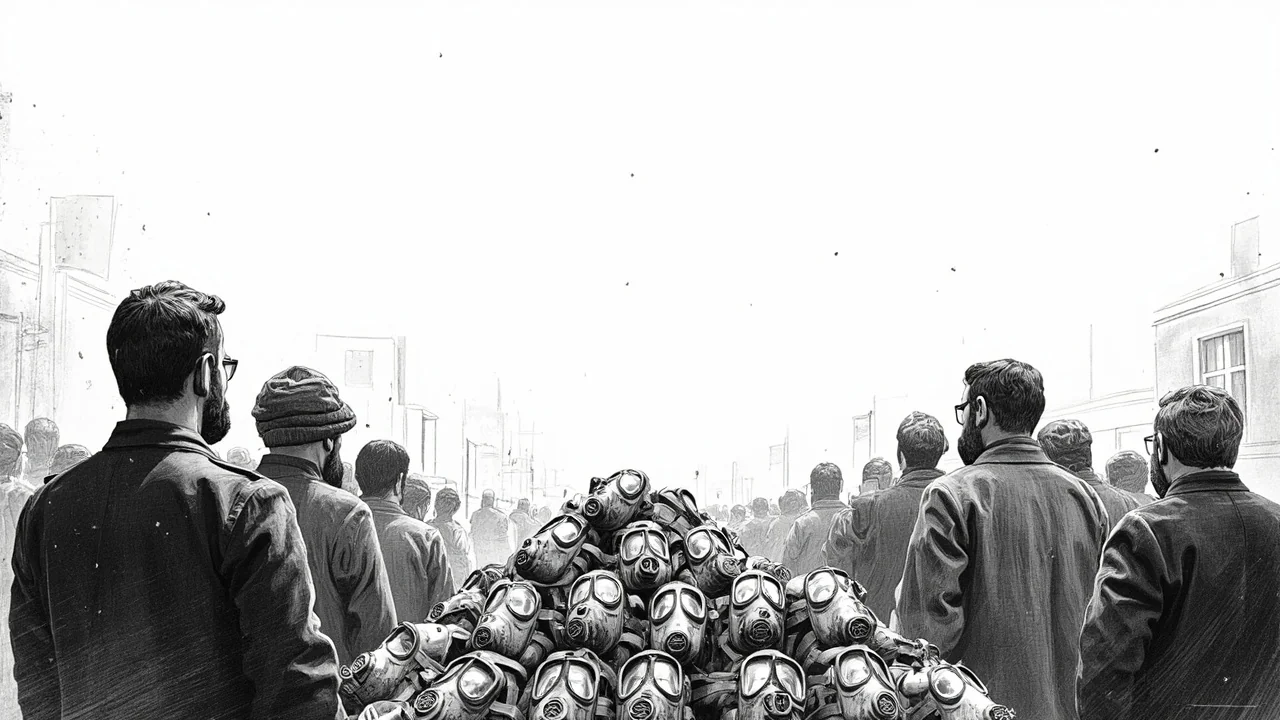
Sweden's government has initiated a major procurement of 20,000 protective masks for personnel in critical sectors. Civil Defense Minister Carl-Oskar Bohlin announced the order at the annual People and Defense national conference in Sälen. This move marks the first concrete step in a broader strategy to rebuild national preparedness, a direct response to heightened security concerns across Europe. The Swedish Parliament has backed this shift, approving increased defense and civil contingency budgets in recent Riksdag decisions.
Minister Bohlin framed the purchase as foundational. "This order should be seen as a first step to ensure domestic production capacity of protective masks for the population," he stated in his conference address. Simultaneously, the Swedish Civil Contingencies Agency (MSB) received a new directive. Its mandate is to conduct a comprehensive analysis of the total need for protective masks within the entire civil defense structure. This two-pronged approach—immediate procurement and long-term planning—signals a methodical shift in Stockholm politics.
A Strategic Shift in Government Policy
The mask order is not an isolated purchase but a component of a recalibrated government policy Sweden. For decades, national stockpiles of civil defense equipment were depleted or dismantled following the Cold War. The reassessment began in earnest after Russia's annexation of Crimea in 2014 and has accelerated dramatically since the full-scale invasion of Ukraine in 2022. The current government, a coalition of the Moderate Party, Christian Democrats, and Liberals with support from the Sweden Democrats, has made strengthening total defense a cornerstone of its agenda.
Analysts view this procurement as symbolic of a wider societal mobilization. "It's a tangible signal," says Dr. Lisa Strömberg, a senior fellow at the Swedish Defense Research Agency. "For years, we discussed preparedness in abstract terms. Ordering specific equipment like this moves the conversation from theory to logistics. It forces ministries, agencies, and suppliers to activate dormant processes." The order will likely be managed through the MSB, which coordinates state acquisitions for civil protection. The focus on "critical sectors" suggests initial recipients will be in energy, water, telecommunications, and transport—infrastructures deemed vital for societal function during a crisis.
The Logistics of Rebuilding a Stockpile
Executing this policy requires navigating complex bureaucratic and industrial challenges. The press release emphasized ensuring "domestic production capacity." This indicates the 20,000-mask order may serve a dual purpose: fulfilling an immediate need and providing a guaranteed contract to stimulate or sustain Swedish manufacturing lines. Dependence on international supply chains for critical safety equipment was identified as a key vulnerability during the COVID-19 pandemic.
The government's directive to the MSB to "analyze the total need" is a critical second phase. This study will define the scale of future investments. Questions include whether masks should be stockpiled for the general public, as was the case during the Cold War, or solely for essential workers. It must also determine types of masks (e.g., for chemical, biological, or radiological threats), storage logistics, distribution plans, and refreshment cycles for equipment. These findings will inform future Riksdag decisions on appropriations, potentially amounting to billions of kronor.
This process mirrors similar efforts in military procurement but within a civilian context. The administrative burden falls across several government districts. Officials at Rosenbad, the government offices, set the policy. The Riksdag building is where funding is authorized. The MSB, along with sector-specific agencies, will handle the technical requirements and storage. The complexity underscores how civil defense is a cross-governmental effort, requiring coordination far beyond the Ministry of Defense.
Historical Context and Public Reception
Sweden maintained extensive civil defense programs, including public bomb shelters and gas mask stockpiles, throughout the Cold War. These were largely phased out in the post-1991 era of perceived lower threat. The decision to rebuild any aspect of this system is historically significant and not without potential public debate. Older generations may recall mandatory civil defense training, while younger Swedes have never contemplated state-issued protective gear.
The political consensus on increased defense spending is relatively strong. However, the specifics of civil defense—how far it should extend into private life and at what cost—could generate more discussion. The government's current approach appears incremental, starting with professionals in critical roles rather than a mass public distribution. This may be a strategic choice to build acceptance and demonstrate competence before scaling up.
"The challenge is balancing urgency with sustainability," notes political scientist Professor Anders Persson. "A rapid, large-scale procurement could overwhelm the system and waste resources. This smaller, targeted order, coupled with a needs analysis, suggests a learning curve. The Riksdag will watch closely to see if the MSB and the ministry can manage this effectively before approving larger sums." Public reception may hinge on clear communication about the threats these masks are meant to address, without causing unnecessary alarm.
The Broader European Landscape
Sweden's actions align with a continent-wide trend. Neighbors like Finland and Denmark have also recently reviewed and updated their civil defense reserves. The war in Ukraine has demonstrated the brutal targeting of civilian infrastructure, making resilience a military and civil priority. For Sweden, now a NATO member, these national measures complement alliance commitments. They ensure the country can contribute to collective defense without being entirely dependent on external aid for basic civilian protection.
The focus on masks, while seemingly specific, touches on core NATO principles of civil preparedness and resilience. A nation that can protect its critical workforce and maintain essential services under pressure is a stronger ally. This procurement, therefore, is both a national security policy and a piece of international policy. It signals to partners in Brussels and Washington that Sweden is serious about shouldering its responsibilities within the total defense framework.
Looking Ahead: From Procurement to Preparedness
The announcement from Sälen is just the beginning. The coming months will test the government's ability to translate policy into practice. Key milestones to watch include the placement of the mask contract with a supplier, the timeline for delivery, and the publication of the MSB's comprehensive needs analysis. The findings of that analysis will likely form the basis for a government bill presented to the Riksdag, possibly within the next budget cycle.
Future debates in the Swedish Parliament may revolve around the geographic distribution of stockpiles, public education programs, and the integration of civil defense with municipal crisis planning. Will every municipality need a reserve? How are private companies in critical sectors incentivized to participate? These are the complex questions flowing from the initial decision to order 20,000 masks.
The true measure of success will not be the number of masks in a warehouse but the strengthening of a whole ecosystem—industrial, logistical, and administrative. It is a slow, unglamorous process of rebuilding a capability Sweden once had and allowed to fade. In an era of renewed uncertainty, the work starting with this procurement order aims to ensure that the nation's civilian front is as resilient as its military defense. The path from a post-Cold War peace dividend to a new era of preparedness is now being charted, one concrete procurement at a time.