
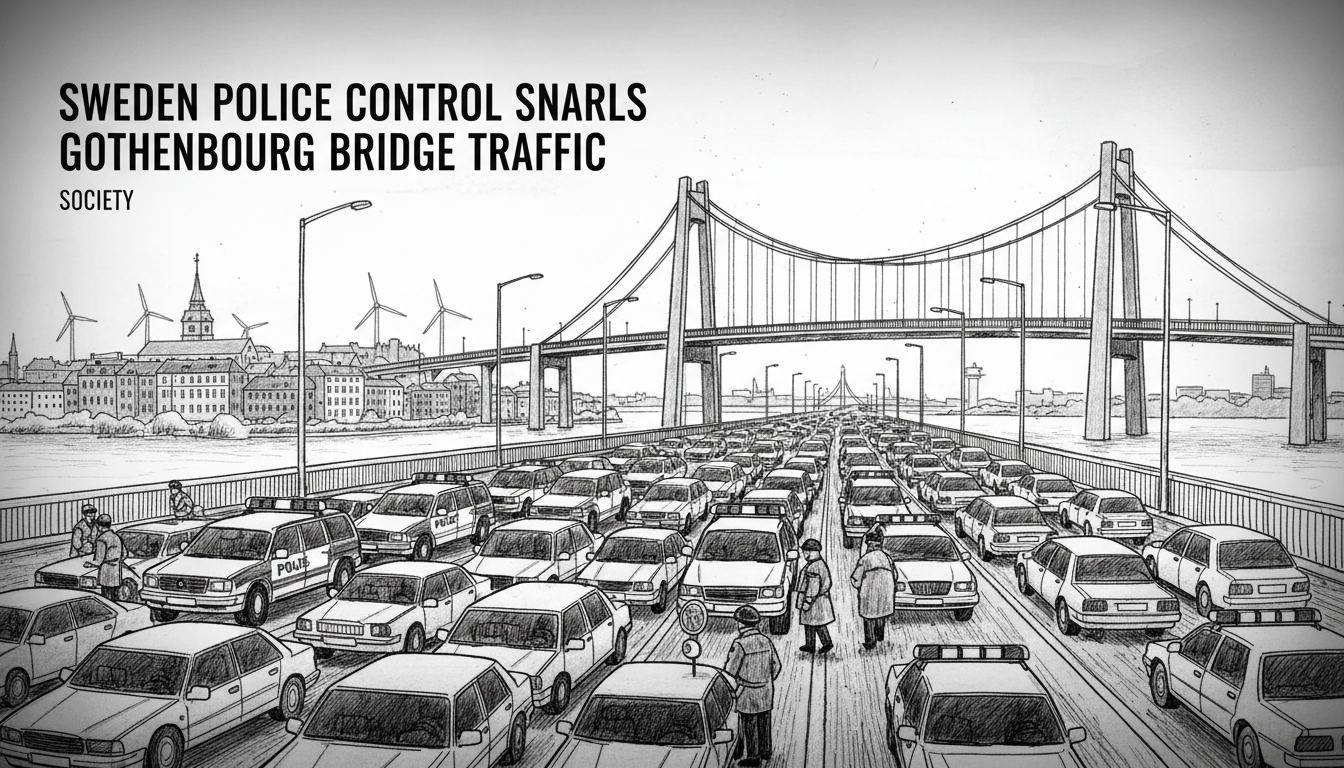
Sweden police control on the Älvsborg Bridge in Gothenburg created major traffic delays on Tuesday evening. The planned operation, while routine, brought a key city artery to a near standstill, highlighting the fragile balance between public safety and urban mobility. For thousands of commuters heading home, the scene was one of familiar frustration.
"It's a traffic control that was planned earlier," said police press spokesperson Adam Isaksson Samara. His statement was brief, but the impact was long. Tailbacks stretched for kilometers on both sides of the iconic suspension bridge. This vital link, used by roughly 60,000 vehicles every day, becomes a critical choke point the moment its flow is interrupted.
A Tuesday Evening Commute Grinds to a Halt
The disruption began during the evening rush. Red brake lights glowed in the fading light, creating an unexpected river of crimson across the Göta älv river. For drivers like Erik Lundström, a teacher returning to the Hisingen island district, the delay added forty minutes to his journey. "You just sit there," he said. "You know it's probably for a good reason, but it tests your patience. You start wondering if you should have taken the ferry."
His sentiment echoes a common Stockholm and Gothenburg dilemma. Both cities are built on archipelagos, making bridges like Älvsborg non-negotiable passages. Opened in 1967, the 930-meter bridge is more than concrete and steel; it's a social and economic lifeline. The 45-meter clearance below allows massive ships to reach the port, but above, the flow of cars is far less guaranteed.
The Ripple Effect of a Single Checkpoint
Traffic experts were not surprised by the scale of the congestion. "A major bridge is the definition of a bottleneck," explained Lena Forsberg, a transport analyst based in Gothenburg. "There are no alternative routes immediately available. When you introduce a disruption, like a police control, the system's capacity plummets. The queues build exponentially, not linearly."
Forsberg points out that these controls, while important, have a disproportionate cost in lost time and increased emissions from idling vehicles. "A fifteen-minute stop for a check can create an hour of city-wide delays. The math is brutal." The police did not specify the exact focus of Tuesday's control. In Sweden, such operations routinely check for sober driving, valid licenses, and vehicle roadworthiness. They are a standard tool, yet their timing and location are always a calculated decision.
Balancing Safety with the Daily Flow of Life
The incident opens a wider conversation about urban planning in Swedish society. Gothenburg, like many Nordic cities, promotes a shift towards public transport and cycling. Yet, the reality for many in the suburbs remains car dependency. "The bridge is my only practical way to get to work," said Fatima Hassan, a nurse living in Mölndal. "When it's blocked, my whole schedule collapses. My kids' daycare charges a late fee after a certain time. It's not just traffic; it's life."
This human impact is the unmeasured statistic behind the 60,000 daily vehicle count. The police, aware of the disruption, must weigh the public safety benefits of a control against this tangible cost. "We plan these controls with traffic in mind," the police statement indicated, suggesting the Tuesday operation was deemed necessary despite the predictable delays.
Gothenburg's Love-Hate Relationship with Its Bridges
To understand the frustration, one must understand Gothenburg's geography. The city is split by the river, with the northern district of Hisingen home to residential areas and major industries like the Volvo Cars headquarters. The Älvsborg Bridge, along with the older Götaälvbron, forms the primary connection. There is a cultural identity tied to these crossings. "You're either from the south side or the north side," joked local blogger Johan Pettersson. "The bridges are our meeting points, and when they're closed, it feels like the city is divided."
This isn't just about cars. Delays on the bridge cascade into the city's extensive tram network and affect freight logistics at the port. The economic tick of the city slows down. While not as dramatic as a major accident, these planned interventions remind everyone of the infrastructure's vulnerability.
Looking Ahead: Can Technology Ease the Jam?
Could better technology mitigate the impact? Experts like Forsberg suggest intelligent traffic systems that provide real-time, accurate warnings could help. "If your navigation app knows a control is happening and can reroute drivers before they join the queue, we could contain the problem," she said. However, this requires seamless data sharing between authorities and tech companies—a complex issue in privacy-conscious Sweden.
The ultimate solution may lie in the city's long-term vision: building redundancy. Discussions about additional river crossings or expanded tunnel networks are perennial, but they are projects costing billions and spanning decades. Until then, the Älvsborg Bridge will remain a single point of potential failure.
For now, the police control is over. The tailbacks have cleared. The bridge hums again with its normal evening traffic. But Tuesday's queues leave a lingering question in the damp Gothenburg air. In a society that prizes efficiency and punctuality, how do we better manage the necessary intrusions of safety and law enforcement? The answer will determine whether future commutes are a smooth journey home or another long wait in the dark.