
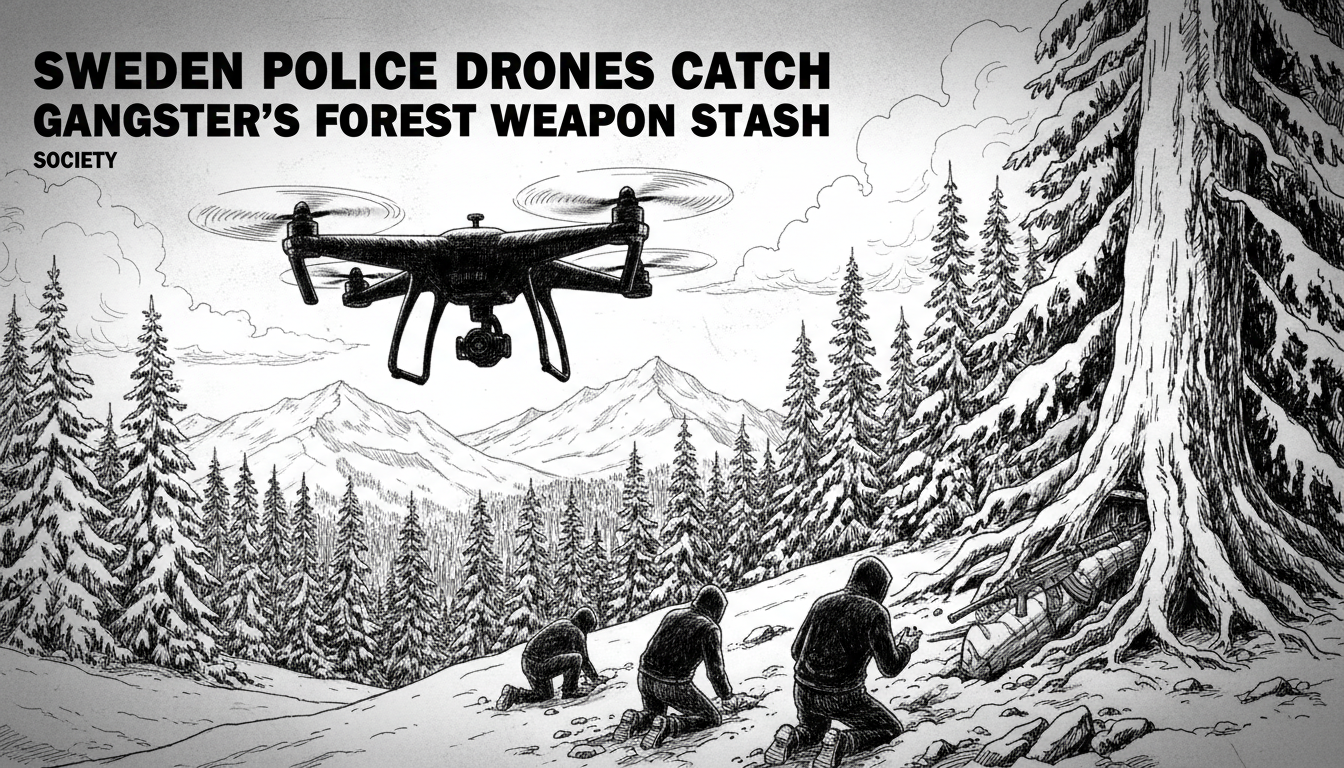
Sweden police drones have captured a high-ranking gang member from Gothenburg hiding a loaded pistol in a forest. The man, a long-time figure in organized crime in the Angered district, walked into a green area in Strömmensberg with the weapon. He walked out empty-handed. He did not know a police drone pilot was filming his every move. Now, he has been sentenced to four years in prison. This case highlights a new front in Sweden's fight against gang violence. It also raises questions about surveillance, privacy, and the roots of crime in Swedish suburbs.
A Silent Witness in the Sky
The scene could be from a quiet nature documentary. A man walks through a wooded area in Strömmensberg, on the outskirts of Gothenburg. The trees are green. The ground is soft. It is a typical Swedish forest, a place for foraging mushrooms or walking the dog. But this man is not there for leisure. He is carrying a loaded pistol. He finds a spot, hides the weapon, and leaves. He believes he is alone. He is wrong. High above, a police drone operated by a remote pilot records the entire event. The footage becomes the central, undeniable evidence in court. "This technology gives us eyes where we previously had none," a police spokesperson involved in tactical operations told Nordics Today. "It allows for safe surveillance of dangerous individuals in environments where sending an officer could be risky or immediately detected."
The Angered Connection and a Persistent Problem
The convicted man is described as a "forefront figure" in organized crime in Angered. Angered is a district in northeastern Gothenburg. It is a place of contrasts. It has strong community ties, vibrant immigrant cultures, and beautiful natural surroundings. It also faces well-documented challenges. Socio-economic issues like higher unemployment and segregation have created fertile ground for criminal networks. These gangs are often involved in drug trafficking, extortion, and violent score-settling. Gothenburg consistently reports some of Sweden's highest rates of firearm-related crime. For residents, the sounds of explosions or gunshots are an occasional, terrifying reality. "We hear about these gang conflicts, but they feel distant until a stash is found in your local woods," said Lena, a mother of two living near Strömmensberg. "It's unsettling. This is where our children play."
The Rise of the Drone Police
Swedish police are increasingly turning to the skies for help. The use of drones, or UAVs (Unmanned Aerial Vehicles), has skyrocketed. In 2023, police reported a significant nationwide increase in drone use for crime prevention and investigation. Their applications are diverse. They map crime scenes after shootings. They search for missing persons in vast forests. They monitor large public events like the Gothenburg Culture Festival. And now, as the Strömmensberg case shows, they conduct covert surveillance. A drone is quiet, relatively inexpensive, and can hover for extended periods. It can transmit live video to a command center kilometers away. For police trying to dismantle gangs that use encrypted communication and counter-surveillance, drones are a powerful new tool. "It's a technological arms race," said Erik Nilsson, a security analyst based in Stockholm. "The gangs use technology to operate, and police must use advanced tech to catch them. Drones are a key part of that evolution."
Legal Skies and Ethical Boundaries
The successful conviction is a clear win for law enforcement. However, the growing use of drone surveillance sparks a necessary debate. Sweden has strict laws governing camera surveillance and personal integrity. Police drone use for surveillance typically requires a court order, similar to a wiretap. Authorities state these legal frameworks are strictly followed. Yet, privacy advocates watch the trend closely. "There must be a clear balance," said Maja Öberg, a legal expert specializing in technology and human rights. "Public safety is paramount, but so is our right to privacy in public spaces. We need continuous democratic scrutiny and clear regulations on how long data is stored and who can access it. A forest path is still a public place." The public's view is mixed. Many residents in high-crime areas welcome any tool that makes them feel safer. Others worry about a slow slide towards a surveillance society.
Beyond the Tech: Addressing the Roots
The drone footage led to an arrest and a prison sentence. It removed a weapon and a criminal from the streets. But experts stress that technology alone cannot solve Sweden's gang problem. "Drones are excellent for law enforcement and prosecution," analyst Erik Nilsson noted. "They are a tactical tool. But strategy is about prevention. We must be honest about the socio-economic factors that make young men vulnerable to recruitment." These factors include segregation, difficulties entering the labor market, and a lack of positive role models. In suburbs like Angered, local community workers, sports clubs, and youth centers are on the frontline of this preventative work. They strive to offer an alternative path to the one promised by gang leaders. Successful initiatives often combine early intervention, mentorship, and help with education and employment. "You can't drone your way out of a social problem," a veteran youth worker in Angered, who asked not to be named, told me. "We need police to do their job, for sure. But we also need jobs, better schools, and real investment in these communities. You need to give people a stake in society."
A Look Ahead: The Future of Fighting Crime
The Strömmensberg case is likely a sign of things to come. Swedish police will continue to integrate drones into their standard toolkit. Future developments may include drones with night vision, thermal cameras to find stashes or people in the dark, and even AI-assisted analysis of video footage. The legal and ethical discussions will intensify alongside these technological leaps. Meanwhile, the human story continues in neighborhoods across Gothenburg, Malmö, and Stockholm. For every gang member caught by a silent drone, there are families hoping for peace, community leaders building resilience, and young people at a crossroads. The four-year sentence closes one chapter. But the broader story of Sweden's relationship with organized crime, its embrace of new technology, and its quest for social cohesion is still being written. The question remains: Can high-tech policing and deep social investment work together to create lasting safety?