
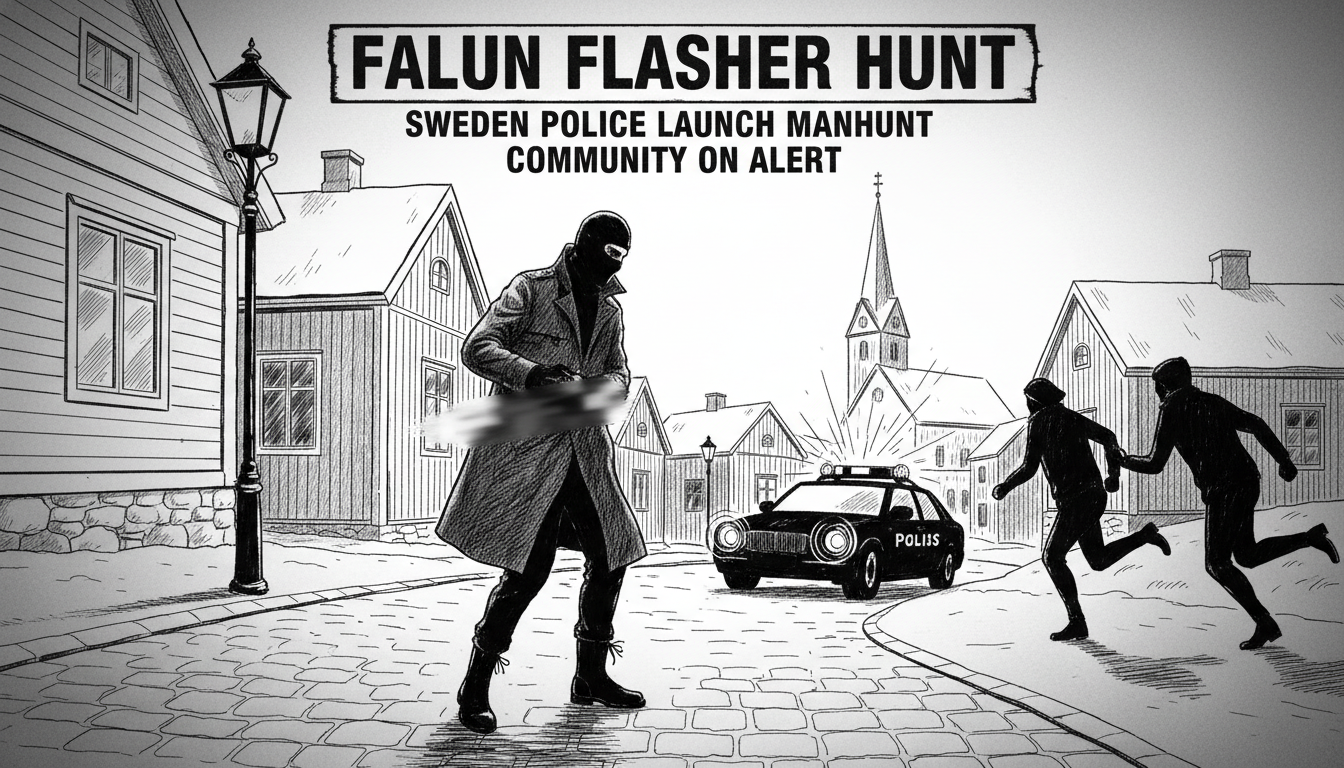
Swedish police are urgently seeking a serial flasher targeting young girls in the historic city of Falun. The unknown man has exposed himself on multiple occasions within a limited geographical area, prompting a public appeal for information. This unsettling pattern has disrupted the sense of safety in a community better known for its UNESCO-listed copper mine and tranquil Dalarna landscapes.
A Pattern of Fear in a Quiet City
Falun, with its iconic red wooden houses and deep mining history, is not a place accustomed to this type of recurring crime. The police description is specific yet frustratingly common: a man aged 20 to 35, standing between 180 and 185 centimeters tall. During his most recent appearance last Saturday, he wore a blue jacket, grey sweatpants, and had his face covered. The deliberate concealment suggests premeditation, a fact that adds to the community's anxiety. "It's the repetition that's so disturbing," says local resident Anna Lundström, who walks her daughter to school near the affected area. "It creates a constant, low-level fear. You start scanning every parked car, every path."
Police have not released the exact locations of the incidents, but their statement about a "limited geographical area" indicates they are likely connected parks, walking trails, or residential zones. This method—territorial and repetitive—is a known pattern in such offenses. The appeal for public help, directing tips to phone number 114 14, is a standard but crucial step. It relies on someone recognizing the description or noticing suspicious behavior in their neighborhood.
The Warmer Weather Factor and Policing Challenges
Criminologists often note a correlation between warmer months and an increase in incidents of indecent exposure. As spring arrives in Sweden, bringing longer days and more people outdoors, opportunities for such offenses rise. This seasonal trend presents a clear challenge for police forces. "These crimes are often about power and shocking the victim," explains a criminology researcher from Stockholm University, who asked not to be named as they are not directly involved in the case. "The offender seeks a reaction. The geographical clustering suggests he feels comfortable and in control in that specific environment."
For local police, the response involves both reactive and proactive measures. Analyzing the pattern of times and locations is key to predicting potential future incidents and deploying patrols effectively. However, policing a diffuse threat like this is resource-intensive. It requires a visible presence to deter the offender and reassure the public, all while investigating leads that may be scant. The public appeal is a vital tool in their arsenal, transforming the community's eyes and ears into an extension of the investigation.
Community Impact Beyond the Crime Statistic
While a single incident of indecent exposure is a serious crime, a series of them alters the social fabric of a community. The fear generated is disproportionate to the physical threat, impacting daily routines and mental well-being. Parents may change their children's routes to school. Teenagers might avoid certain shortcuts. The freedom to walk alone, a deeply ingrained aspect of Swedish society, becomes curtailed.
This case in Falun touches on broader conversations in Sweden about safety, public space, and well-being. Sweden's crime rate discussions often focus on gang violence in major cities, but incidents like these resonate deeply in smaller communities where they are rare. They challenge the perceived safety of familiar surroundings. The response often becomes a communal effort, with neighbors checking in on each other and local social media groups buzzing with shared vigilance.
A Look at the Legal and Social Context
In Sweden, indecent exposure is prosecuted as a sexual crime. The legal process focuses on the violation of the victim's integrity and the perpetrator's intent to shock or intimidate. Sentencing can vary based on the circumstances, including whether the offender has previous convictions and the impact on the victims. Beyond the legal consequences, there is a significant social stigma attached to such crimes, which can be a powerful deterrent but also makes suspects harder to identify as they go to great lengths to conceal their identity.
The case also intersects with Sweden's ongoing national dialogue about security and policing resources. In recent years, there has been significant investment in law enforcement, but the distribution of resources across urban and rural areas remains a topic of debate. A case like this in Falun tests the local force's capacity for sustained, investigative police work that relies on patience and community engagement.
The Path Forward: Vigilance and Resolution
The immediate path forward for Falun's police is clear: follow every tip, maintain a visible presence, and hope for a break in the case. For the community, the advice is one of cautious vigilance—reporting anything suspicious without resorting to fear. The strength of Swedish civil society often shines in these moments, with a collective determination to reclaim a sense of security.
Will a recognizable detail—a distinctive jacket, a particular gait—finally lead to an arrest? Or will the pattern break as suddenly as it began? The resolution of this case hinges on that one piece of connecting information. Until then, the description of the man in the blue jacket and grey sweatpants hangs over parts of Falun, a reminder that safety is sometimes fragile, even in Sweden's most picturesque settings. The community waits, watches, and hopes for the phone at police headquarters to ring with the crucial lead.