
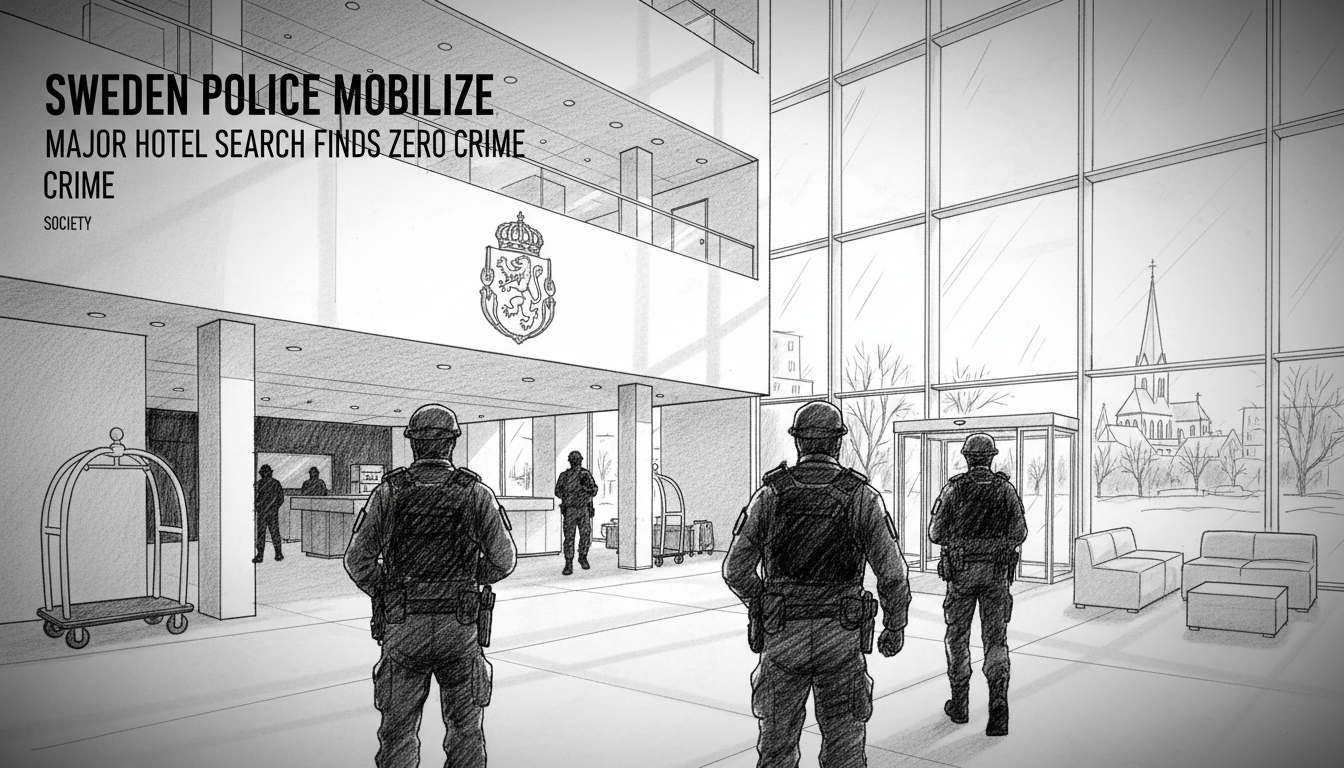
Sweden police launched a major operation in central Stockholm Sunday morning, mobilizing multiple units after a report of a suspected serious crime at a hotel. The dramatic response, involving searches of the hotel and adjacent properties, concluded with a surprising result: no victims, no suspects, and no crime found. The incident highlights the complex realities of policing in a major city where perception often clashes with reality. Stockholm's crime rate has become a focal point of national conversation, with reported increases in certain violent offenses shaping public anxiety. Yet this event underscores how initial alarms can diverge dramatically from the facts on the ground. I walked from my apartment in Vasastan toward the Norrmalm district where the operation unfolded. The scene was already calming, the blue lights gone, but a tangible buzz remained among pedestrians. "I saw three police vans speed past my café," said Erik Lundström, 42, who was walking his dog near Hötorget. "My first thought was the worst. It's hard not to jump to conclusions these days when you hear sirens." His sentiment is common. While overall crime statistics present a nuanced picture, high-profile incidents and political debates have heightened public sensitivity. Police spokesperson Mats Eriksson confirmed the scale and the anticlimactic outcome. "We received a report around 11 a.m. about an ongoing serious crime," Eriksson said. "We initiated a significant response. We have not found any injured person. We have also not located any suspected perpetrator." The hotel in question, which authorities have not officially named, sits in a busy commercial area frequented by tourists and business travelers. Hotels, by their very nature, are transient spaces. They see constant flows of strangers, making them vulnerable to various incidents, from theft to more severe crimes. They also generate numerous false alarms—domestic disputes between guests, mistaken identities, or overinterpretations of benign situations.
The Anatomy of a High-Stakes False Alarm
A full-scale police mobilization is not a trivial matter. It drains resources, diverts officers from other duties, and carries a significant financial cost. Each patrol car, each specialist officer, represents time and money spent responding to a threat that, in this case, did not materialize. However, as security experts stress, the alternative—not responding with appropriate force to a credible report of a serious crime—is unthinkable. "The calculus for police dispatch is always risk versus consequence," explained Anna Forsberg, a security consultant and former police officer I spoke with. "When a call comes in labeled 'serious crime,' especially in a densely populated area like central Stockholm, the protocol is to assume it's valid until proven otherwise. Underreacting to a genuine incident would be a catastrophic failure." Forsberg notes that the definition of a 'serious crime' in an initial report can be broad. It might stem from a witness seeing someone with a weapon, hearing screams, or observing a violent struggle. The witness's perception is key, and fear can magnify what is actually happening. The Stockholm police have refined their response protocols in recent years, aiming for speed and decisiveness. This incident shows that system working precisely as designed: a threat was reported, and force was deployed to contain it. The fact that the threat was not real is, in one sense, the best possible outcome.
Public Trust and the Perception of Safety
The psychological impact of such events lingers. For residents and visitors in Stockholm, the sight of a heavy police presence reinforces a narrative of a city under strain. "You feel it in the air," said Lena Kovács, a bartender at a popular spot near Stureplan. "People talk more about safety. They ask if it's okay to walk home late. I don't have the data, but I have the mood. And the mood is a bit more nervous than five years ago." This nervousness exists despite Sweden consistently ranking high in global quality-of-life indexes. The disconnect is fascinating. Is Stockholm less safe, or does it simply feel that way? Statistics from the Swedish National Council for Crime Prevention show rises in gun homicide and explosives-related crimes in recent years, though from relatively low levels compared to many countries. Other crimes, like burglary, have decreased. The raw numbers are one thing; the lived experience is another. High-visibility police actions, even false alarms, become chapters in the story people tell themselves about their city. They feed into political debates about immigration, integration, and gang violence. A quiet Sunday morning search becomes a symbol, its meaning contested by different sides of the social discourse.
The Resource Dilemma for Modern Police Forces
Every false alarm poses a quiet dilemma for law enforcement. Resources are finite. The officers and equipment used in Sunday's operation were, for a time, unavailable for other duties. Could a domestic violence call in Södermalm have been delayed? Was a traffic accident on Västerbron responded to more slowly? These are the hidden trade-offs. Police forces must constantly balance the 'cry wolf' risk against their duty to protect. If too many false alarms occur, does response protocol become more cautious? Most analysts say no. The standard must remain high. "The day police start downgrading responses based on a statistical likelihood of a false alarm is the day a real tragedy happens," Forsberg, the security consultant, stated bluntly. "The cost of a false alarm is measured in kronor. The cost of a failed response is measured in lives." This logic is impeccable but expensive. It requires well-funded, well-staffed police forces. Stockholm's force is under constant scrutiny, praised for its efficiency in cases like this, but criticized for struggling with longer-term gang investigations. Their performance is a mosaic of different capabilities.
Analysis: Navigating the Fog of Urban Life
So, what does this non-event tell us? First, it reveals a system functioning as intended. A threat was reported, assessed as credible, and met with overwhelming force. That is exactly what citizens should want. Second, it exposes the fragile ecosystem of urban safety. Public feeling is shaped as much by headlines and fleeting glimpses of police lights as by annual crime reports. Third, it underscores a universal urban truth: cities are complex, crowded places where misunderstandings and false alarms are inevitable. The true test of a society is not whether these incidents occur, but how its institutions and citizens respond. The Stockholm police responded with professionalism. The public, while perhaps anxious, went about their Sunday—brunching in Östermalm, strolling through Djurgården, shopping in Gamla Stan. Life in the city resumed. Yet, the memory of the alarm persists. It becomes a data point in someone's internal risk assessment. It might make a family think twice about their hotel choice. It might become an anecdote in a debate about law and order. The aftermath of a crime that wasn't there may be more socially significant than the phantom incident itself. In the end, the story of the silent alarm at a Stockholm hotel is a modern parable. It is about vigilance and vulnerability, perception and reality, and the endless challenge of feeling secure in a world that can never be fully, perfectly safe. The police did their job. The city moved on. But the quiet question hanging over the clean-up operation remains: next time, will we be so lucky?