
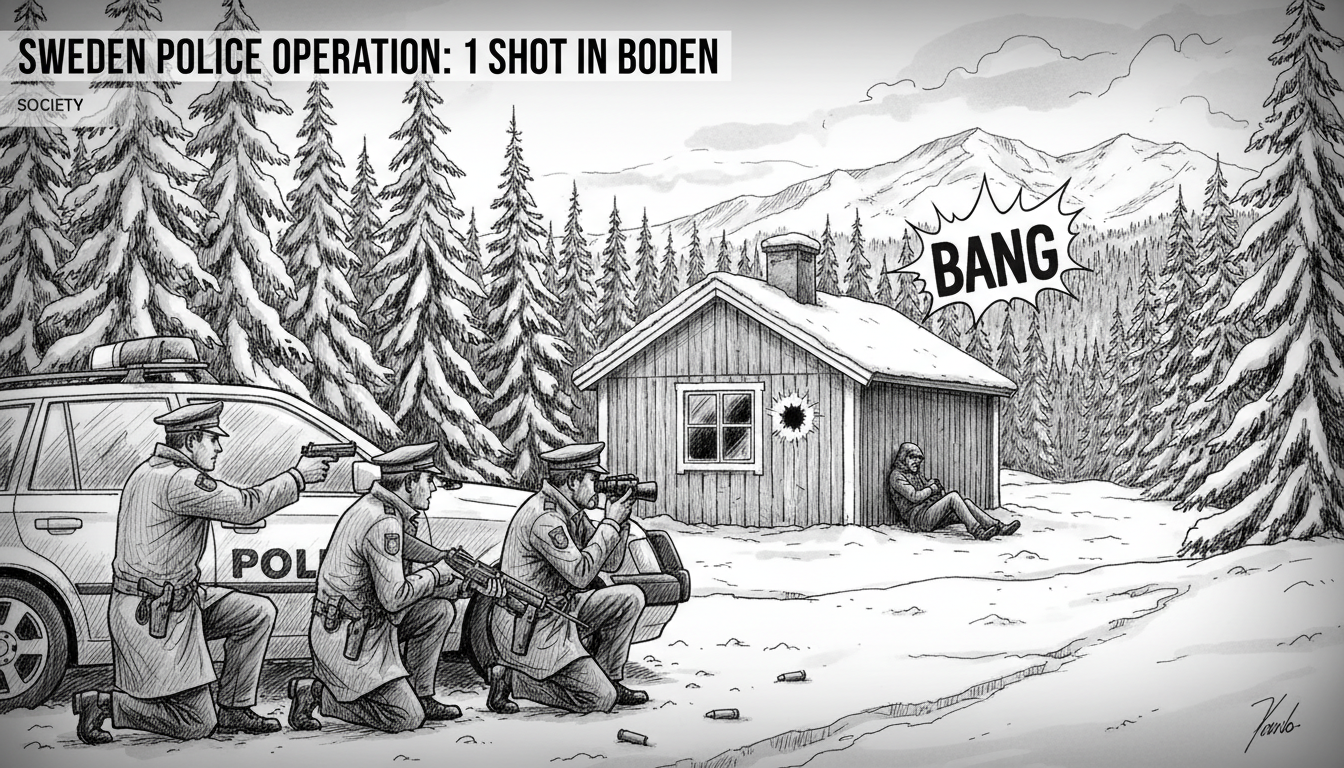
Swedish police launched a major operation in Boden, Norrbotten, on Thursday afternoon, with reports indicating several people were injured and one suspect was shot by officers. The incident unfolded in a residential villa area that remains cordoned off by a significant police presence.
"There is a police car here, but it's very calm on the scene now," said a reporter on site, describing a subdued atmosphere following the initial emergency response. A local resident reported seeing numerous police vehicles and several ambulances arrive in the area around 1 p.m. Authorities have been tight-lipped, with a police communications officer for the northern region declining to provide further details on the suspected violent crime.
A Quiet Community Jolted by Violence
The scene of the police operation is a villa neighborhood in Boden, a municipality of roughly 28,000 people known more for its military history than violent crime. For residents, the sight of a large-scale police response is deeply unsettling. The contrast between the community's typical tranquility and the sudden eruption of a serious incident creates a profound sense of shock. Boden’s identity is intertwined with the Swedish Armed Forces; it is a key garrison town hosting a major army regiment, and its streets are more accustomed to seeing soldiers in uniform than police tape cordoning off crime scenes. This context makes the police action stand out even more starkly against the backdrop of everyday life in northern Sweden.
Local reactions often follow a pattern in these situations. Initial fear gives way to a search for normalcy. "You don't expect this here," is a common refrain heard in Swedish towns when violence interrupts the peaceful norm. The incident will likely dominate conversations at local coffee shops, grocery stores, and around kitchen tables for days, as the community grapples with the breach in its perceived safety.
Boden: A Garrison Town with a Strategic Past
To understand the impact of such an event, one must understand Boden itself. Located in Norrbotten County, Sweden's northernmost region, its development has been shaped by defense strategy. The massive Boden Fortress, a network of underground bunkers and forts built in the early 20th century, stands as a monument to its military importance. This history fosters a close-knit community with many residents connected to the armed forces or associated industries. The population is stable but not large, which amplifies the impact when a serious incident occurs—everyone feels it, and news travels quickly through informal networks.
The town represents a specific facet of Swedish culture news, one often overlooked by international media focused on Stockholm or Malmö. Life here is connected to the vast forests, the rhythmic seasons, and the particular challenges and camaraderie of the north. A major police operation doesn't just represent a crime statistic; it disrupts the fundamental sense of security in a place where people know their neighbors and the rhythms of life are predictable.
Examining Crime Trends in Sweden's North
While detailed information about Thursday's incident remains scarce, it inevitably brings the national conversation about crime and resource allocation to the doorsteps of Boden's residents. Analysts frequently examine whether law enforcement resources match the needs across Sweden's vast geography. Norrbotten is the country's largest county by area but among the smallest in population density. A major police deployment in Boden, involving multiple units and an ambulance response, tests the logistical reach of emergency services in the region.
Experts monitoring Swedish society trends note that serious violent incidents in smaller northern communities often prompt debates about societal fractures, integration challenges in shrinking towns, and the availability of social services beyond major urban centers. While not directly linked to this specific event, these broader discussions about community cohesion, youth engagement, and economic opportunity in Sweden's periphery form the backdrop against which any isolated violent act is analyzed. The question asked is often twofold: What happened here today? And what does it say about the health of our community in a wider sense?
The Human Impact Beyond the Headlines
Behind the police barriers and official statements are the residents of a quiet neighborhood whose day was shattered. For them, the keywords are not "Sweden crime rate" or "Northern Sweden news"—they are safety, shock, and the desire for clarity. The human impact of such an event lingers long after the police tape is taken down. Children may have witnessed the commotion, families feel uneasy in their own homes, and the community's trust is subtly eroded.
Swedish lifestyle in these towns is built on a foundation of mutual trust and a low-threat environment. An incident like this punctures that illusion. Recovery involves not just a police investigation but a community process. Local leaders, school officials, and social services often mobilize in the aftermath to provide support and reassure citizens. The role of the local press is also crucial, providing verified information to counter rumors that spread swiftly in worried communities.
A Long Night and a Search for Answers
As darkness falls over Boden—a darkness that is deep and prolonged in the winter but fleeting in the late spring—the investigation continues. Police will work methodically, interviewing witnesses, examining evidence, and piecing together the timeline of events. The suspect's condition and the nature of the injuries to others are among the first questions awaiting answers. The Swedish legal and healthcare systems now take over, with a focus on both justice and care for the victims.
The coming days will see a slow release of more information, as authorities balance transparency with the integrity of their investigation. For the people of Boden, life will attempt to return to its normal pace. Parents will take children to school, people will go to work at the garrison or local businesses, and the stunning northern landscape will impose its calm. But the memory of the police cars, the ambulances, and the unanswered questions of a Thursday afternoon will persist. It serves as a stark reminder that no community, no matter how peaceful or remote, is entirely insulated from sudden violence. The true test for this Swedish town will be how it supports those affected and rebuilds the quiet confidence that defines its character.