
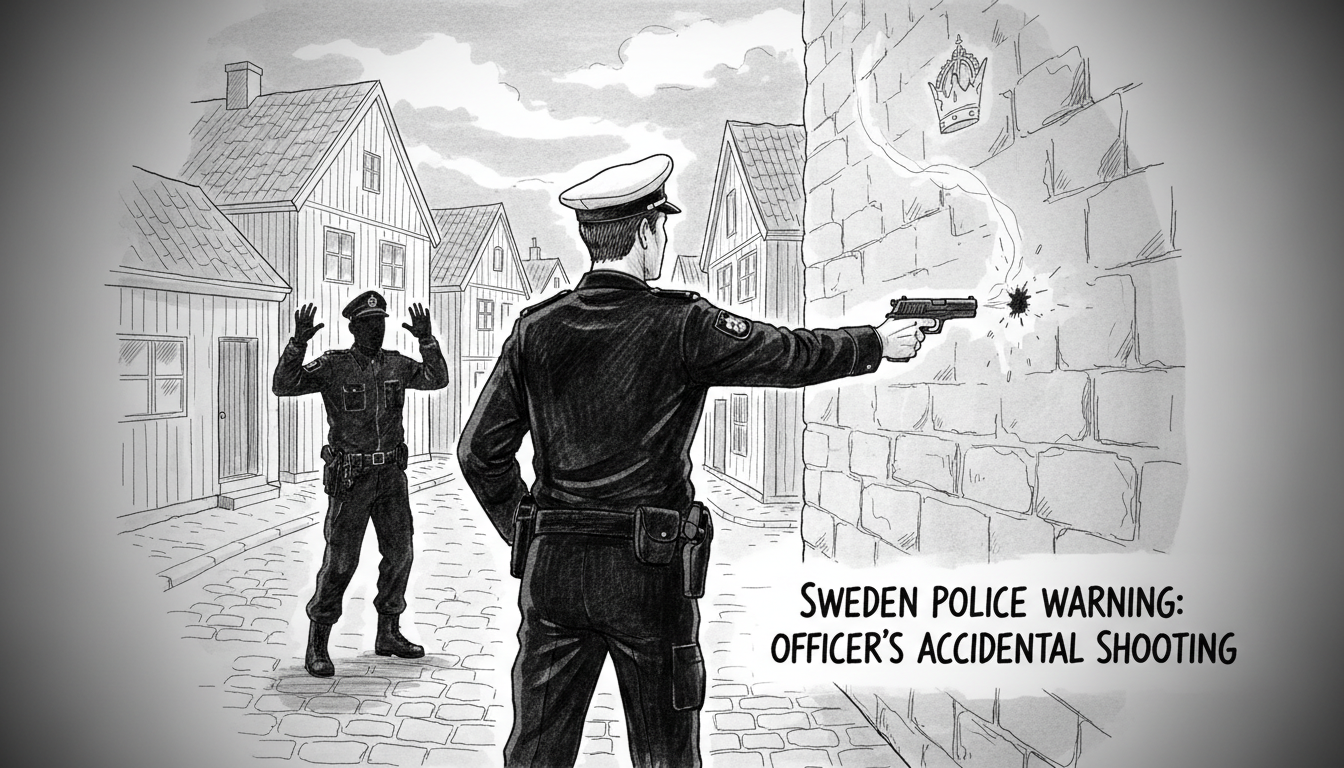
Sweden police training protocols are under scrutiny after an officer in Västra Götaland accidentally shot herself in the leg. The incident occurred during a routine firearms exercise earlier this year. The officer was holstering her service weapon when a single round discharged, striking her in the leg. Sweden's police disciplinary board has now issued the officer a formal warning for negligence.
This case opens a window into the high-stakes world of police firearms training. It highlights the fine line between preparing for danger and managing inherent risk. For the international community watching Sweden's approach to law enforcement, such incidents raise questions about safety culture and accountability.
A Routine Exercise Turns Dangerous
Firearms training is a fundamental, recurring part of a Swedish police officer's career. Officers regularly visit shooting ranges to maintain proficiency with their service weapons, typically a Sig Sauer pistol. The drills are designed to be methodical, governed by strict safety protocols. Every movement, from loading to aiming to holstering, follows a prescribed sequence.
The incident in Västra Götaland broke that sequence. According to the internal investigation, the officer was in the process of securing her weapon after a training drill. As she moved to holster the pistol, a single shot was fired. The bullet struck her in the leg, causing a non-life-threatening injury. She received immediate medical attention. The focus then shifted from response to accountability.
Sweden's Police Authority operates its own internal disciplinary system, the Personalansvarsnämnd (PAN). This board investigates incidents where an officer may have neglected their duties. Their conclusion was clear: the officer had failed in her firearm safety obligations through carelessness. The resulting formal warning is a serious mark on her professional record.
The Weight of a Formal Warning
In the structured hierarchy of Swedish law enforcement, a formal warning from the disciplinary board is a significant sanction. It is not a criminal penalty, but a severe professional reprimand. It signals a failure to meet the exacting standards required for handling state-issued lethal force.
"A warning from PAN is a clear statement that the officer's actions fell below the required standard of care," explains a legal scholar familiar with police procedure, who asked not to be named due to the sensitivity of ongoing cases. "It's about maintaining absolute trust in the system. When an officer handles a weapon, there is zero room for error. The disciplinary process reinforces that principle."
This sanction can impact an officer's career progression, specialized unit applications, and overall standing. More broadly, it serves an internal function. It communicates to all officers that safety lapses, even those that only result in self-injury, will have consequences. The goal is deterrence and the reinforcement of a safety-first culture.
Training Under the Microscope
Swedish police recruits undergo months of rigorous training at the National Police Academy. Firearms education is a core component, blending practical shooting skills with deep theoretical knowledge on use-of-force laws and safety. The mantra is constant: treat every weapon as if it is loaded; never point it at anything you are not willing to destroy.
Yet, experts note that training environments themselves carry risk. "You have officers, often in simulated high-stress scenarios, handling real weapons," says Erik Bergström, a retired police instructor and author of several manuals on operational safety. "Fatigue, momentary lapses in concentration, or a subtle mechanical issue can converge. The protocols are designed to eliminate human error, but we are human. This incident will likely trigger a review of the specific holstering drill at that unit."
Bergström emphasizes that such accidents, while rare, are a known risk in police and military forces worldwide. "The question is never if the training is necessary—it absolutely is. The question is how we continuously refine it to make it as safe as humanly possible. Every incident provides painful but valuable data."
A Culture of Accountability
The public issuance of a disciplinary warning is a deliberate act of transparency. Sweden's police force operates under significant public scrutiny, particularly regarding use of force. By publicly detailing the incident and the sanction, the authority demonstrates that officers are held to account internally, not just when public harm occurs.
This approach aligns with Sweden's broader societal principles of transparency and institutional accountability. There is an expectation that public servants, especially those empowered to use force, will be subject to rigorous oversight. The disciplinary board's public decisions are part of fulfilling that social contract.
However, this transparency also invites public debate. Some will see the warning as appropriate accountability for a serious error. Others may question if the sanction is too harsh for an officer who was the sole victim of her own mistake. This tension lies at the heart of professional disciplinary systems: balancing corrective justice with the understanding that professionals can have costly bad days.
The Human Factor in a High-Stakes Profession
Beyond the protocols and warnings lies the human element. The officer involved must recover physically and professionally from an event that is both traumatic and career-limiting. The psychological impact of accidentally causing oneself harm with a tool of the profession should not be underestimated.
Colleagues within the unit are also affected. Such incidents can create a ripple of heightened anxiety and caution, potentially impacting training efficacy. Conversely, they can also serve as a powerful, visceral reminder of the ever-present dangers of their equipment, reinforcing vigilance.
"We train to manage external threats, but one of the most critical skills is managing ourselves—our focus, our stress, our routines," Bergström reflects. "This is a stark reminder that the weapon is a constant responsibility. There is no autopilot."
Looking Ahead: Protocols and Prevention
The aftermath of this incident will likely involve several steps. The local police district in Västra Götaland will review its specific training procedures. The national Police Authority may examine if broader guidance on holstering or weapon handling during exercises needs refinement.
Equipment checks are also standard. The officer's service weapon and holster would have been meticulously inspected to rule out a mechanical fault contributing to the accidental discharge. While the disciplinary finding points to human error, eliminating technical causes is a crucial part of the investigative process.
Ultimately, the goal is prevention. The warning, the internal reports, and the inevitable discussions among officers are all aimed at ensuring such an accident does not happen again. In a profession where a fraction of a second and a millimeter's movement can mean the difference between life and death, there is no such thing as a minor safety lapse.
This single incident in a Swedish training facility echoes a universal challenge in law enforcement worldwide. How do you perfectly balance the need for realistic, rigorous preparation with an unwavering commitment to safety? For Sweden's police, the answer continues to be built on a foundation of strict protocol, transparent accountability, and the hard-learned lessons from days when everything does not go according to plan. The formal warning is not just a conclusion; it is a message to every officer holstering their weapon today.